

What happens if your moving date is fixed, but your Irish home hasn’t sold? The question “Sell property due to relocation Ireland” often comes with real pressure: you’re balancing a new job, a new home or travel plans while trying to manage viewings and decisions from elsewhere.
It’s understandable to want a clear timeline, but no sale route can guarantee a particular completion date. An open-market sale may suit you if you’re prepared to manage viewings and wait for a buyer. A direct cash sale can reduce reliance on listings and viewings, so it may be worth considering when timing matters. The right choice depends on your priorities and the property.
This guide explains how to compare those options and organise key decisions before you leave. You’ll find practical steps for preparing the property, arranging paperwork with your solicitor and co-ordinating the sale with your move. Whether you’re still in Ireland or already settling elsewhere, a clear plan can help you decide what to do next.
Key Takeaways
- Separate your preferred moving date from the sale’s completion date, then plan around both.
- Compare an open-market listing with a direct cash sale by weighing market exposure, viewings and the co-ordination each route involves.
- Searching “Sell property due to relocation Ireland”? Start organising property information before marketing or discussing a sale.
- Focus on essential property details first, then decide whether extra presentation work is manageable alongside your move.
- Consider a direct purchase from Covenant Properties if reducing reliance on open-market listings and viewings fits your circumstances.
Selling property due to relocation in Ireland: start with your moving priorities
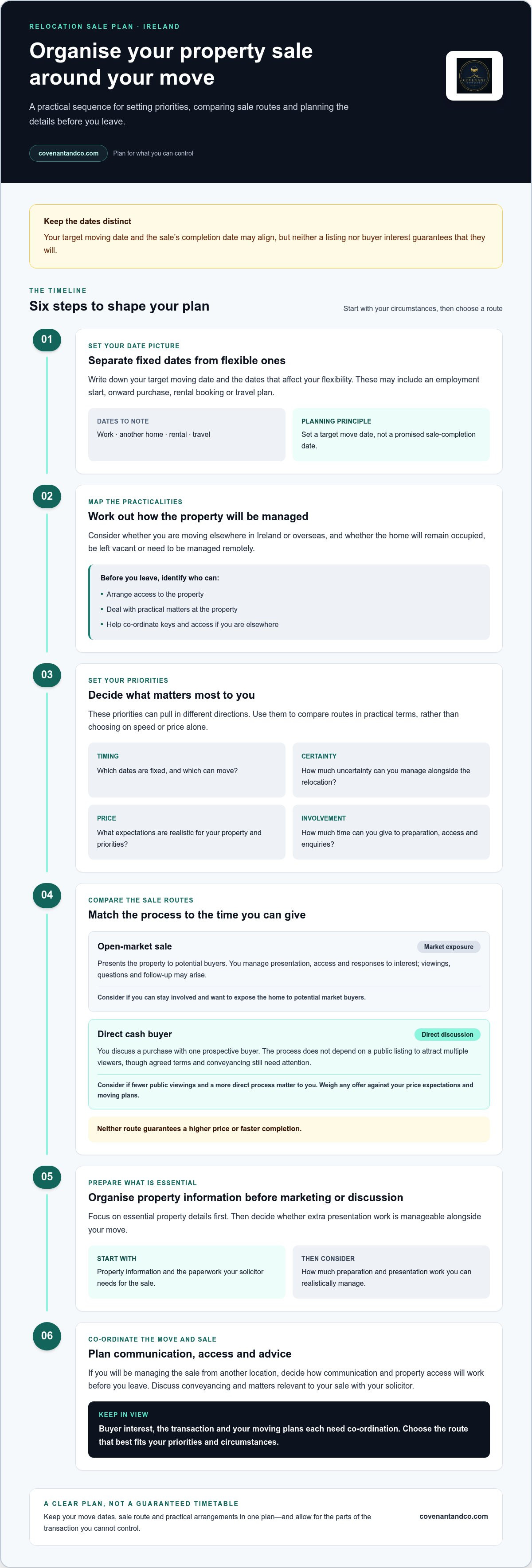
Relocating and selling a home can quickly become two demanding projects at once. You may be arranging work, travel, a new place to live and the practical details of handing over your current home. Start by separating your hoped-for moving date from the date a sale might complete. They may align, but neither a listing nor a buyer’s interest guarantees that they will.
Before comparing sale routes, decide what matters most: timing, certainty, price expectations and how involved you can be. These priorities can pull in different directions. An open-market sale gives the property exposure to potential buyers, but involves preparation, viewings and enquiries. A direct sale may reduce reliance on those activities, but you’ll still need to consider the proposed terms and conveyancing. The best route depends on your priorities and circumstances.
Think beyond the sale itself. If you’re moving for a job, your start date may limit how long you can remain in Ireland. If you’re buying another home, the move may depend on that purchase. Renting could give you more flexibility, or add another set of dates to co-ordinate.
Which relocation details affect your sale plan?
First, establish whether you’re moving elsewhere in Ireland or overseas. Neither situation dictates a particular sale route, but it affects how easily you can attend the property or respond in person. Note whether the home will remain occupied, be left vacant or need to be managed remotely. If you’ll be away, decide who can arrange access and deal with practical matters at the property.
Write down any dates that affect your flexibility, such as an employment start, onward purchase, rental booking or travel plan. Also consider ongoing property responsibilities while you own the home. For background on the annual residential property tax, see Local Property Tax in Ireland. Your solicitor can advise on matters relevant to your sale.
What should you decide before choosing a sale route?
Set a target moving date, not a promised sale-completion date. Then be realistic about the time and attention you can give to preparing the property, accommodating viewings and answering buyer enquiries. If you’ll be managing the sale from another location, plan how communication and access will work before you leave.
Finally, consider the balance you want between price expectations, convenience and control. A higher hoped-for price may mean allowing time for market interest to develop; a simpler process may matter more if your move is fixed. Neither preference is wrong. Choose based on your circumstances, rather than relying on a timetable you can’t control.
- Timing: Which dates are fixed, and which can move?
- Certainty: How much uncertainty can you manage alongside the relocation?
- Price: What expectations are realistic for your property and priorities?
- Involvement: How much time can you give to preparation, access and enquiries?
If you’re searching “Sell property due to relocation Ireland”, use these answers as your starting point. They’ll help you compare routes in practical terms, rather than choosing on speed or price alone.
Open-market sale or direct cash buyer: compare routes for an Irish relocation
The main difference is how you find a buyer and manage interest in the property. An open-market sale presents the home to potential buyers, usually through marketing and viewings. With a direct acquisition, a buyer considers purchasing from you directly. Neither route guarantees a higher price or faster completion. Consider how each fits your move and the time you can give the sale.
Use this comparison to focus on the day-to-day trade-offs, not just the headline offer or asking price.
| Consideration | Open-market sale | Direct cash buyer |
|---|---|---|
| Control | You manage presentation, access and responses to buyer interest. | You discuss a direct purchase with one prospective buyer. |
| Market exposure | The property is presented to potential market buyers. | The process doesn’t depend on a public listing to attract multiple viewers. |
| Buyer enquiries | Interest may bring viewings, questions and follow-up. | Enquiries are handled directly with the prospective buyer. |
| Relocation coordination | Access and updates may need managing around your move, especially from another location. | Fewer public viewings may simplify co-ordination, though conveyancing and agreed terms still need attention. |
When might an open-market sale fit your plans?
Marketing the property and holding viewings may suit you if you can stay involved and want to expose it to potential market buyers. Allow time to arrange access, respond to interest and consider enquiries as they arise. Progress depends on buyer interest and the transaction itself, so don’t treat your target moving date as a guaranteed completion date. Once you’ve relocated, coordinating keys and access may take extra planning.
When might a direct cash sale be worth considering?
If fewer public viewings and a more direct process matter to you, a cash sale may be worth considering. Covenant Properties directly acquires residential properties across Ireland. Weigh any offer against your price expectations, moving plans and the proposed terms. Consider what the agreed process would mean for your practical arrangements, and discuss conveyancing with your solicitor.
The right choice depends on what you value, not on a promise that one route is always quicker or more rewarding. If you’re moving to Ireland from abroad, Official guidance on moving to Ireland can help with broader relocation questions. To consider a direct purchase, explore Covenant Properties’ direct property purchase.
How to organise an Irish property sale around your relocation
Preparation can make the sale easier to manage, whether you decide to market the property or discuss a direct purchase. You don’t need every detail resolved before taking the first step. Bring together the information you already have, then keep key decisions and communications organised as the sale progresses.
Agreeing a sale isn’t the same as completing the legal transfer. An accepted offer is a step forward, but conveyancing still needs to progress before ownership transfers. Keep that distinction in mind when arranging your move, and don’t treat an agreed sale as a confirmed completion date.
A practical sequence from planning to conveyancing
- Set your priorities. Note your target moving date, how flexible you can be and how much time you can give to sale-related tasks. This gives you a practical basis for discussing which route may suit you.
- Gather property information. Collect the ownership, property and mortgage details you already hold. Make a record of keys, access arrangements and useful information about the home, such as where manuals or service records are kept.
- Organise your records. Save digital copies in a secure place you can access after moving. Use clear file names and keep a simple list of documents gathered and items still to locate. Share sensitive records only through arrangements agreed with the relevant professional.
- Discuss the sale route. Use the information you have when preparing to market the property or discussing a direct sale. Explain your circumstances and the practical arrangements you’ll need to manage from your new location.
- Progress conveyancing with your solicitor. Involve a solicitor in the transaction and keep them informed of your relocation plans. They can explain the current requirements for your circumstances and guide the legal work as the sale proceeds.
What should you gather before discussing a sale?
Begin with what’s available, rather than waiting until you have a perfect file. Note the ownership details, any mortgage information and property documents you can locate. Add practical details: who has keys, how access can be arranged, and any particular instructions for the property. If you’ll leave before the sale completes, this record can help you or an appointed contact answer straightforward questions without relying on memory.
How can you manage conveyancing from another location?
Before you move, discuss communication preferences and document handling with your solicitor. Agree how you’ll receive updates, make decisions and manage documents that need your attention while you’re away. Keep your contact details current and set aside time to respond, especially if you’ll be in a different time zone. Requirements can depend on the transaction and your circumstances, so ask your qualified solicitor to verify the current Irish conveyancing process. If you’re looking to Sell property due to relocation Ireland, early organisation helps you stay prepared without assuming paperwork alone can control the sale timetable.
Prepare the property and your move without creating extra pressure
Preparing a home for sale can expand to fill whatever time you have, so set a sensible boundary. First, deal with information and arrangements that will help you manage the property and the sale. Then decide whether optional presentation work, such as repainting or replacing furnishings, is worth the time and effort alongside your move.
If you choose an open-market route, tidying rooms and arranging access can help you prepare for viewings. A long list of cosmetic jobs may add pressure without fitting your priorities. Focus on the basics first: clear out what you’re taking, keep essential property information accessible and make a realistic plan for the home while you’re away.
What should you do before leaving the property?
Take meter readings and note relevant utility account details for your records. Keep important documents and useful contact details somewhere secure that you can access after moving. Make a clear plan for keys, agreed access and how post will reach you. These are practical planning steps, not a substitute for advice from your solicitor or relevant service providers.
Think through whether the property will be occupied or vacant during the sale. An occupied home may need arrangements with whoever remains there; a vacant one still needs a clear plan for access and updates. Write down who is responsible for each agreed task, so there’s less to resolve at a distance.
How can you reduce coordination problems while away?
Choose a communication routine that works with your new location. For example, agree how property updates will reach you and when you’ll review decisions. Keep a simple record of actions, dates and responsible contacts. If a viewing or property visit is planned, confirm who is arranging access and how you’ll be told it has taken place.
Keep essential preparation separate from optional presentation work. Essentials might include a key record, meter details, account information and a reliable way to receive post. Optional work could include decorating or changes made purely for appearance. If the move is already demanding, prioritise arrangements that help you stay informed and leave cosmetic decisions until you know you have time.
For a broader set of practical tasks, use this Irish property sale checklist to organise the work around your move. If fewer public viewings and a direct discussion about a purchase would better suit your plans, explore a direct property sale with Covenant Properties. A direct route may reduce reliance on open-market viewings, but the right choice still depends on your circumstances and the terms involved.
Consider a direct sale with Covenant Properties when relocation calls for clarity
A direct sale can be worth considering if you’re moving and want to discuss a purchase without first presenting the property to the open market. It isn’t automatically the right choice for every owner. Your priorities, the property and the proposed terms all matter.
Covenant Properties purchases residential property directly across Ireland. When discussing a potential purchase, outline the home and explain what the relocation involves, such as your preferred moving date, whether you’ll be managing things remotely and any practical limits on access. This context helps frame the discussion around your circumstances, without assuming a particular price or completion date can be promised.
What does a direct property sale involve?
You and the prospective buyer discuss a potential purchase directly. If you receive a proposal, consider its terms alongside your priorities and take time to understand what is involved. A direct route may reduce reliance on a public listing and open-market viewings, but it does not remove the legal steps needed to transfer ownership.
A proposed sale still needs to progress through conveyancing and completion. Your solicitor can advise on the legal process for your circumstances. Keep your relocation plans flexible enough to account for the work still required after agreeing terms. A discussion or proposal is not a guarantee of a completed sale on a particular date.
What are sensible next steps if you are considering this route?
Prepare a brief outline of the property and your situation. Include what you know about its condition, whether it is occupied, your preferred timing and any constraints that could affect access or decisions. You don’t need every document to hand to explain the broad picture.
Then weigh a proposed direct sale against your priorities and alternatives. Consider what matters most: fewer public viewings, the opportunity to present the home to market buyers, your price expectations, or the time you can give to managing enquiries. Compare the terms carefully, and involve your solicitor as the sale progresses.
If you’d like more context before deciding, use the comparison points above to weigh a cash buyer against an estate-agent-led sale. You can also discuss a direct property purchase with Covenant Properties and outline what your move requires. There’s no single route that suits every relocation. The aim is to choose with a clear view of the trade-offs, rather than relying on an assumed outcome.
If you’re researching how to Sell property due to relocation Ireland, use the conversation to explain your priorities and understand the proposed next steps. A clear discussion can help you decide whether direct acquisition fits your plans, while your solicitor guides the legal transfer.
Choose your next step with confidence
Before making a decision, write down what you need the sale to make possible. Which parts of your move are fixed, and where could you allow flexibility? A short list of priorities can make conversations clearer and help you judge any proposed route on more than urgency alone.
If you’re considering how to Sell property due to relocation Ireland, a direct purchase may be one option to explore alongside a traditional listing. Covenant Properties offers a streamlined alternative to market listings, with acquisition experience across residential and commercial property, as well as land. Whether that approach fits depends on your property, plans and expectations.
You can outline your circumstances and discuss a potential direct sale without treating that conversation as a commitment. Discuss a direct property sale with Covenant Properties when you’re ready to consider the option.
A clear next step can make a big move feel more manageable. Take it one decision at a time.
Frequently Asked Questions
Can I sell my Irish property if I have already moved abroad?
Yes, you can continue a sale after moving abroad, but plan how you’ll handle decisions and paperwork from a distance. If you’re looking to Sell property due to relocation Ireland, tell your solicitor where you’ll be living and how best to reach you. Ask about any signing steps that may need extra planning, especially if you’ll be in a different time zone. Don’t assume every part can be completed remotely.
Do I need to sell my property before relocating?
No, you don’t necessarily need to sell before you move. The order that suits you depends on your finances, onward housing and whether you can manage a property from elsewhere. For example, keeping the home temporarily may mean arranging ongoing bills, maintenance and access while you’re away. Consider how those commitments fit your budget and plans, then get appropriate legal or financial advice before deciding whether to sell first or later.
Can I sell a property in Ireland without holding viewings?
Yes, a direct sale may reduce the need for public marketing and repeated viewings, depending on the buyer and arrangements for the property. It won’t remove the need to discuss the home or complete the legal process. If limiting access is important, state that early when comparing routes. You can also discuss whether a necessary inspection can be arranged at a time that works with your move.
What documents should I organise before moving away from my property?
Gather the ownership and property information you already have, relevant mortgage details, keys and contact details for professionals involved with the home. Your solicitor can identify what else is needed for your particular transaction. Keep copies in secure storage that you can reach from your new location, and note where originals are kept. Before sending sensitive material, use a document-sharing method approved by your solicitor.
How should I handle an outstanding mortgage when selling my property?
Tell your solicitor about the mortgage early in the process. The lender and solicitor can explain what information and arrangements apply to your circumstances, including how the mortgage is dealt with as part of the sale. Don’t assume the sale automatically clears every amount owed or that any remaining funds will be available on a particular date. Confirm figures and timing with the relevant professionals before relying on them for your next move.
What happens if my relocation date changes after agreeing a property sale?
Contact your solicitor promptly and explain what has changed. They can advise based on the sale documents and the transaction’s current stage, and help you understand whether any agreed arrangements are affected. An accepted offer isn’t the same as completed legal transfer, so don’t assume a change to your travel or job date changes the sale terms. Avoid making new commitments until you understand the implications.
Should I leave an Irish property vacant while it is being sold?
That depends on your circumstances and the arrangements you can manage. Before leaving it empty, consider who can check on the property, receive or redirect post and arrange access if needed. Record utility account details and keep a way to receive updates. Speak with your insurer or relevant adviser about any policy conditions for an unoccupied home, as cover and responsibilities may depend on your specific situation.


