

The quickest-looking sale isn’t automatically the right one. If you’re searching for “Sell property for financial urgency Ireland”, you may be weighing a pressing deadline against the risk of accepting an offer before you understand the alternatives.
It’s understandable to want clarity about when a sale might complete and how much money could be left afterwards. A traditional private treaty sale, an auction and a direct cash purchase each work differently. A direct sale can offer a more streamlined route, but the offer may be below the property’s full market value. Urgency matters, but so do your needs and priorities.
This guide explains the main options for selling property in Ireland when finances feel time-sensitive. You’ll learn what can affect timing and proceeds, and how legal steps and missing documents can hold up progress. We’ll also explain the direct-purchase option offered by Covenant Properties for residential and commercial property, land and development sites. Use the comparisons and action plan to decide what to explore next, without rushing into a commitment.
Key Takeaways
- For Sell property for financial urgency Ireland, compare an open-market sale with a direct cash purchase against your deadline and priorities.
- Assess potential proceeds, process certainty and timing separately. A faster route isn’t automatically the fairest or most suitable offer.
- Clarify your immediate needs and organise paperwork that could affect progress.
- Preparation can help a sale move forward, but it can’t remove every legal or buyer-related delay.
- When considering a direct sale, be ready to discuss the property type, ownership and your priorities.
Selling property in Ireland under financial pressure: start with the decision
Financial pressure can make every property decision feel urgent. A debt deadline, a change in income, care needs or a major life change may prompt you to consider selling. But a sale isn’t automatically the right answer or a complete solution. First, define what you need it to achieve and identify which other decisions depend on it.
If you’re searching “Sell property for financial urgency Ireland”, separate the need for money from the choice of sale route. A sale may release funds, but the amount and timing depend on the property, the transaction and your circumstances. Ireland’s property market has experienced periods of rapid growth and falls, as outlined in this account of the Irish property bubble. That history is a reminder to assess your own needs rather than rely on assumptions about future market conditions.
A direct property sale is a transaction in which an owner sells directly to a purchaser rather than marketing the property to the wider market. It can suit owners who value a more streamlined process, but you still need to assess the offer, paperwork, ownership and completion arrangements.
What to clarify before deciding to sell
Write down the deadline or practical need the sale is meant to address. Is there a date by which a payment is due, or is your aim to reduce financial pressure more generally? Distinguish your hoped-for completion date from when the sale proceeds could be available. Those dates may not be the same, so make your decision around the specific need, not just the point at which a sale completes.
Check who owns the property and who needs to be involved in the decision. Joint owners or other parties may need to agree or provide documents. Clarifying this early helps you understand the steps ahead. Preparation can support progress, but it can’t guarantee when a transaction will finish or when proceeds will be available.
When property is part of a wider financial assessment
Selling can affect more than the property itself. If care funding is part of the picture, the Fair Deal Scheme may be relevant. Its assessment has specific rules, so don’t assume the treatment of a property in one person’s case applies to another. Consult current HSE guidance for information about the scheme, and seek independent legal or financial advice suited to your circumstances.
The same principle applies if debt, a change in income or another major life event is shaping your decision. A property sale is one possible route, not a substitute for understanding your wider financial position. Before committing, clarify the outcome you need, the people involved and the decisions that may depend on the sale. That gives you a steadier basis for comparing routes.
Compare property sale routes in Ireland: open market or direct cash purchase?
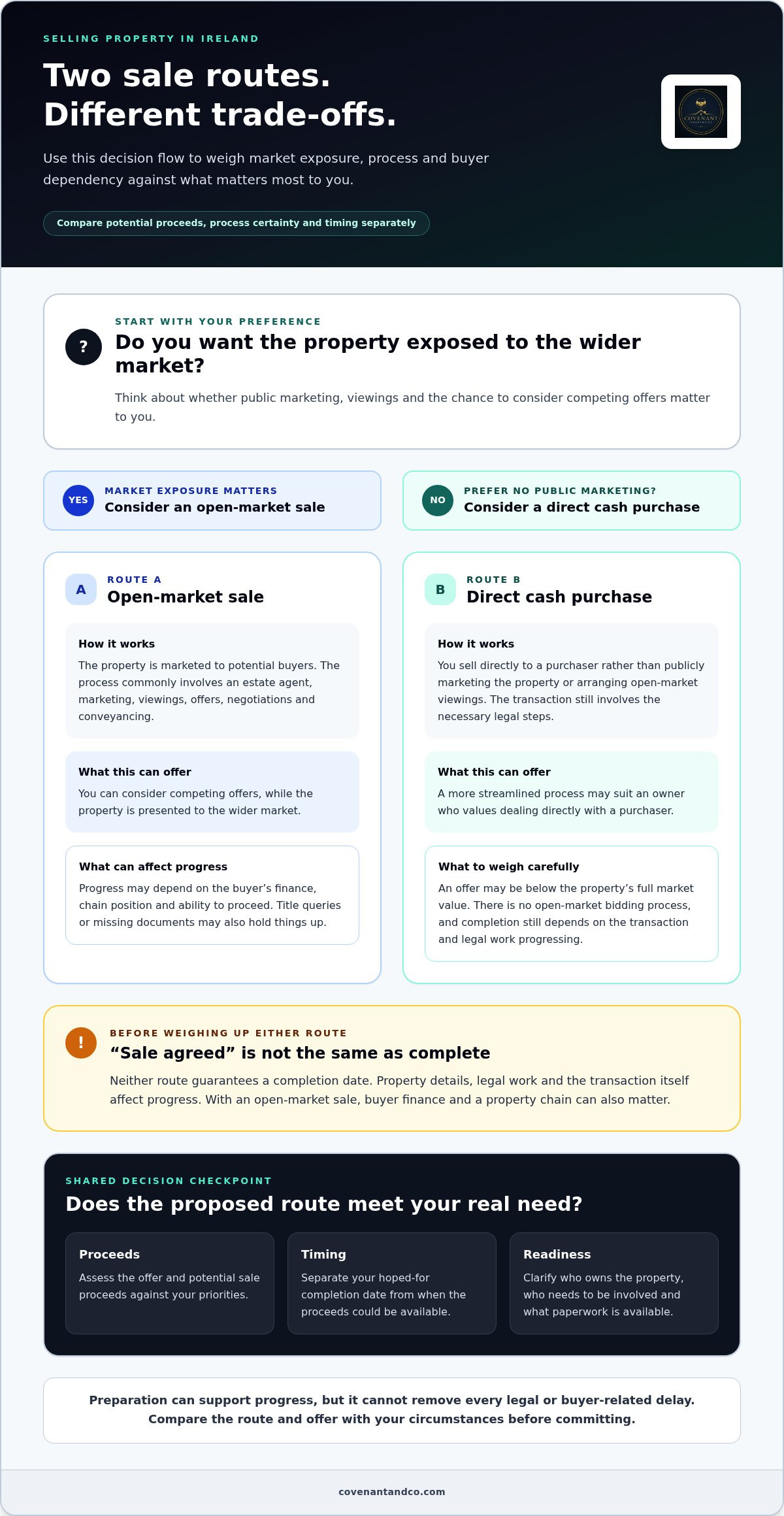
The sale route affects who sees the property, the steps involved and how progress depends on the buyer. Neither option guarantees a particular completion date. Property details, legal work and the transaction itself all matter. Use this comparison to identify what to weigh when deciding how to Sell property for financial urgency Ireland.
Open-market sale
- Market exposure: The property is marketed to potential buyers, with viewings and offers forming part of the process.
- Process: Usually involves an estate agent, marketing, negotiations and conveyancing.
- Buyer dependency: Progress may depend on the buyer’s finance, chain position and ability to proceed.
- Seller control: You can consider competing offers, although the process may involve more steps and uncertainty.
Direct cash purchase
- Market exposure: You sell directly to a purchaser rather than publicly marketing the property or arranging open-market viewings.
- Process: You discuss the transaction directly with the buyer, followed by the necessary legal steps.
- Buyer dependency: There is no open-market bidding process, but completion still depends on the transaction and legal work progressing.
- Seller control: You can assess the proposed terms against your needs, including the balance between process and potential sale proceeds.
Market conditions can influence buyer interest, but they can’t determine which route suits your situation. Bisnow’s coverage of Ireland's Real Estate Investment in 2026 provides wider context on investment activity. It’s background, not a prediction of the price or timing any individual seller will achieve.
What an open-market sale may involve
An open-market sale commonly moves from appointing an agent to marketing, viewings, offers and conveyancing. After an offer is accepted, buyer finance, a property chain, title queries or missing documents may affect progress. “Sale agreed” does not mean the transaction is complete. The sequence and timing vary, so treat general descriptions as guidance rather than a promise about your sale.
What a direct cash purchase may change
A direct purchase avoids public marketing and open-market viewings. Covenant Properties buys residential and commercial property, as well as land and development sites, directly for cash. This route may suit an owner who values a more streamlined process, although an offer may be below the property’s full market value. Compare the offer and process with what matters most to you. A guide to cash buyers for houses in Ireland can help you consider this route in more detail.
Speed and certainty are separate questions. A direct buyer removes some open-market steps, but legal work and property-specific issues still affect progress. An open-market sale gives the property wider exposure, but depends on buyer interest and ability to proceed. If a direct purchase seems relevant, you can discuss a property sale with Covenant Properties and outline the asset and circumstances. Any terms and timing depend on the transaction.
Will urgency mean accepting less or taking on more risk?
No. Needing to act quickly doesn’t mean you have to accept an offer without understanding it. But urgency can make a promise of speed seem more important than the full terms. Keep three questions separate: what is the property worth, how certain is the proposed process, and when might the sale complete?
Compare the certainty of the route separately from the value of the offer. A direct purchase may reduce reliance on open-market viewings and competing buyers, but that doesn’t make every offer fair or suitable. Wider market exposure doesn’t guarantee a higher final price or a particular completion date either. Your priorities matter: an owner with a firm deadline may weigh certainty differently from someone who can wait and test the market.
How to assess an offer without rushing
Start with an informed view of the property’s market value. Compare the offer with that view and consider whether any difference is acceptable in light of the process and your circumstances. Don’t judge the headline amount alone. Estimate what you may receive after any relevant mortgage balance, sale costs and other obligations, with appropriate professional advice where needed.
Then read the proposed conditions. Clarify what could cause the offer to change, what needs to happen before the buyer proceeds and what steps are expected next. Ask for the offer and key terms in writing. Before signing, have your solicitor explain the contract, conveyancing steps and any implications you don’t understand. Irish property transactions can involve ownership and registration matters; the overview of Irish Real Estate Laws and Regulations provides wider legal context, but it isn’t a substitute for advice on your own sale.
Warning signs and sensible safeguards
Be cautious if you’re pressed to sign immediately or if verbal assurances about price, timing or process aren’t reflected in the written terms. Clear communication should make the proposal easier to understand. If important points remain unanswered, pause to get them clarified, even when a deadline is on your mind.
- Amount: How does the offer compare with an informed estimate of market value?
- Conditions: What could change the offer or prevent the sale progressing?
- Evidence of funds: What information supports the buyer’s ability to complete the purchase?
- Process: What are the proposed next steps, and who is responsible for them?
Keep written records of the offer, conditions, communications and agreed next steps. An expression of interest, verbal discussion or “sale agreed” position is not the same as a completed sale with funds available. If you’re considering how to Sell property for financial urgency Ireland, judge certainty by the actual terms and progress of the transaction, not reassuring language alone.
Prepare an urgent property sale in Ireland with a practical action plan
Good preparation helps you see what needs attention and can prevent avoidable hold-ups. It can’t remove every legal, property-related or buyer-related delay, and it doesn’t guarantee a completion date. First address decisions that affect your deadline, then organise the information needed to move the sale forward.
If you’re considering how to Sell property for financial urgency Ireland, use this action plan to separate immediate priorities from supporting paperwork.
- Set out the immediate need. Write down the practical deadline, what you need the sale to achieve and the minimum terms you could accept. Separate your preferred completion date from when you may need the funds to be available.
- Confirm who needs to decide. Identify the property’s owners and anyone else whose agreement or information may be needed. Agree how decisions and records will be shared, so a missing response doesn’t become an avoidable source of delay.
- Collect core property information. Locate available title and ownership records, relevant property documents and details of any existing mortgage or other finance. List what you have and what still needs to be found.
- Ask your solicitor about transaction requirements. A solicitor can identify which documents and title matters are relevant to your property and explain the conveyancing steps. Don’t assume every sale needs exactly the same paperwork.
- Keep other assessments separate. If you’re gathering documents for a financial assessment, store those records separately from the sale paperwork. The processes may require different information and serve different purposes.
- Choose the next route to explore. Compare a traditional market sale with a direct-purchase option against your priorities. You can discuss the asset and your circumstances with Covenant Properties as a potential direct purchaser of residential or commercial property, land or a development site.
Gather the information that can help move matters forward
Create a clear digital or paper folder for property records, ownership details, existing finance information and correspondence. Note anything you can’t locate, rather than letting an incomplete list create confusion. Your solicitor can advise which records are needed for the transaction and whether any title questions need attention. Keep personal financial-assessment documents in a separate folder so the sale process and any wider assessment remain clear.
Set priorities and coordinate the next steps
Share the deadline, preferred outcome and decision-makers with the people involved in progressing the sale. Keep property records accessible and respond promptly to requests for information. If a direct sale is one route you’re weighing, you can discuss your property and circumstances with Covenant Properties without assuming a particular offer or outcome.
Preparation supports a more organised process, but legal questions belong with your solicitor, tax questions with an appropriately qualified adviser, and financial-assessment questions with the relevant authority or adviser. This guide offers general information, not individual legal, financial or tax advice. A broader sale guide can explain the wider steps, while your own professional advice should reflect your situation.
Explore a direct property sale with Covenant Properties
A direct sale is one route to consider if you want to discuss selling without first putting the property on the open market. Covenant Properties purchases residential and commercial property, land and development sites directly for cash across Ireland. The first conversation is an opportunity to outline what you own, what is prompting the decision and what you hope the sale will achieve.
Starting a conversation doesn’t commit you to a sale. Explain your preferred decision timeline and priorities, then consider whether a direct purchase fits alongside the other routes you’ve weighed. The right next step depends on the property and your circumstances. No particular offer, terms or completion date can be assumed in advance.
Property types Covenant Properties considers
Residential property includes houses and apartments. Commercial assets can include buildings used for business purposes. Covenant Properties also considers land and development sites, with or without planning permission. Sharing the type of asset and any relevant details helps keep the discussion focused on the property rather than treating every sale as the same.
For land or a development site, outline whether planning permission is in place and share any information you have about the site. For a home or commercial building, details such as its current use and general condition can help explain your situation. You don’t need every answer at the outset. Be clear about what you know and what still needs to be established.
What to expect when discussing a sale
Start with the basics: the property type, ownership, your decision timeline and the outcome that matters most to you. Mention any existing finance or practical circumstances that could affect a sale. Property records or other relevant documents may help inform the conversation, but the transaction will still need to follow the legal and conveyancing steps relevant to the property.
Timing and terms depend on the asset and transaction details. A direct purchase offers an alternative to public marketing, but it doesn’t remove legal work or guarantee that funds will be available by a particular date. Take time to understand any proposed terms and seek independent legal, financial or tax advice where it’s relevant to your circumstances. Covenant Properties can discuss the property and possible next steps; individual advice should come from an appropriately qualified adviser.
If a direct sale seems worth exploring, share the property details and what you need the sale to achieve. You can discuss a direct property sale with Covenant Properties and consider whether this route suits your priorities. Urgency isn’t a reason to skip important questions. Before deciding, aim to understand the property, proposed terms and steps ahead.
Take your next step with a clear plan
Financial urgency can narrow your focus to the nearest deadline. Define what a workable outcome looks like: the funds you need to release, the timing you’re aiming for and the terms you could accept. This gives you a practical brief for the next conversation and keeps it centred on your priorities.
If you’re considering how to Sell property for financial urgency Ireland, a direct sale is one option to explore alongside other routes. Covenant Properties is a private investment group representing local Irish investors, purchasing residential and commercial property, land and development sites across Ireland. Proposed timing and terms depend on the property and transaction, so keep your own deadline and requirements in view as you consider what to do next.
You don’t need every detail resolved before starting a conversation. Sharing the property type, your circumstances and what matters most can help establish whether a direct sale is worth exploring. Take time to understand any proposed terms and seek independent advice where appropriate.
Share your property details and explore a direct sale with Covenant Properties.
Frequently Asked Questions
Can I sell my property quickly if I need money urgently in Ireland?
It may be possible to agree a sale promptly, but the time until completion and access to proceeds depend on the property, buyer and legal work. A direct buyer can avoid some open-market stages, but won’t remove title questions or conveyancing. If your deadline is tied to a particular payment, ask your solicitor what steps remain and distinguish the expected completion date from when sale funds could be released.
Is a cash property sale in Ireland faster than selling through an estate agent?
A direct cash purchase can involve fewer public marketing steps because it doesn’t rely on agent-led viewings or attracting competing offers. However, “cash” doesn’t mean the sale skips contracts, title checks or conveyancing. The buyer’s readiness and the property’s paperwork also affect progress. Compare the proposed process and conditions, not just the buyer’s description, and don’t treat a suggested timeframe as a guaranteed completion date.
Will I have to accept less for my property if I sell urgently?
No, urgency doesn’t automatically mean accepting a lower offer. A direct buyer’s offer may be below the property’s full market value in exchange for a different route to sale, so weigh the amount against your priorities. For comparison, obtain an independent valuation or review recent comparable sales, then consider likely net proceeds after any mortgage balance and selling costs. Tax treatment depends on your circumstances.
What documents do I need to sell property in Ireland?
Requirements vary, but useful records can include title deeds or ownership details, planning permissions and building documents, maps, mortgage information and Local Property Tax records. A valid Building Energy Rating certificate is required before a residential property is advertised for sale in Ireland. Your solicitor can identify the documents needed for your specific property and sale route. Seek guidance rather than delaying while trying to find every record.
Can I sell a property that has a mortgage or other finance secured against it?
Yes, a property with a mortgage can generally be sold, but the secured finance must be addressed as part of the transaction. Ask your lender for an up-to-date redemption figure, which sets out the amount needed to repay the mortgage, and give it to your solicitor. If the expected sale proceeds may not cover the balance, speak with your lender and solicitor about the position before agreeing terms.
Does selling my home affect a Fair Deal financial assessment?
It may affect the financial information relevant to an individual Fair Deal assessment, but the impact depends on the scheme’s rules and your circumstances. Don’t assume that a property and the money from its sale are treated identically. Check current HSE guidance and get independent financial or legal advice before making a decision based on care-funding expectations. Keep assessment records and sale documents organised separately so you can provide the relevant information when requested.
Do I need a solicitor to sell property in Ireland?
For a property sale in Ireland, plan to have a solicitor handle the conveyancing. They can review title, prepare or explain the contract, deal with legal queries and coordinate the transfer and completion. Instructing a solicitor early can help identify property-specific issues before they hold up progress. Ask them to explain any document or contract term you don’t understand before signing, whether you’re selling through the market or directly.


