

A clean-looking building can still carry environmental risks that affect its use or redevelopment. When buying commercial property with environmental issues in Ireland, assess the site’s contamination history, planning position, legal exposure and any remediation needs. According to the Environmental Protection Agency, the Environmental Liability Directive applies to environmental damage caused by emissions, events or incidents from 1 April 2009, subject to stated exclusions.
It’s understandable to focus first on the building, its location and its potential. But the site’s past uses and environmental condition can also shape the decisions you make before purchase or redevelopment.
This guide explains what to look for, how environmental assessments fit into due diligence, and which planning and legal questions matter. It also covers how to approach contamination and remediation, so you can make a clearer decision about the property and the next steps.
Key Takeaways
- Review the site’s previous uses and arrange environmental assessment where contamination could affect purchase or redevelopment decisions.
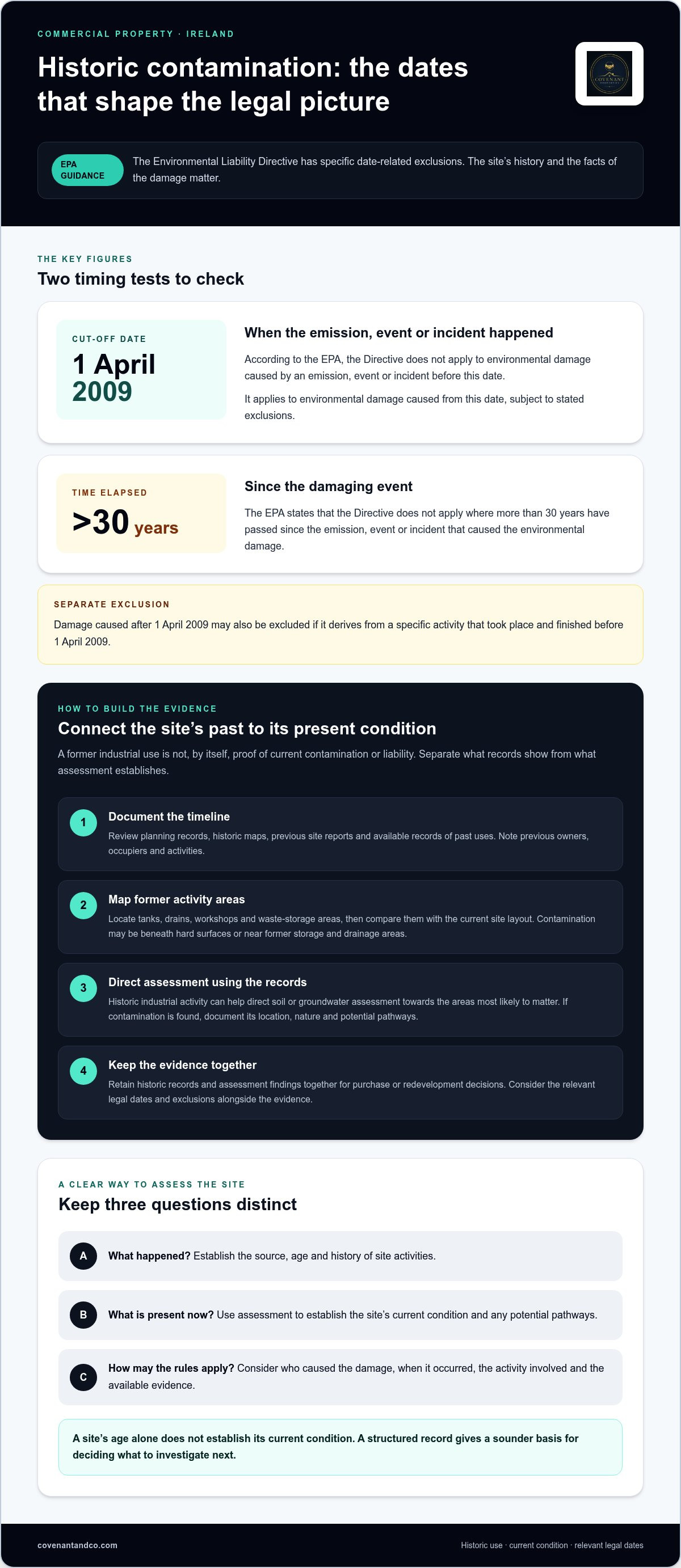
- According to the Environmental Protection Agency, the Environmental Liability Directive does not apply where more than 30 years have passed since the emission, event or incident that caused the environmental damage.
- Confirm that the property’s zoning supports your intended use and identify any planning permission that may be required.
- Build remediation needs into your redevelopment planning, including how contamination could affect site works and waste management.
- According to the Environmental Protection Agency, the Environmental Liability Directive applies to environmental damage caused by emissions, events or incidents from 1 April 2009, subject to stated exclusions.
Historic contamination and Irish legislation
Owners and occupiers should establish the source, age and current effects of contamination before changing a site’s use. Their legal position depends on the applicable legislation and the facts, including who caused the damage and when.
According to the Environmental Protection Agency, the Environmental Liability Directive does not apply where more than 30 years have passed since the emission, event or incident that caused the environmental damage. The Directive also does not apply to environmental damage caused by an emission, event or incident before 1 April 2009. A separate exclusion applies to damage caused after that date if it derives from a specific activity that took place and finished before 1 April 2009.
That makes the site’s history important. A former fuel depot, engineering works or waste-handling yard may have had several operators. The date of an incident, the activity involved and the evidence linking it to contamination can affect how the legislation applies. A site’s age alone does not establish its current condition.
Start by building a documented timeline. Review planning records, historic maps, previous site reports and available records of past uses. Note where tanks, drains, workshops or waste storage areas were located, then compare these records with the current layout. This can help identify where further environmental assessment may be useful before purchase or redevelopment.
For a commercial estate, assess each relevant part of the land rather than relying on the current building’s appearance. Contamination may lie beneath hard surfaces or near former storage and drainage areas. A clear site history helps distinguish a recorded former use from evidence of actual environmental damage, and provides a better basis for deciding what to investigate next.
Connect the legal timeline with the physical investigation. For example, records of former industrial activity can help direct soil or groundwater assessment towards the areas most likely to matter. If contamination is found, document its location, nature and potential pathways. These details help explain how it could affect people, water or neighbouring land.
- Build a timeline of past owners, occupiers and site activities.
- Map former tanks, drains, workshops and waste areas against today’s site plan.
- Keep historic records and assessment findings together for purchase or redevelopment decisions.
Historic contamination can be complex, but a structured record makes it easier to assess. Separate what is known about the site’s past from what assessment establishes about its present condition. Then consider relevant legal dates and exclusions alongside the evidence, rather than treating every old industrial use as proof of liability.
Zoning and planning regulations
Planning permission may be required for certain uses of a commercial property in Ireland. An EPA licence is a separate environmental consideration, so assess the proposed activity and its environmental effects alongside the planning position. Contamination alone does not establish whether permission or a licence applies.
Start by matching the intended use to the property’s zoning and the local authority’s planning requirements. A warehouse changing to retail use, for example, may raise different planning questions from continued warehouse use. The property’s existing use does not, by itself, show that a proposed new use is permitted.
Review the local development plan and the property’s planning history. Compare the approved use and any conditions with the business you intend to operate. Then establish whether proposed works, a change of use or site remediation could require planning permission. Exempted development may be relevant, depending on the proposal and applicable requirements.
For a contaminated commercial site, consider the proposed works and future use together. Excavation, drainage changes or removal of affected materials may form part of a redevelopment proposal. The planning assessment should describe the work, its impact on the site and how the completed property will be used. Environmental assessment can inform this, but it does not replace the planning decision.
- Record the current use and the intended purpose for each part of the site.
- Compare the proposal with zoning and local authority planning requirements.
- Review planning history, approved plans and any conditions attached to earlier decisions.
- Describe remediation and construction works clearly in the redevelopment proposal.
EPA licensing requires a separate review of the activity planned at the site. Consider whether the proposed operation involves emissions, waste or other environmental effects that may bring licensing requirements into play. Planning permission is not a substitute for an environmental licence, and a licence does not resolve zoning or building issues.
Planning and environmental advice can clarify local authority requirements, exempted development and when planning permission is needed. Building and fire regulations also matter to a commercial project, particularly where a conversion changes the building’s layout or use. Keep these checks connected, but treat them as distinct requirements.
Before committing to a purchase, prepare a short planning brief: current use, proposed use, works, contamination findings and any known planning conditions. This gives the relevant decision-makers a clear description to assess. If the site’s planning position affects your purchase decision, a commercial property cash purchase may be a relevant route to consider.
Contamination in redevelopment projects
Redevelopment changes how a site is used and disturbed. A former workshop converted into offices may need different site investigations from a building that remains in industrial use. Before design work advances, connect the proposed layout with the site’s known history and environmental assessment. This can identify where contamination could affect excavation, foundations, drainage or future occupants.
Begin with a site plan showing former buildings, tanks, drains, storage areas and proposed works. Compare it with available environmental reports and historical records. If a report identifies a former fuel storage area, for example, assessment can focus on whether affected soil or groundwater could interfere with planned foundations or drainage. Findings should identify specific locations, not just describe the site as a whole.
Use the assessment to define the redevelopment questions. These may include the type and location of contamination, how it could move, and whether planned works could disturb it. A proposed basement, service trench or new drainage route can change which areas need closer attention. Where results leave gaps, targeted further assessment can clarify the design implications.
Remediation planning should fit the proposed end use and construction sequence. Options may include removing affected material, treating it on site or managing it in place through the project design. The appropriate approach depends on the assessment findings, site conditions and intended use. Record the reasons for the chosen approach, the area it covers and how completion will be documented.
Material handling needs careful coordination. Before excavation, establish how potentially affected soil will be identified, separated, stored and managed. Keep clean and affected materials distinct where the assessment calls for it. Agree site controls with the project team, including how dust, runoff and vehicle movements will be managed. These steps can help prevent excavation from spreading contamination to unaffected parts of the site.
- Match assessment locations to the proposed foundations, trenches and drainage.
- Set out how excavated material will be identified and handled.
- Record remediation objectives, work completed and relevant assessment results.
Local authorities may need information about site conditions and proposed works when considering planning matters. Keep environmental findings consistent across project documents, including the site plan, remediation proposal and construction details. If the design changes, such as by moving a drainage route through an area identified for further assessment, revisit the relevant findings before work proceeds.
A clear record supports decisions throughout redevelopment. It helps the project team understand which areas need controls, how remediation relates to the intended use, and what evidence documents the work. For a former industrial site, this joined-up approach can make environmental considerations part of the design and construction plan, rather than a late surprise during excavation.
EPA directions and remedial action
An EPA direction can require remedial action at a contaminated site. Understand what it requires, who is responsible and how its deadline affects work on the land.
EPA directions for remedial action
An EPA direction sets out the action required to address environmental damage. Read it closely: identify the site area, required measures, completion date and any reporting obligations. These details affect investigation, remediation planning and work around existing buildings. Keep a copy with the site records and share its requirements with anyone managing the property or proposed works.
An appeal to the District Court against an EPA remedial-action direction must be made within seven days. According to the Environmental Protection Agency, action under the Environmental Liability Directive must be taken within five years of the specified completion date or the EPA becoming aware of the operator’s identity. These periods relate to different steps, so distinguish the direction’s terms from the statutory action timeframe.
Investigation and remediation responsibility
Who pays depends on the circumstances, including who caused the damage, who receives an EPA direction and any agreement between the parties. A buyer should examine the direction, site reports and sale documents to understand how investigation or remediation responsibilities are allocated. Do not assume that ownership alone identifies who is responsible for every cost.
For environmental liability and directions, the EPA is a key source of records. Local authorities hold planning-related records for their areas, which can help build a site history. Bring these together with environmental assessments and documents supplied for the transaction. This can clarify what is known about the site and what action has been required or completed.
If a direction names an operator, record their identity and the specified completion date. According to the Environmental Protection Agency, the five-year period for EPA action under the Directive runs from the specified completion date or when the EPA becomes aware of the operator’s identity. Keep the relevant correspondence and evidence of completion together.
Assessment and remediation costs
Environmental assessment and soil remediation costs depend on the site and scope of work. Relevant factors include the area assessed, sampling needs, contaminants, soil conditions, disposal requirements and remediation method. A site with localised impacts needs a different work plan from one requiring broader investigation.
Build the budget around defined tasks rather than a single broad allowance. Separate records review, site investigation, laboratory analysis, remediation, material handling and follow-up reporting. Request project-specific quotes based on the proposed scope. Costs depend on the case and are provided after a quote request. This makes assumptions visible and helps you compare the proposed work.
There is no automatic grant or tax relief established here for every contaminated commercial site. Treat public support as a separate project question, and include only a grant or relief that applies to the site and proposed work. Keep application conditions and any confirmed award separate from the remediation budget, so the project plan does not rely on support that has not been secured.
Environmental issues in commercial property purchases
Environmental due diligence helps buyers and tenants understand site conditions before committing to a commercial property. Review the existing use, likely hazards, proposed use and transaction documents together.
Environmental history checks
Start with a timeline of the property’s previous uses, operators and known incidents. Review available planning records, site reports, historic maps and information supplied for the transaction. A former workshop, fuel storage area or waste-handling use can help identify which parts of the site warrant closer assessment.
According to the Environmental Protection Agency, the Environmental Liability Directive applies to environmental damage caused by emissions, events or incidents from 1 April 2009, subject to stated exclusions. Compare relevant dates and activities with the site history, rather than assuming that a former use proves contamination or liability.
Property contamination and hazard assessment
Assess each hazard in light of the property’s location, building condition and intended use. Flood risk, asbestos, radon, ground gas and groundwater contamination call for different lines of enquiry. For example, inspecting building materials addresses a different issue from checking whether groundwater could affect planned excavation.
Use a site-specific assessment to identify what needs investigation and where. Record the evidence, affected areas and potential pathways, such as movement through soil or water. Findings should relate to the proposed use and planned works, rather than treating every hazard as equally relevant to every building.
Buyer and tenant due diligence
Before signing, buyers should review title and planning information, environmental reports, site history and any recorded directions or remediation documents. Tenants should also consider the permitted use, responsibilities set out in the lease and how site conditions could affect their planned operations.
Make a written list of unanswered questions about the site and link each one to a decision: further assessment, a change to the proposed works or a transaction term. Keep relevant reports, correspondence and agreed responsibilities with the purchase or lease documents. This creates a clear record of what informed the decision.
Effects on value, insurance and finance
Environmental issues can affect a property’s value if they limit its use, require remediation or create uncertainty about future works. The effect depends on the evidence, proposed use and practical response. A documented assessment and remediation plan can give buyers a clearer basis for evaluating the property than an unresolved concern.
Insurance and finance decisions may also reflect the site’s condition and the work required. Insurers consider the risk they are covering, while finance decisions can take account of the property’s use, condition and supporting information. Clearly set out known findings, remediation requirements and intended use when assessing the transaction’s viability.
If environmental findings are changing your purchase decision, explore a direct commercial property sale as an alternative route.
Covenant Properties: Residential Property Cash Purchase
Covenant Properties buys commercial property directly for cash, including property with environmental issues. If environmental findings, remediation requirements or planning constraints have changed your plans, a direct sale may be worth considering alongside the property’s documented condition and site history.
For land or development sites, Covenant Properties also buys land and sites for acquisition. The right route depends on what you own and whether you want to sell the property or site. Clear information about known environmental issues helps frame the decision and transaction.
If you’re considering a sale, contact Covenant Properties or visit covenantandco.com.
Choose your next step with clarity
Environmental findings are most useful when they help you decide what to do next. Consider the reports, planning position and intended use together, then decide whether to proceed, adapt the project or consider a sale. If you’re buying commercial property with environmental issues in Ireland, your decision should reflect the site’s practical constraints as well as its potential.
If selling is the right direction, Covenant Properties buys commercial property and land or development sites directly for cash. Residential property owners can also explore a direct cash sale. These options provide a clear route to consider, while understanding the property’s condition and transaction terms remains important.
Take the next step at your own pace. Contact Covenant Properties to discuss a property sale or site acquisition. A considered decision can help you move forward with greater confidence.
Frequently Asked Questions
What factors does a business need to consider when purchasing a commercial property?
Assess whether the property can support your business use, not just whether the building suits your immediate needs. Consider title and access, planning history, building condition, environmental findings, occupancy arrangements, insurance and finance requirements. For example, a proposed food operation may depend on a suitable water supply and waste management. Set out the intended use early, then compare it with the property’s documented constraints and transaction terms.
What environmental issues commonly affect commercial property in Ireland?
For commercial property with environmental issues in Ireland, concerns can include contamination linked to historic fuel storage, workshops, industrial processes or waste handling. Other site and building risks include asbestos-containing materials, radon, ground gas, flooding and affected groundwater. The relevant issue depends on the property’s past use, location, construction and planned activity. A concern in a report is a prompt to understand its site-specific significance, not proof that every part of the property is affected.
What steps should I take if contamination is found at a commercial property in Ireland?
Pause work that could spread or disturb affected material, and record where the finding occurred. Keep relevant reports, photographs, sampling details and site plans together. Establish the affected area and potential pathways, then use the findings to shape a practical response and any project changes. Before proceeding with a transaction or redevelopment, ensure the documented findings, agreed responsibilities and remediation approach inform the decision and project records.
How can I assess flood risk, asbestos, radon, ground gas and groundwater contamination on an Irish property?
Review the site’s past uses, planning records, historic maps and previous reports, then arrange targeted environmental assessment of areas where contamination may affect soil or groundwater. The assessment should identify the contamination’s location, nature and potential pathways.


