

A short-lease commercial property sale generally concerns the transfer of an interest under a commercial lease with a limited term remaining. The remaining term and lease conditions shape what the buyer acquires and how the seller should present the opportunity.
It’s understandable to focus on the asking price or the property’s current use. With a short lease, however, the time left and the attached terms matter just as much. Before deciding how to proceed with a short-lease commercial property sale in Ireland, assess both the premises and the lease.
This guide explains how to assess a commercial lease and property, what to prepare for a sale or purchase, and which factors affect the decision. It also outlines when a direct sale may be a practical route and what to consider next.
Key Takeaways
- Compare leasehold and freehold listings carefully, and focus on exactly what interest is being offered for sale.
- Assess the remaining lease term alongside its conditions, property use and ongoing obligations before deciding whether to buy.
- Use completed commercial sales as context, while recognising that location, size and lease details all influence value.
- There is no single number of years that defines a short commercial lease; the practical impact depends on the lease and the buyer’s plans.
- If you’re selling, consider whether a direct commercial property sale or land and site acquisition suits your circumstances.
Buying and selling commercial property in Ireland
Commercial sales can transfer either a freehold or a leasehold interest, so establish exactly what is being sold. The lease, occupancy position and intended use shape the steps for both parties.
Selling with vacant possession or a tenant
Vacant possession means the buyer receives the property without a tenant in occupation. If a tenant remains, the buyer acquires the property subject to the tenancy and its terms. The suitable option depends on whether the buyer plans to occupy the premises, invest in them or continue their existing use.
A commercial tenant’s ability to assign or sublet depends on the lease wording and any consent conditions. A sale alone doesn’t remove those conditions or automatically transfer the tenant’s rights to another party. For example, a typical restaurant leasehold listed by Covenant Properties at 156 m² shows why buyers should distinguish a leasehold sale from a sale of the building itself.
Sale taxes and costs
Tax treatment depends on the interest sold, the transaction structure and the seller’s circumstances. VAT can also affect the transaction, so address its position alongside the sale terms rather than assuming it follows from the property’s use. No single tax calculation applies to every commercial sale.
Sale costs can include legal work, marketing and preparing property or lease documents. The work required depends on whether title records, tenancy terms and property details are ready. For a tenanted sale, clearly set out the rent, lease obligations and any assignment or subletting provisions so buyers can assess the interest.
Irish law and commercial lease rules affect the rights and obligations attached to a tenanted property. The lease is central: its clauses govern matters such as permitted use, rent, assignment, subletting and termination, alongside applicable legal requirements. Include the lease documents in the sale information, rather than treating the tenant’s position as separate from the transaction.
Short lease length and sale steps
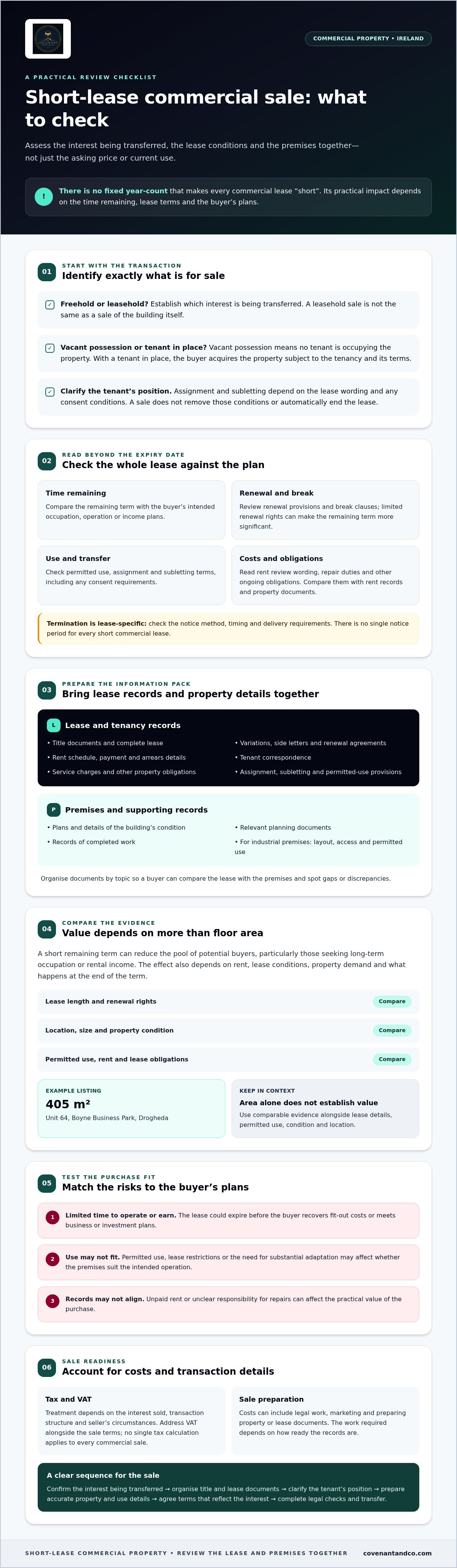
No single lease length makes every commercial lease “short” in a sale. In practical terms, a lease is short when the remaining time gives the buyer limited opportunity to operate, occupy or earn income before expiry. Compare the term with your plans and review any renewal or break provisions.
There is no single notice period for ending every short commercial lease. The required notice depends on the lease’s termination clauses and the circumstances of the tenancy. Check the notice method, timing and delivery requirements together. Selling the property does not, by itself, end the lease.
For a short-lease sale, first establish whether the transaction concerns the freehold or leasehold interest. Organise the title and lease documents, clarify the tenant’s position, and prepare accurate details of the property and its use. Then agree terms that reflect the interest being transferred, complete the legal checks and proceed with the transfer.
Commercial property purchase advice
A short lease affects what the buyer acquires and how long they can use or occupy the premises. Review the documents, lease terms and property together before deciding whether the purchase fits your plans.
Sale documents for a short lease
For a commercial sale with a short lease, assemble the title documents and complete lease, including variations, side letters and renewal agreements. Provide a rent schedule, payment and arrears details, tenant correspondence, and records of service charges or other property obligations. This information helps buyers understand the interest for sale and the commitments that continue after completion.
Property information matters too. Provide plans, details of the building’s condition, relevant planning documents and records of completed work. For an industrial unit, include information explaining its layout, access and permitted use. Organise documents by topic so buyers can compare the lease with the premises and identify any gaps.
How a short lease affects sale price
A short remaining term can reduce the number of potential buyers, especially those seeking long-term occupation or rental income. The effect depends on rent, lease conditions, property demand and what happens at the end of the term. Buyers may focus more on the remaining time if renewal rights are limited or the premises need substantial adaptation.
Compare like with like, not simply nearby asking prices. Unit 64, Boyne Business Park, Drogheda, is listed with an area of 405 m². That gives a useful example of the details a buyer can compare, but floor area alone does not establish value. Use the lease length, permitted use, condition and location alongside any comparable evidence.
Risks for buyers
The main risk for a buyer is acquiring a leasehold interest with too little time to meet business or investment plans. The lease could expire before the buyer recovers fit-out costs, or its permitted use might not suit the intended operation. Industrial premises also call for careful review of access, layout and lease restrictions.
Read the whole lease, not just the expiry date. Check rent review wording, break clauses, repair duties, assignment and subletting terms, and renewal provisions. Compare those obligations with the seller’s rent records and property documents. Discrepancies, such as unpaid rent or unclear responsibility for repairs, can affect the practical value of the purchase.
Before proceeding, make a short decision list: confirm the interest being sold, map the lease term against your plans, review the supporting documents, and identify the costs and obligations you would assume. If a direct acquisition is relevant to your situation, explore a commercial property cash purchase as one possible sale route.
Sold commercial property
Completed sales offer useful context, but they do not automatically value another building. In Ireland, compare the interest sold, location, floor area and property type. For a short lease, the remaining term and lease conditions matter too. The examples below illustrate the variety of commercial transactions.
The unit’s listed area is 154 m². Those details offer a specific comparison, but they do not establish the lease length or terms attached to the sale. A buyer or seller should avoid treating the price alone as proof of value for a different leasehold interest.
It provides another example from County Wicklow, involving a different property and floor area. Before comparing it with a target property, account for differences in location, condition, use and the interest transferred. Similar size or surroundings do not make two sales equivalent.
Other completed sales give further context, though the available details vary. Unit 2 at Churchfield Industrial Estate in Cork has a gross external area of 13,290 sq ft. Units 1 and 2 at the same estate together extend to 2,460 sq. m. These examples highlight why property type and measurement basis should be recorded accurately.
One mixed-use example is 63/64 Thomas Street, which includes a retail unit and three apartments. That combination differs from a standalone shop, office or industrial unit. For a fair comparison, identify whether the sale includes multiple parts, shared facilities or separate occupiers. The property description can change what a buyer understands the transaction to include.
Use a simple comparison process:
- Record the sale price, address, property type and area where available.
- Separate completed sales from properties merely listed or sale agreed.
- Check whether the transaction concerns freehold ownership or a leasehold interest.
- Compare the lease term and tenant position when those details are available.
- Note differences in condition, permitted use and income arrangements.
Sale agreed is not the same as a completed sale, so keep it separate from completed evidence. Likewise, Unit 64, Boyne Business Park, Drogheda, has a listed area of 405 m², but that area alone does not provide a completed sale price.
These records help frame questions, but do not settle a property’s value. Compare a short-lease property with sales that match its location, use and transferred interest as closely as possible. Where the lease details differ, explain those differences instead of relying on a headline figure.
How short is a short commercial lease in Ireland?
For a buyer, judge whether a lease is “short” against the time needed to use the premises or earn income. Consider the remaining term alongside the lease conditions, tenant position and intended use. The term alone cannot show whether the purchase suits a particular plan.
Start by finding the lease’s expiry date and working out how much time will remain at the expected completion date. Compare that period with your plans for occupation, fitting out or rental income. For example, a buyer planning to adapt a retail unit needs enough time to use the premises after completing the work.
Next, review clauses that could change how much time is practically available. A break clause may allow the lease to end earlier. A renewal option may provide a route to continue, but its wording and conditions matter. Note these provisions separately from the stated expiry date, then consider their effect on your intended use.
Use this checklist when assessing the remaining term:
- Set out your intended use, such as operating a shop or occupying an office.
- Compare the lease expiry with the time your plan requires.
- Review any break, renewal, assignment or subletting clauses.
- Identify the tenant’s rights and continuing obligations.
- Consider the property’s condition and any planned adaptation.
Property size does not define lease length. The Coach House & Olde Bar in Glaslough has a listed area of 1,080 m², but floor area alone cannot tell a buyer how much time remains under a lease. That example shows why physical details and lease details need separate review.
Apply the same test across property types. An industrial unit may suit a business that needs a particular layout, while a restaurant may depend on its existing fit-out and permitted use. In each case, compare the lease term with the time needed to operate. A lease that suits one buyer’s plans may restrict another.
Sellers should state the remaining term clearly and provide the documents that explain it. Buyers should map the expiry date and key clauses against their intended use before comparing properties. This gives “short” a practical meaning in the transaction, rather than relying on a label alone.
In a short-lease commercial property sale in Ireland, the key question is whether the lease’s remaining term and conditions suit the buyer’s plans. A sound assessment considers the expiry date, relevant clauses, tenant position and property use together. Keep each factor visible when reviewing a listing or preparing sale information.
How does an existing short lease affect the sale price of commercial property in Ireland?
An existing short lease can affect price because the buyer acquires premises with limited time to use them. The impact depends on the remaining term, rent, lease conditions, tenant position and property demand. Together, these factors determine the interest’s usefulness to a buyer and the income or occupation it supports.
A short remaining term may suit a buyer seeking temporary occupation but restrict someone planning a long-term business. If a tenant remains, rent and payment history can affect the investment case. If the property is vacant, the buyer may gain possession sooner but should consider how quickly the premises can be used or let.
Lease clauses also shape the buyer’s options. A break option, renewal right, rent review or restriction on assignment can change what is possible. For example, a renewal provision may support continued occupation, while a strict permitted-use clause could limit future plans. The asking price should reflect the rights actually being transferred, not assumptions about future occupation.
Compare similar properties carefully. That listing illustrates why property type, size and leasehold status need to be considered together. It does not establish the value of another property, particularly where the remaining term or lease conditions differ.
Asking prices provide context, not proof of completed value. A seller should not apply one directly to a particular leasehold property. Buyers should also compare the premises, location, tenant arrangements and transferred interest before drawing conclusions.
For a clearer price discussion, set out the factors in a consistent order:
- Confirm whether the sale concerns freehold ownership or a leasehold interest.
- Record the lease expiry, rent, review terms and any renewal or break provisions.
- Describe whether the property is occupied and outline the tenant’s obligations.
- Compare location, condition, floor area and permitted use with similar examples.
- Explain how each difference affects the buyer’s intended use or income plan.
Its asking price and area provide market context, but reveal nothing about another property’s lease terms. The comparison is useful only when the leasehold interest and property characteristics align.
A short lease does not produce one fixed discount. Its effect follows from the time, rights, income and use the buyer receives. If a direct sale is relevant, explore a commercial property sale as a possible route.
A 307.3 m² licence and leisure property at Druids Well, Newtownmountkennedy, is offered for sale at a price on application. A restaurant leasehold in Monkstown, County Dublin, is listed for sale at a price on application. Together, these examples underline the need to check lease terms.
Covenant Properties: Residential Property Cash Purchase
Covenant Properties offers a direct Commercial Property Cash Purchase for owners considering a sale. This can be a practical route if a short lease, tenant arrangements or the traditional sale process make a direct transaction a better fit for your plans.
Start by outlining the interest you own, the lease position and your preferred sale route. Covenant Properties also offers Residential Property Cash Purchase and Land and Site Acquisition for owners with those property needs. Each service suits a different situation, so focus on the property you want to sell.
If you’re weighing up a direct sale, contact Covenant Properties to discuss your property.
Choose the sale route that fits your next move
A short-lease commercial property sale in Ireland is about more than transferring premises. It also involves deciding what you want to do next and which sale route fits your plans. Use the lease details and your preferred outcome to begin a focused conversation about the property.
Covenant Properties offers a direct Commercial Property Cash Purchase for owners considering a sale. Its Residential Property Cash Purchase and Land and Site Acquisition serve other property situations. To take the next step, explain what you own, the lease position and the outcome you want, so the discussion can focus on your circumstances.
If you’re ready to discuss selling, contact Covenant Properties about your property. A clear starting point can help you consider your options with confidence.
Frequently Asked Questions
What is a short lease for commercial property in Ireland?
No single number of years defines a short commercial lease in Ireland. The term is short when limited time remains for the buyer’s intended use or investment plans. For example, a lease that leaves too little time to recover the cost of fitting out a shop may be short in practical terms, even if another buyer could make use of the same remaining term.
What Irish laws and commercial lease rules apply when selling a tenanted property?
The lease and applicable legal requirements govern rights and obligations attached to a tenanted property, including permitted use, rent, assignment, subletting and termination. A sale does not automatically remove lease conditions or transfer the tenant’s rights to another party.


