

Can you sell land without a registered folio? Yes. An Unregistered residential land sale Ireland does not automatically mean there is a defect in the title, but ownership usually needs to be supported by a chain of deeds and other records. That can feel daunting when documents are old or missing.
It is also easy to confuse title registration with planning status. They are separate matters: registration records ownership, while planning permission concerns how land may be developed or used. A sale of unregistered land triggers first registration with Tailte Éireann, so the title evidence and a suitable map may need careful preparation.
This guide explains what unregistered title means, which documents a solicitor may need to examine, and the steps involved in preparing for a sale. It also covers what to gather before considering your options and how to compare a direct acquisition with an open-market sale. Neither route suits every situation. Clear information about your title, planning position and priorities can help you decide what to do next.
Key Takeaways
- An Unregistered residential land sale Ireland can proceed, but the ownership evidence and first-registration steps need to be assessed for the specific title.
- Start gathering deeds, transfer records and documents that help identify the land, such as maps, before discussing the sale.
- Keep title evidence separate from planning information: each answers a different question and may shape the sale in its own way.
- Compare an open-market sale with direct acquisition by considering marketing, buyer enquiries and the title investigation involved.
- Covenant Properties acquires residential and development land across Ireland, including land with or without planning permission.
What does unregistered residential land mean for a sale in Ireland?
Unregistered title describes how ownership is recorded, not whether the land can be sold. In Ireland, registered land has an entry on a folio in the Land Registry. Ownership of unregistered land is generally evidenced by a chain of deeds instead. This affects the documents a buyer’s solicitor will examine and the registration steps involved in a sale.
Title is separate from planning permission and zoning. Deeds and title records help establish who owns the land and what rights or burdens may affect it. Planning documents and local planning information relate to matters such as permitted use, zoning and development potential. A plot can have a clear ownership history but no planning permission; planning status does not, by itself, prove ownership.
How unregistered title differs from registered title
A registered folio records details such as the owner, the land and certain registered rights. With unregistered title, ownership is traced through deeds and related records, which may document earlier transfers. A solicitor assesses the documents and circumstances to establish whether the evidence is satisfactory. The checks required can vary from one title to another.
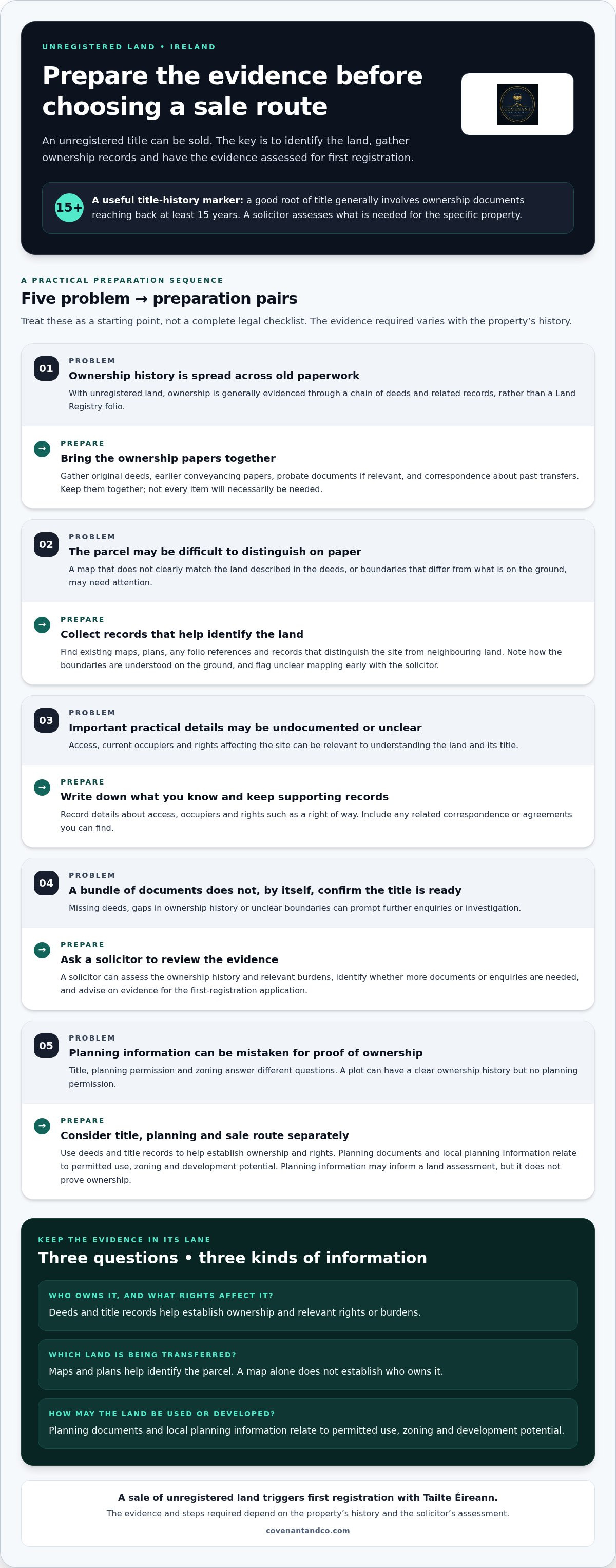
Tailte Éireann is responsible for Ireland’s property registration services. A sale of unregistered land triggers an application for first registration, but the evidence and steps needed to support that application depend on the property’s history. For unregistered land, a good root of title generally involves a chain of ownership documents reaching back at least 15 years. The seller’s solicitor can assess what is needed in the specific case.
Does unregistered status mean the land cannot be sold?
No. Unregistered status alone does not make a sale impossible. The buyer’s solicitor needs satisfactory evidence that the seller can transfer the title, and the first-registration process must be addressed. The phrase Unregistered residential land sale Ireland describes a conveyancing situation, not an automatic barrier to selling.
Older records may take time to locate and interpret. Missing deeds, unclear boundaries or gaps in the ownership history can prompt further enquiries or investigation. A map that does not clearly match the land described in the deeds may also need attention. These issues do not all lead to the same outcome, but they can affect how ready a title is for a transaction.
In practice, readiness depends on the available evidence, how clearly the land is identified and the solicitor’s assessment. Gathering old deeds and records early can help clarify what needs attention before you choose a sale route.
How can unregistered residential land be prepared for sale?
Preparation means making the land identifiable and bringing together records that may help establish ownership. The evidence required depends on the property’s history, so treat this as a starting point rather than a complete legal checklist. A solicitor should assess the title and advise what is needed for the specific sale and first-registration application.
A practical preparation sequence
- Locate ownership papers. Gather original deeds, earlier conveyancing papers, probate documents if relevant, and correspondence about past transfers. Keep the documents together, but do not assume every item will be needed.
- Collect information identifying the land. Find existing maps, plans, folio references if available, and records that help distinguish the site from neighbouring land. Note how the boundaries are understood on the ground.
- Record practical details. Write down what you know about access, current occupiers and rights that may affect the site, such as a right of way. Include any related correspondence or agreements you can find.
- Ask a solicitor to review the evidence. They can assess the ownership history and relevant burdens, then identify whether documents or further enquiries are needed. Mapping or boundary questions may need clarification before the transaction can proceed.
- Consider value and sale route separately. Planning information can inform a land assessment, but it does not prove ownership. For a separate overview of valuation factors, read this guide to valuing land for sale in Ireland.
Keep land identification separate from title evidence
A map can help show which parcel is being discussed, but it does not establish who owns it. Similarly, an entry in the Residential Property Price Register records transaction information, not proof of title to a particular site. Ownership is supported by title evidence assessed in context. Tailte Éireann maintains Ireland’s property registration systems, including the Land Register and Registry of Deeds. Its Property Registration information explains these records and their role.
For an Unregistered residential land sale Ireland, accurate mapping matters because the land described in the title evidence needs to correspond with the parcel being transferred. If old plans are unclear or boundaries do not match what is on the ground, flag this early for the solicitor to consider. The evidence required is not identical for every property.
Once you have organised the records, you can consider whether a direct acquisition suits your circumstances alongside other sale routes. Explore Covenant Properties’ land acquisition option as one possible next step.
Direct sale or open market: which route suits unregistered land?
Unregistered title does not determine how you should sell. The choice is between seeking broad public exposure and having a focused discussion with a direct buyer. Either way, the buyer will need satisfactory title evidence and legal due diligence still applies. Consider how much marketing you want, the enquiries you are prepared to manage, and the work needed to present the land clearly.
| Consideration | Open-market sale | Direct acquisition |
|---|---|---|
| Process | Usually involves preparing a listing and managing interest and enquiries. | Centres on a direct discussion with a prospective purchaser. |
| Marketing | Public marketing can provide broader exposure, depending on the land and buyer demand. | Does not use a public listing as the route to a buyer. |
| Buyer pool | May attract different types of buyers, each with their own requirements. | Focuses on the purchaser considering the land directly. |
| Title investigation | Ownership evidence and title checks remain part of the transaction. | Ownership evidence and legal due diligence are still required. |
When might a traditional market sale be appropriate?
Public marketing may suit you if broad exposure is a priority and you are prepared to manage a listing and enquiries. Its usefulness depends on the land’s characteristics and the level of buyer demand. It does not guarantee a higher sale outcome, and the marketing period cannot be assumed in advance. Consider whether the title documents and land information are organised enough to support questions from interested buyers.
When might direct land acquisition be worth considering?
A direct route may suit an owner who prefers a focused conversation with a potential purchaser rather than public advertising. Covenant Properties acquires land nationally across Ireland, including sites with or without planning permission. Planning status can still affect value and due diligence, so consider it alongside the title evidence.
If a direct sale feels less transparent, ask for the proposed terms in writing and take independent legal advice before agreeing to proceed. The same care applies to any sale route. Compare the proposed terms, any conditions and what each route means for your circumstances. For owners weighing that option, Covenant Properties’ direct land acquisition route offers an alternative to a public-market listing.
For an Unregistered residential land sale Ireland, the right route is the one that fits your priorities and the property’s particular title position. Neither choice removes the need to establish ownership and complete the relevant legal checks.
What steps should you take before selling unregistered land?
You can make a useful start before choosing a sale route. Build a clear record of what you have, what you know and what remains uncertain. This helps your solicitor identify title gaps and gives prospective buyers a consistent picture of the land. Do not try to resolve legal questions yourself or treat incomplete records as proof that a sale cannot proceed.
Organise ownership, boundary and planning information
- Make a title file. List the deeds, previous transfer papers, maps and correspondence you can find. Note missing documents too, rather than presenting the file as complete.
- Describe the land. Record the boundaries as you understand them, how access is reached, whether anyone occupies the site, and any known easements or other rights. These are useful facts for review, not conclusions about their legal effect.
- Keep planning records separate. Gather any planning permissions, applications or zoning information, and describe the position accurately. Planning status may affect how buyers assess the site, but it does not establish ownership.
- Prepare a valuation brief. Note the land’s characteristics and the supporting information available. Do not rely on one historic entry in the Residential Property Price Register to determine the value of a particular site. It records past transactions, not a full assessment of your land.
For wider sale-preparation ideas, see this fast-track property sale checklist for Ireland. For land specifically, valuation should take account of the site and relevant evidence, including planning information where applicable.
Prepare for the legal and buyer review
Give your solicitor the file and ask them to identify title gaps and the evidence needed for your proposed transaction. If deeds are missing, explain what you know about their history and share any related correspondence. Keep copies of communications and provide the same factual information to each prospective buyer. If a boundary or access detail is uncertain, label it as uncertain rather than guessing.
Do not promise a completion date until the legal and title requirements are understood. The steps depend on the individual title, and unresolved records or mapping questions may need attention. Organising the information can make the next discussion more focused, whether you consider a public listing or direct acquisition.
If you are considering a direct route, discuss a land acquisition with Covenant Properties as one option alongside your legal preparations.
How can Covenant Properties help with an unregistered land sale in Ireland?
Once you have started organising the title information, a direct acquisition is one route to consider alongside a public-market sale. Covenant Properties acquires residential and development land across Ireland, including sites with or without planning permission. Planning status still matters when a site is assessed, but a lack of permission does not automatically rule out a discussion.
An Unregistered residential land sale Ireland still requires a property-specific review and satisfactory legal conveyancing. A direct purchase does not remove the need to establish ownership, investigate the title or address first registration where required. Discussing a direct route lets you outline the land and its circumstances to a potential purchaser without treating a public listing as the only option.
What happens when you discuss a direct land sale?
You can describe the site, explain that its title is unregistered and outline the documents you have gathered. These might include deeds, previous transfer papers, maps and planning information. If records are incomplete, explain what is missing and what you know about the land’s history. Clear information gives the discussion a useful starting point, while the buyer’s review and legal checks still need to take place.
This conversation is not a substitute for independent legal advice. Your solicitor should assess the title evidence, explain what may be required for the transaction and handle the legal conveyancing. The precise requirements depend on the property and its records. No particular offer or completion timeframe should be assumed before the relevant details have been considered.
What should you decide before moving forward?
Consider any proposed terms in light of your priorities. Do you value public exposure, prefer a direct buyer discussion, or need more time to organise the title documents? Compare the written terms carefully, including any conditions and the steps each party is expected to take. Ask your solicitor to explain the contract, title requirements and implications before you sign.
You do not need to decide on a sale route before understanding the land’s circumstances. A clear conversation can help you decide whether direct acquisition is worth exploring while keeping your other options in view.
If you would like to discuss your land and its title position, discuss a land sale with Covenant Properties. It is a starting point for considering the route, not a commitment to proceed.
Take the next step with a clear picture of your land
An Unregistered residential land sale Ireland is possible, but readiness depends on the title evidence and the circumstances of the particular site. Organising deeds, maps and ownership records gives your solicitor a clearer starting point for reviewing what may be required.
Keep title evidence distinct from planning information. They answer different questions, and both may matter when you consider the land’s prospects and value. You can then compare a public-market sale with direct acquisition in light of your priorities, without assuming one route suits every property.
Covenant Properties acquires land and development sites across Ireland, including sites with or without planning permission. Any proposed sale remains subject to property-specific review and satisfactory legal conveyancing. Take independent legal advice on the title and any written terms before deciding how to proceed.
If you are considering a direct route, discuss a land sale with Covenant Properties. A clear first conversation can help you consider your options with confidence.
Frequently Asked Questions
Can you sell unregistered land in Ireland?
Yes, unregistered land can be sold in Ireland, provided the seller can show satisfactory evidence of ownership and the title can be dealt with through the legal process. The phrase “Unregistered residential land sale Ireland” describes a title status, not an automatic barrier to a transaction. A solicitor will assess the available deeds and records, identify any gaps and advise what further investigation may be needed for the particular land.
What does unregistered land mean in Ireland?
Unregistered land is land whose ownership is evidenced through deeds rather than an entry in a Land Register folio. The deeds may show a sequence of past transfers and other relevant title details. This does not, by itself, mean the land has a defective title. It means the ownership evidence needs to be examined in context, with the specific documents and history determining what is required for a sale.
Does unregistered land have to be registered before it is sold?
A sale of unregistered land triggers compulsory first registration with Tailte Éireann. This does not necessarily mean you must complete a separate registration process before putting the land on the market or discussing a sale. The application and supporting title evidence form part of the transaction’s legal process. Your solicitor can explain how registration applies to your title and the steps needed in your circumstances.
What documents do I need to sell unregistered land?
The documents required depend on the land’s ownership history. Start by gathering deeds, previous conveyancing papers, transfer records, maps and correspondence relating to the site. Information about boundaries, access, occupiers and known rights may also help. These records are a starting point, not a definitive checklist. Your solicitor will assess what supports the title and what additional evidence or clarification may be needed.
Can I sell unregistered land if some deeds are missing?
Possibly, but missing deeds can make it harder to establish the ownership history and may require further investigation. Tell your solicitor which documents are missing and share any related records or correspondence you have. They can assess whether the remaining evidence is sufficient or whether other information is needed. The effect depends on the particular title, so missing paperwork does not automatically mean a sale is impossible.
Is unregistered land the same as land without planning permission?
No. Unregistered land describes how ownership is recorded, while planning permission concerns whether specific development has been authorised. These are separate issues. A site may have unregistered title and planning permission, or registered title and no planning permission. Zoning and development potential are also distinct from proof of ownership. Planning status can influence how a site is assessed, but it does not establish who owns it.
Should I sell unregistered residential land through an agent or directly to a buyer?
It depends on your priorities. An agent-led open-market sale can provide public exposure, while a direct sale offers a focused discussion with a prospective buyer. Neither route removes the need for satisfactory title evidence, legal review or conveyancing. Covenant Properties acquires land and development sites across Ireland, including sites with or without planning permission. Compare any written terms with your priorities and get independent legal advice before signing.


