

Could a boundary dispute stop you selling your home, or affect how you sell it? If you’re dealing with Property with boundary disputes Ireland, uncertainty can feel bigger than the boundary itself. Which documents matter? Does a neighbour’s claim have merit? And what might a buyer ask before proceeding?
It’s understandable to worry that a disagreement could escalate or delay a sale. You can take practical steps before deciding what to do next: gather relevant records, note what is disputed and consider whether to speak with your neighbour, a solicitor or a surveyor. General information can help you prepare, but it isn’t a substitute for advice on your specific circumstances.
This guide compares ways to investigate, resolve or document the issue, and explains what to consider before selling. A direct property sale may be worth asking about, but whether a property with an unresolved dispute can be purchased depends on its circumstances. The aim is to help you move forward with clearer information, not guesswork.
Key Takeaways
- Property with boundary disputes Ireland can involve more than a fence line, including access, ownership or responsibility for shared features.
- Gather title records, correspondence and clear notes about the site before deciding what to do next.
- Compare neighbour discussion, a survey, mediation and solicitor-led advice to find a proportionate route for your situation.
- Before marketing your property, ask your solicitor what information about the dispute should be disclosed and when.
- A direct sale may be another option to explore, but share the dispute details early and don’t assume a buyer will accept the property.
Boundary disputes in Ireland: what is actually in dispute?
A fence that has stood for years, a hedge that appears to mark the edge of a garden, or an access route used without a second thought can suddenly become uncertain. One neighbour may believe the boundary runs along one side of a wall; another may point to a different line. Before deciding what to do, identify exactly what is disputed.
A boundary dispute is a disagreement about the position, ownership, use or upkeep of a boundary or nearby feature. These issues can overlap, but they aren’t all the same. Uncertainty about the dividing line differs from an allegation that a structure crosses onto adjoining land. A disagreement about access is different again, as is a dispute over who should maintain a shared wall or driveway.
Which boundary problems commonly arise between property owners?
Owners may disagree about where a fence, hedge or wall should sit, or whether it marks the legal boundary at all. A physical feature can provide useful context, but shouldn’t be treated as decisive on its own. Consider the documents and circumstances together.
Encroachment means one party alleges that a structure, such as an extension or wall, crosses onto adjoining land. Other disagreements concern a claimed right to pass over a route or responsibility for a structure used by both properties. Long-standing occupation can raise separate legal questions, including adverse possession in Ireland. The history of a fence or access route doesn’t, by itself, settle who owns land or has a particular right.
Does a boundary dispute mean a property cannot be sold?
Not automatically. A disagreement doesn’t itself establish ownership, prove an encroachment or decide who is responsible for a structure. Sale options depend on the particular facts, the available title evidence and the questions raised during a buyer’s due diligence. An unresolved issue may affect a transaction, but its impact can’t be judged from the label “boundary dispute” alone.
If you’re considering selling Property with boundary disputes Ireland, remember that a neighbour’s claim and the legal position are separate questions. Don’t assume the claim is correct, but don’t ignore it either. Keep relevant records and get advice before making decisions or giving assurances to a prospective buyer.
Ask your solicitor what information should be disclosed and when, based on your circumstances and the transaction. This article provides general information, not a determination of anyone’s legal rights. Investigate the issue carefully rather than treating a fence, map or disagreement as the final answer.
How to investigate a property boundary dispute in Ireland
Start by building a clear record, not by assuming a fence or map settles the issue. Work through the evidence in stages: gather title material, compare the documents with the layout on site, record what you observe, then get advice on any gaps or contradictions.
- Collect records: Ask your solicitor which deeds, title documents and maps may be relevant.
- Compare descriptions: Note what each document says about the boundary, access or structure in dispute.
- Document the site: Take dated photographs from clear viewpoints and keep a factual note of what they show.
- Keep communications: Save letters, emails and messages with their dates. Separate direct observations from assumptions.
- Seek appropriate advice: Ask a solicitor or suitably qualified surveyor for help, depending on whether the uncertainty is legal, physical or both.
Which property records and maps should you gather?
Title records differ. Registered land may have a folio and associated map; unregistered land may involve deeds and other documents held or recorded through the Registry of Deeds. Ask your solicitor which records and searches apply to your property. Tailte Éireann is the state body responsible for land registration and mapping in Ireland, but a map shouldn’t be treated as conclusive proof of the precise legal boundary. Read it alongside the relevant title documents and evidence from the site.
Keep copies together and note where each item came from. If two documents appear inconsistent, mark the exact wording or feature that differs instead of trying to resolve the conflict yourself.
When might a surveyor or solicitor help?
A suitably qualified surveyor may measure and record physical features, such as a wall, fence or building, so they can be compared with the documents. A solicitor can interpret title evidence and advise on legal rights and next steps. If both the on-site position and its legal meaning are uncertain, you may need input from both. Before commissioning work, be clear about the question you need answered.
Physical evidence can show where a feature stands; it doesn’t, by itself, determine the legal boundary. When selling Property with boundary disputes Ireland, an organised evidence file can help your solicitor explain what is known, what remains uncertain and what may need to be addressed in the transaction.
If you’re also considering a direct sale, Covenant Properties purchases residential property directly. You can explore a direct residential property purchase, but check whether your particular circumstances can be assessed and share relevant documents early. A buyer’s assessment is separate from legal advice or resolving the dispute.
Boundary dispute resolution in Ireland: compare your practical options
Court proceedings aren’t automatically the first or best step. The right route depends on what’s disputed: the position of a wall, the meaning of title documents, access, or a neighbour’s proposed work. You may need evidence, a conversation, legal advice or a combination of these. Each option has limits, and none guarantees agreement or a particular outcome.
| Option | Purpose and when it may suit | Limits and when to consider escalation |
|---|---|---|
| Neighbour discussion | Clarify each person’s understanding and share relevant information. It may suit a disagreement where communication feels safe and both sides are willing to engage. | A conversation can’t determine legal rights, and views may remain opposed. Keep a written note of what was discussed; seek professional input if the issue persists or becomes contentious. |
| Professional survey | Record the position and measurements of physical features, such as a fence, wall or building. It may help when the layout on site is unclear. | A survey documents physical evidence; it doesn’t, by itself, settle legal ownership or the boundary. Ask a solicitor how the findings relate to title documents. |
| Mediation | Provide a structured discussion with an impartial mediator. It may help where both parties are willing to explore a practical agreement. | Mediation doesn’t guarantee agreement or decide the legal position. Get legal advice before signing any proposed agreement, and consider another route if it doesn’t resolve the issue. |
| Solicitor-led advice | Help interpret title evidence and advise on ownership, access rights, proposed works or possible proceedings. | Advice can clarify options but may not end a disagreement. If the matter is escalating or a deadline may apply, seek advice promptly about next steps. |
When is an informal conversation or mediation worth considering?
If it feels safe and appropriate, start calmly. Stick to facts, explain what you understand to be in dispute and listen to the neighbour’s account. Avoid making accusations or agreeing to change a boundary before you understand the implications. Keep dated notes and copies of any follow-up messages.
Mediation can help parties discuss options with support, but it isn’t a binding answer in every case. In Ireland, solicitors must advise clients to consider mediation before commencing court proceedings. Whether it suits your circumstances is a separate question; take legal advice before signing an agreement.
When should you seek surveying or legal advice?
Consider a surveyor when the location or measurements of physical features need careful documentation. Speak with a solicitor if the dispute turns on ownership, access rights, planned works or legal proceedings. Some cases involve both factual and legal questions. If communication breaks down, the disagreement escalates or a deadline may apply, don’t rely on informal discussion alone. For Property with boundary disputes Ireland, a proportionate next step can help you understand the issue before deciding whether to escalate.
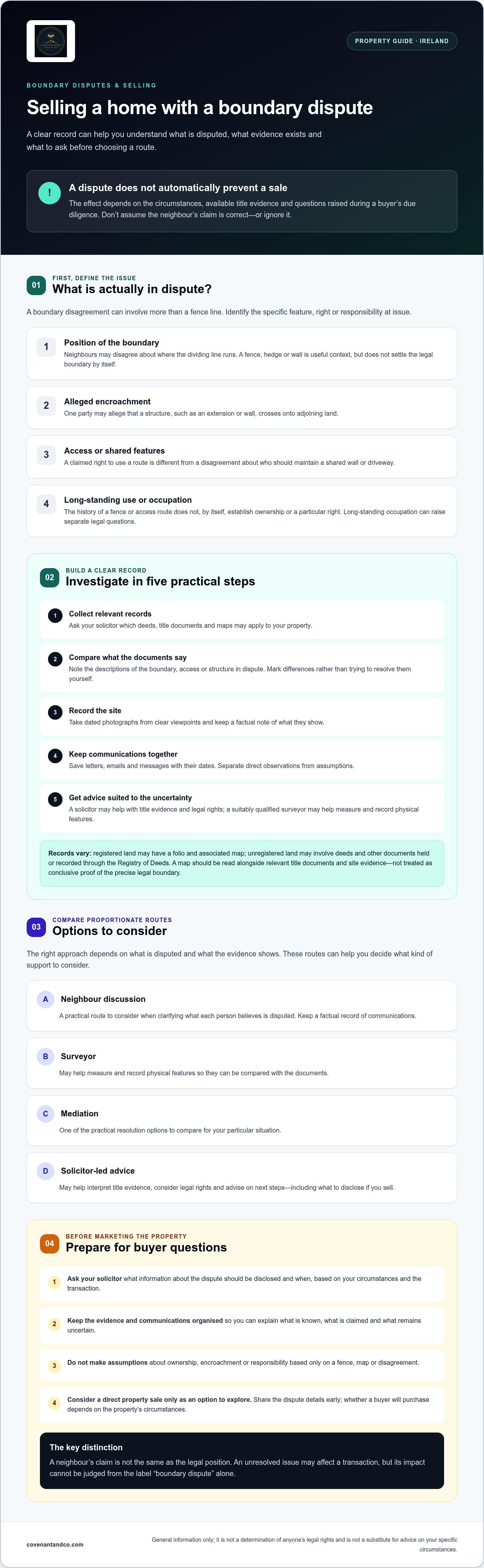
Selling a property with a boundary dispute: prepare before choosing a route
A sale is easier to assess when the facts are organised, even if the disagreement hasn’t been resolved. Before speaking with prospective buyers, put together a clear file and ask your solicitor how the issue may affect the sale. Distinguish what’s documented from what’s still contested, rather than presenting an uncertain claim as settled fact.
What should you prepare before speaking to a buyer?
Gather the relevant title records and maps, any survey material already obtained, correspondence with your neighbour and documents relating to an existing agreement. Include dated photographs or notes if they help explain the area in question. Keep originals safe and make copies available to your solicitor.
Prepare a short, neutral summary. Identify which part of a boundary is disputed, when the disagreement arose and what each party says, without claiming that an allegation has been proven. Mark what is agreed, what is supported by documents and what remains unresolved. Ask your solicitor to review the information, advise what should be disclosed and when, and check any transaction documents before you rely on them.
Resolving, documenting and disclosing are different approaches. Resolution may provide greater clarity, but can involve further discussion or professional input. Documenting an open issue helps explain what is known, but doesn’t settle it. Disclosure questions depend on the circumstances and transaction, so get legal advice rather than assuming a brief explanation is sufficient.
Should you resolve the dispute before marketing the property?
There isn’t one answer for every seller. The timing depends on the nature of the dispute, the available evidence, the proposed sale and your solicitor’s advice. Resolving the matter first may help clarify what is being sold. In other situations, you may explore a sale while the issue remains open, provided you understand how it should be described and what questions could arise during due diligence. Buyers and lenders may assess different situations differently.
If you’re weighing up sale routes, our guide to selling a house without an estate agent explains what to consider beyond a traditional estate-agent-led sale. For owners considering Property with boundary disputes Ireland, a direct sale is another option to explore, not a guaranteed solution. Covenant Properties directly purchases residential property, but whether a disputed property can be assessed depends on its circumstances.
If you’d like to discuss your situation as a possible direct property sale, share the details of your property and dispute. Having relevant documents ready can help explain the circumstances. Any buyer assessment remains separate from legal advice or resolving the boundary issue.
Explore a direct property sale if a boundary dispute complicates matters
If resolving a boundary disagreement before selling feels difficult, a direct buyer may be another route to explore. It isn’t a guaranteed solution, and a buyer’s assessment won’t determine ownership or settle the dispute. The legal question remains separate. Your solicitor can advise on your rights and obligations, while a prospective buyer decides whether the property suits their own criteria.
Covenant Properties directly purchases residential and commercial properties, as well as land and development sites, across Ireland. This doesn’t mean every property with an unresolved boundary dispute will be considered. Be open about the issue from the outset and provide relevant material, such as title records, survey reports, correspondence and any agreements. This gives a buyer information to assess the particular circumstances, without replacing independent legal advice.
What should you ask before choosing a direct property buyer?
Ask how the buyer approaches unresolved boundary issues and which documents it needs to understand the property. Check what happens next if more information is required, and request clear written terms before making a decision. Have your solicitor review any proposed agreement and explain its implications.
Compare the direct route with other options, including resolving the dispute before sale or marketing through a conventional process. Each has different practical considerations. A 2026 guide to cash buyers for houses in Ireland can help you understand broader points to compare, but your own solicitor can advise on your specific transaction.
How can you discuss your property's circumstances?
Start with a straightforward summary: the property type, what is disputed, whether the issue remains unresolved and which documents you can share. Separate established facts from allegations or unanswered questions. For owners weighing up Property with boundary disputes Ireland, this helps set realistic expectations. Any assessment and decision to purchase depend on the individual property and circumstances.
Covenant Properties doesn’t provide legal advice, surveying or mediation. Use the appropriate independent professional for those matters, and keep that advice separate from a buyer’s assessment. If you’d like to discuss your property and possible sale route, discuss your property and sale options. An initial enquiry is a chance to explain the situation and find out whether the route may be relevant, not a promise of purchase.
Take your next step with clearer information
A boundary disagreement doesn’t automatically rule out a sale. First, gather the relevant documents and record what’s known. Then speak with your solicitor about your rights, the appropriate way to handle the dispute and what to disclose during a transaction.
There’s no single route that suits every property. You might seek to resolve the issue, document it carefully or consider selling while it remains open, guided by advice on your circumstances. A direct sale can also be an alternative to the traditional open market, but a buyer’s decision depends on the property and available information.
Covenant Properties directly acquires residential and commercial properties, land and development sites across Ireland. If Property with boundary disputes Ireland is your situation, explain the issue and share the relevant documents when making an enquiry. A property assessment is separate from legal advice or dispute resolution.
Discuss your property and sale options with Covenant Properties. With a clearer picture of the evidence and your choices, you can decide on a next step with greater confidence.
Frequently Asked Questions
Can I sell a property with a boundary dispute in Ireland?
Yes, it may be possible to sell a property with an unresolved boundary dispute in Ireland. “Property with boundary disputes Ireland” describes an issue to investigate, not an automatic bar to sale. The practical route depends on the facts, title evidence and buyer due diligence. A buyer may ask for information or clarification. Gather relevant documents, keep your account factual and ask your solicitor how the dispute could affect the transaction and what should be disclosed.
How do I find the legal boundary of my property in Ireland?
Start by asking your solicitor which title documents and maps are relevant to your property. Registered land may have a folio and map, while unregistered land may involve deeds and records connected with the Registry of Deeds. Tailte Éireann provides land registration and mapping services. Compare documentary descriptions with the physical features on site, but don’t assume either settles the question alone. A solicitor can advise on the legal evidence; a surveyor may document site features.
Are Land Registry maps conclusive proof of a property boundary?
No. A Land Registry or folio map generally helps identify land, but shouldn’t automatically be treated as conclusive proof of the precise boundary line. Consider the map alongside relevant title documents, descriptions and physical evidence. If these appear inconsistent, don’t draw a legal conclusion from the map alone. Ask your solicitor to review the title material and explain whether a surveyor’s measurements could help clarify the physical layout.
Can my neighbour put up a fence on a disputed boundary?
There isn’t a reliable yes-or-no answer without knowing the title, the agreed arrangements and the precise location of the proposed fence. A disagreement doesn’t itself establish who owns the strip of land or who can make changes there. Before work begins, keep a written record of the concern and seek legal advice, particularly if the work may affect access or an existing structure. Avoid moving or damaging a fence yourself while the position remains disputed.
Should I hire a solicitor or a surveyor for a boundary dispute?
Choose based on what needs to be clarified. A surveyor can measure and document physical features, such as the position of a wall or fence. A solicitor can interpret title documents and advise on ownership, access rights and legal options. Some disputes involve both factual and legal questions, so you may need input from both professionals. If the disagreement is escalating or a deadline may apply, contact a solicitor promptly for advice about your circumstances.
Do I have to disclose a boundary dispute when selling my property?
Ask your solicitor what information must be disclosed and when, based on the dispute and the sale documents. Don’t assume that an unresolved disagreement can be omitted, or that every situation calls for the same wording. Give your solicitor relevant correspondence, reports, agreements and details of any ongoing claim. Accurate, consistent information can help address questions during the transaction. This is general information, not a decision on your specific legal or contractual obligations.
Can I sell my property before a boundary dispute is resolved?
It may be possible, but whether it’s practical depends on the dispute, the available evidence and the buyer’s due diligence. Some sellers may seek to resolve the issue first; others may explore a sale while clearly documenting what remains open. Ask your solicitor how to handle disclosure and transaction documents before marketing the property. If considering a direct buyer, explain the dispute and share available records early. Any purchase decision depends on the individual circumstances.


