

Why are you still paying thousands of euros for a service that often adds more stress than it removes? For many Irish homeowners, the traditional route feels like a drain on both time and equity. You want to keep your hard-earned money. You want a process that doesn't involve endless viewings or the constant fear of a "sale agreed" status falling through at the last minute. It's entirely possible to sell home without estate agent Ireland while staying fully compliant with national regulations.
We understand that the lack of transparency in the bidding process is frustrating. You deserve a sale that is simple, fast, and fair. This guide promises to show you how to bypass high commissions and long delays by exploring the three main ways to sell your Irish property. We'll compare DIY marketing, traditional auctions, and direct cash purchases to help you find the most efficient path forward for your specific situation. By the end, you'll have the clarity needed to choose a route that offers a certain result without the middleman.
Key Takeaways
- Confirm your legal "Right to Sell" and understand why no Irish law requires you to hire an intermediary.
- Discover how to use the Property Price Register to set a realistic price and take full control of your marketing strategy.
- Break down the hidden costs of traditional sales, including the 23% VAT on commissions, to see how much equity you can save.
- Identify the essential legal and energy requirements you need to organise before listing your property.
- Explore how a direct cash purchase allows you to sell home without estate agent Ireland while avoiding the stress of public viewings.
Is it legal to sell home without estate agent Ireland?
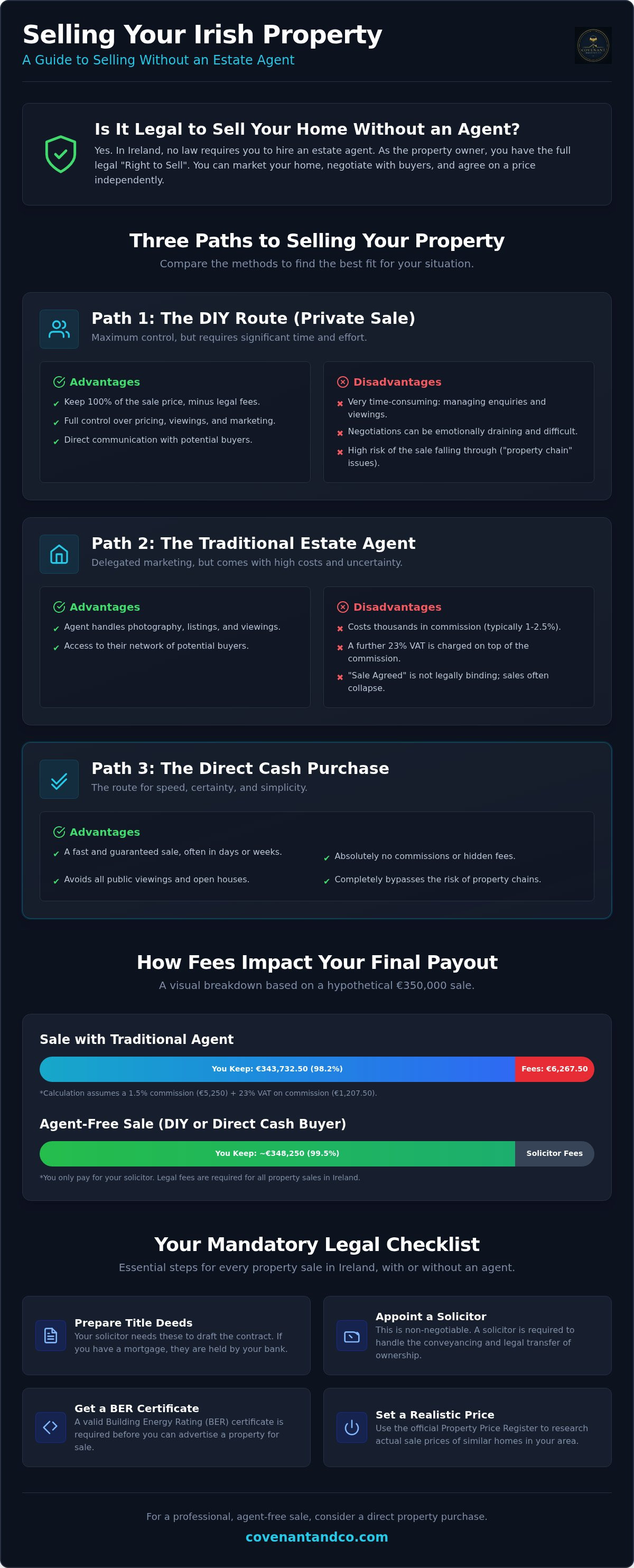
You might feel pressured to hire a professional the moment you decide to move. However, no Irish law requires you to use an estate agent to sell your property. The "Right to Sell" belongs entirely to you as the property owner. You have the legal authority to market your home, negotiate with buyers, and agree on a price. Many people choose this path to regain control over their equity. You can absolutely sell home without estate agent Ireland while staying on the right side of the law.
It is helpful to distinguish between marketing and the legal transfer of ownership. An estate agent is essentially a marketing specialist. They handle photography, listings, and viewings. Whilst their services can be helpful, they are entirely optional. A solicitor, on the other hand, is practically mandatory. You need a qualified legal professional to handle the conveyancing process, manage the exchange of contracts, and ensure the deeds are transferred correctly. You don't need a middleman to find a buyer, but you do need a solicitor to close the deal.
The role of the PSRA in Irish property
The Property Services Regulatory Authority (PSRA) is the body that licences and regulates estate agents in Ireland. Their primary job is to protect consumers from rogue operators. If you are selling your own home, you are not providing a "property service" for a fee. This means you don't need a PSRA licence to advertise your own house or talk to potential buyers. The freedom to sell home without estate agent Ireland allows you to act as your own representative without the need for bureaucratic registration.
Mandatory legal requirements for every Irish sale
Even without an agent, you must follow specific rules to ensure the sale is valid and transparent. These requirements protect both you and the buyer. Keeping your paperwork organised from the start will prevent delays later on.
- BER Certificate: For all property sales in 2026, you must obtain a valid Building Energy Rating (BER) certificate before you can legally advertise the property for sale.
- Title Deeds: You must have your Title Deeds ready for your solicitor to review; if you have a mortgage, these are likely held by your bank.
- Contract of Sale: A professional solicitor must draft the formal contract of sale to ensure it meets all current Irish legal standards and protects your interests.
By handling the initial stages yourself, you remove a layer of cost and communication. It's a straightforward way to keep more of your money where it belongs. As long as you have your solicitor in place and your BER certificate ready, you are legally prepared to move forward.
The DIY route: How to organise a private sale
Taking the reins of your own sale requires a methodical approach and a thick skin. Your first task is setting a realistic asking price. Don't rely on guesswork or sentimental value. Instead, use the Property Price Register to see the actual transaction prices of similar homes in your area. This data provides a grounded starting point for your negotiations. Once you've set a price, you'll need to vet every enquiry personally. Always ask for "Approval in Principle" or proof of funds before inviting anyone for a viewing. This simple step filters out "tyre-kickers" and protects your time.
Hosting viewings is the most time-consuming part of the process. You'll need to be available during evenings and weekends to accommodate potential buyers. Whilst it's rewarding to show off your home's best features, you must maintain home security. Never leave valuables on display and try to have a second person in the house during appointments. If the thought of constant public viewings feels overwhelming, you might prefer a direct cash purchase offer to skip the marketing phase entirely.
Marketing your property independently
In 2026, digital "curb appeal" is your most powerful tool. Most buyers will decide whether to visit your home based on the first three photos they see online. You'll need high-quality, bright photography that makes rooms look spacious and inviting. Private listing sites are much more affordable than traditional agency packages, but they require you to manage all the administrative work. You are the one responsible for writing the description, uploading the BER certificate, and responding to every email promptly to keep momentum high.
The hidden workload of private negotiations
Direct negotiation can be emotionally draining. It's difficult to stay objective when a buyer criticises your home to justify a lower offer. You must also remember that the "Sale Agreed" stage in Ireland is not legally binding. Either party can walk away before the exchange of contracts without any legal penalty. This period is often fraught with uncertainty.
A significant risk that many DIY sellers overlook is the "property chain." If your buyer needs to sell their own house to fund the purchase, your sale is at the mercy of their progress. If their sale collapses, yours does too. This chain risk is a primary reason why private sales can take months to complete. You may also face "gazundering," where a buyer lowers their offer at the last minute because they know you're eager to close. Managing these interpersonal dynamics requires patience and a clear understanding of your bottom line.
Comparing the costs: DIY vs Agent vs Cash Buyer
Understanding your "Net Realisable Value" is the only way to compare different selling methods fairly. This figure represents the actual cash left in your pocket after every fee, tax, and marketing expense has been deducted. When you choose to sell home without estate agent Ireland, you are protecting your equity from a series of small, draining expenses. Most homeowners focus on the high-level offer, but the final amount that hits your bank account is what truly matters. It is about the bottom line, not the headline price.
Calculating the true cost of an estate agent
Consider a hypothetical sale of a property valued at €400,000. A standard estate agent commission of 1.5% results in a €6,000 fee. However, the 23% VAT adds an additional €1,380 that many sellers fail to budget for. Once you include professional photography, floor plans, and premium portal listings, your upfront and closing costs can quickly climb toward €8,500. These figures represent a significant chunk of equity that could otherwise be used for your next deposit.
The open market also carries the heavy burden of "holding costs." If your sale takes six months to complete, you are responsible for half a year of mortgage interest, Local Property Tax (LPT), and home insurance. Maintenance costs for a vacant or staged property also accumulate. If a sale falls through, which is a common occurrence in chain-heavy transactions, you have to start this expensive clock all over again. The longer the process drags on, the lower your actual profit becomes.
The direct cash acquisition advantage
Direct cash buyers like Covenant Properties eliminate these variables. By removing the agent, the commission drops to zero. There are no marketing fees, no staging costs, and no signage to pay for. This model prioritises the speed of the transaction, allowing you to stop the bleed of holding costs almost immediately. You receive a no-obligation offer within 24-48 hours, providing a level of financial clarity that the open market simply cannot match.
Choosing a direct purchase means you aren't gambling on a buyer's mortgage approval or their own house sale. You trade the potential for a slightly higher gross price for the absolute certainty of a lower-cost, faster transaction. It's a pragmatic choice for those who value their time and peace of mind as much as their equity. You can sell home without estate agent Ireland and move on to your next chapter without the financial "hangover" of traditional fees.
Essential steps to sell home without estate agent Ireland
Selling your property independently requires you to be organised from day one. You cannot afford to wait for a buyer to appear before getting your legal house in order. The moment you decide to sell home without estate agent Ireland, your first call should be to a conveyancing solicitor. They will immediately request your title deeds from your lender. This process can take several weeks, so starting early is essential to avoid delays. Your solicitor acts as your anchor, ensuring every step of the transaction is legally sound and binding.
You must also arrange a Building Energy Rating (BER) assessment. It is a legal requirement to display this rating in any advertisement or listing. Beyond the BER, you need to gather your Local Property Tax (LPT) payment history and ensure your Non-Principal Private Residence (NPPR) status is cleared if the property was not your main home between 2009 and 2013. If you've added an extension or converted an attic, you must have planning compliance certificates ready. Having this documentation in a dedicated folder prevents the sale from stalling during the sensitive final weeks of the closing process.
Finding a solicitor for a private sale
Some legal firms prefer working with estate agents because the agent handles the initial administrative burden of the "Sale Agreed" phase. However, many solicitors are happy to support private sellers who are well-prepared. When searching, look for a firm that offers a transparent, fixed-fee conveyancing quote. This ensures you aren't hit with unexpected costs later. Your solicitor handles the heavy lifting, including the actual transfer of funds and the formal exchange of deeds. They are your most important partner in this journey.
Managing viewings and security
When you choose to sell home without estate agent Ireland, safety is paramount when showing your home to strangers. Always try to have a friend or family member present during viewings. It's also vital to verify that a buyer is genuinely ready to move. Don't hesitate to ask for a copy of their "Approval in Principle" (AIP) letter from their mortgage provider. This document proves they have the financial capacity to complete the purchase. Maintain a meticulous paper trail of every offer received. Recording the date, time, and specific conditions of each bid keeps the process transparent and professional for everyone involved.
If the thought of managing this legal checklist and vetting strangers feels overwhelming, there is a simpler way. You can request a direct cash offer and skip the public viewings and paperwork entirely.
Covenant Properties: The professional way to avoid agents
If you want to sell home without estate agent Ireland but find the DIY workload daunting, a direct cash purchase is the most reliable alternative. Covenant Properties operates as a national cash buyer, meaning we purchase your home directly using our own private capital. This model removes the uncertainty of the open market and the high costs of traditional intermediaries. You aren't searching for a buyer; you've already found one. We handle both residential and commercial property acquisitions, providing a professional exit strategy for any property type.
In 2026, the traditional Irish property market remains plagued by long delays and broken chains. By selling directly, you bypass these obstacles entirely. We provide a no-obligation cash quote within 24-48 hours of your enquiry. Because we don't rely on bank financing, the sale is "chain-free." This means you don't have to wait for us to sell another property before we can buy yours. It is the fastest, most predictable way to complete a transaction in the current climate, moving you from an initial enquiry to a certain result in a fraction of the usual time.
A bespoke solution for your timeline
One of the greatest stresses of selling is the lack of control over the calendar. We change that by allowing you to choose your own closing date. Whether you need to move in two weeks or two months, we work around your schedule. Additionally, we purchase properties in "as-is" condition. You don't need to spend money on repairs, professional staging, or deep cleaning to attract a buyer. Your privacy is also protected; there are no public listings, no online galleries of your home's interior, and no "For Sale" boards outside your door. It is a quiet, dignified transaction that respects your circumstances.
How to get started today
Our process is designed to be as simple and transparent as possible. It follows three straightforward steps:
- Enquire: Share a few basic details about your residential or commercial property through our website.
- Offer: Receive your no-obligation cash quote within 24-48 hours after a brief assessment.
- Complete: Choose your preferred closing date and finalise the sale through your solicitor.
There are no fees, no commissions, and no hidden costs to worry about. We encourage you to compare a cash offer against the "Net Realisable Value" of a traditional sale. When you factor in the saved commissions, marketing costs, and months of mortgage holding fees, the direct route often proves to be the most financially sound choice. It's a straightforward way to sell home without estate agent Ireland while maintaining total peace of mind and financial clarity.
Take control of your property sale today
You now have the clarity needed to choose the right path for your move. Whether you embrace the DIY workload or prefer the speed of a direct acquisition, you've seen that you don't need a traditional middleman to succeed. You can legally sell home without estate agent Ireland while keeping your equity intact. By preparing your documents early and understanding the true "Net Realisable Value" of your home, you put yourself in the strongest possible position.
If you value certainty and want to avoid the stress of public viewings or broken chains, we are here to help. We provide a guaranteed sale using our own private capital, allowing you to move forward without delay. Get your free, no-obligation cash offer from Covenant Properties today and receive a fair quote within 48 hours. With zero commission and no estate agent fees, it's the simplest way to secure your financial future. You've done the research; now it's time to take the next step toward a faster, fairer sale.
Frequently Asked Questions
Is it cheaper to sell a house without an estate agent in Ireland?
It is generally much cheaper because you remove the agent's commission, which typically ranges from 1% to 2.5% of the sale price. On a €400,000 home, this saving can exceed €7,000 once you factor in the mandatory 23% VAT on professional fees. You will still need to pay for a BER certificate and legal fees. Whilst you save on commissions, you must be prepared to handle the marketing and viewings yourself.
Do I need a solicitor if I am selling my house privately?
You absolutely need a solicitor to handle the legal transfer of the property. Whilst an estate agent is optional, a legal professional is required to draft the contract for sale, manage the exchange of deeds, and ensure the mortgage is cleared. They also handle the secure transfer of funds between parties. Attempting to complete the conveyancing process without a qualified solicitor is not recommended and is often rejected by the buyer's mortgage lender.
How much does it cost to sell a house privately in Ireland?
The primary costs include a BER certificate, which usually costs between €150 and €300, and solicitor fees, which vary based on the property value. You should also budget for private listing fees on property portals and professional photography if you want to attract high-quality bids. If you choose to sell home without estate agent Ireland by dealing with a cash buyer, many of these marketing and staging expenses are eliminated entirely.
Can I list my house on Daft.ie without an estate agent?
You can list your property on major portals, but you often need to use a dedicated "private seller" service or a flat-fee platform that has the authority to post on these sites. Most large Irish property websites are designed for agent use, so individual homeowners must follow specific steps to gain access. Always ensure your listing includes your BER rating, as failing to display this information can lead to fines from the authorities.
What is the fastest way to sell a house in Ireland without an agent?
The fastest method is a direct cash purchase from a professional acquisition firm. This route bypasses the open market, meaning you don't have to wait for mortgage approvals or property chains to resolve. You can receive an offer within 24 to 48 hours and choose a closing date that suits your timeline. This is significantly quicker than a DIY sale, which can often take several months to reach completion.
What documents do I need to sell my house privately in Ireland?
You will need a valid Building Energy Rating (BER) certificate, proof of Local Property Tax (LPT) payment, and your Title Deeds. If the property has been extended, you must provide planning permission documents or a certificate of exemption. You also need a discharge certificate for the NPPR charge if applicable. Having these documents ready before you find a buyer will prevent the sale from stalling during the final legal stages.
Is a cash offer for my house better than an open market offer?
A cash offer is often superior because it provides certainty and speed. Open market offers are frequently subject to the buyer securing a mortgage or selling their own home, which introduces the risk of the deal collapsing. A cash buyer uses private capital to guarantee the sale, removing the "chain" risk entirely. Whilst the headline price might be slightly lower, the lack of commission and holding costs often results in a similar net profit.
What happens if a private buyer pulls out after the sale is agreed?
In Ireland, a sale is not legally binding until both parties have signed the formal contracts and a deposit has been paid. If a buyer pulls out during the "Sale Agreed" phase, there is usually no legal penalty for them. This is a common frustration in the private market. To minimise this risk, always verify a buyer's proof of funds early and consider the reliability of a cash purchase over a mortgage-backed offer.


