

Could a line in your title deeds really stop you selling your property? If you’re searching “Sell property with restrictive covenants Ireland”, the short answer is that a covenant can complicate a sale, but it doesn’t automatically prevent one.
It’s understandable to feel uncertain when the wording is unfamiliar or you’re worried it could delay a sale. The effect depends on the covenant, the property and the circumstances. A conveyancing solicitor can interpret the title documents and explain what options may be available, including whether the covenant can be challenged or changed.
This guide explains what information to gather, what questions to discuss with your solicitor and how to compare practical routes to market. You’ll also learn how a direct property sale could fit into your plans. Covenant Properties buys residential and commercial property, land and development sites across Ireland. It considers a property’s circumstances as part of an acquisition assessment, offering an alternative to a traditional market listing.
Key Takeaways
- A restrictive covenant doesn’t automatically prevent a sale. Its wording, purpose and effect on the property all matter.
- To Sell property with restrictive covenants Ireland, gather the title documents and ask a solicitor to explain the covenant’s implications.
- Separate restrictions affecting how the property is used now from those that may matter only if a buyer proposes a change.
- Compare possible routes, including seeking consent or a release, proceeding with disclosure, or considering a direct sale. The right option depends on the circumstances.
- A direct sale offers an alternative to open-market marketing. The property and its circumstances form part of the acquisition assessment.
What does a restrictive covenant mean when selling property in Ireland?
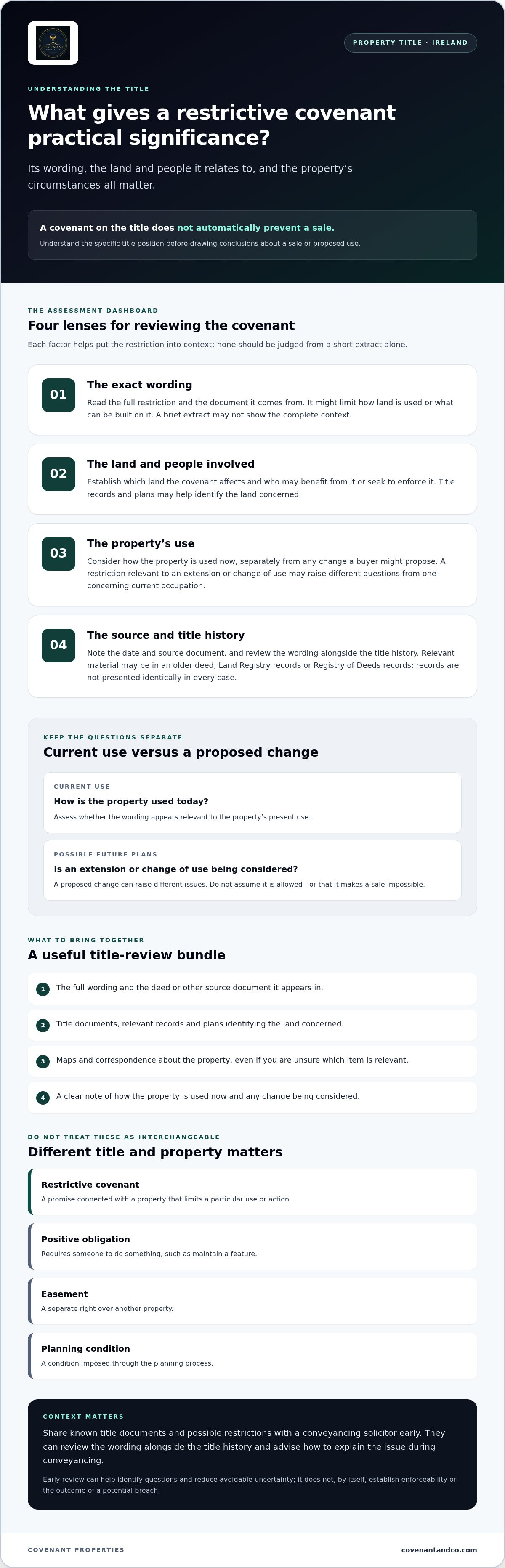
A restrictive covenant is a promise connected with a property that limits a particular use or action. For example, its wording might restrict how land can be used or what can be built on it. The general idea of a covenant is outlined in Covenant (law), but that overview doesn’t determine the legal effect of a specific Irish property document.
The effect depends on the covenant’s wording, how it arose, which land it affects and the circumstances today. A restrictive promise differs from a positive obligation, which requires someone to do something, such as maintain a feature. An easement is a separate right over another property, while a planning condition is imposed through the planning process. These can raise different questions, so don’t treat them as interchangeable.
For an owner searching “Sell property with restrictive covenants Ireland”, the key point is to understand the wording in context. Review it early rather than waiting until a buyer raises questions during conveyancing. Early disclosure and advice can help identify what needs explaining and reduce avoidable uncertainty. They don’t, by themselves, establish whether a covenant is enforceable or what may happen if it’s breached.
Where might a restrictive covenant appear in Irish property documents?
Look through the title deeds and any documents referred to in them. Depending on how the property is held and its history, relevant material may also appear in Land Registry records or Registry of Deeds records. The wording could be in an older deed rather than a clear, modern note on a document you already have. Records aren’t presented identically in every case.
A conveyancing solicitor can review the wording alongside the title history and explain what it appears to relate to. Keep copies of deeds, maps and correspondence about the property together, even if you’re unsure which document is relevant. If you have only part of a deed or a short extract, make that clear rather than treating it as the complete record.
Does a restrictive covenant automatically stop a property sale?
No. The presence of a covenant alone doesn’t establish that a sale cannot proceed. Relevant questions include what the covenant says, who may benefit from it, which land it affects and whether it has practical relevance to the proposed sale or use. A restriction affecting possible future development, for instance, may raise different issues from one that appears to relate to the property’s current use.
Legal effect and possible remedies depend on the facts and current Irish law. Ask your solicitor to assess the specific title before drawing conclusions. That gives you a clearer basis for discussing disclosure and sale options.
How can a restrictive covenant affect an Irish property sale?
A covenant may come to light when you collect title documents, respond to a buyer’s questions or progress the conveyancing process. If its wording raises an issue, the parties may need time to understand what it means and whether it affects the proposed sale. A restriction can prompt questions without necessarily preventing the transaction from proceeding.
A covenant’s effect depends on its exact wording, the land and people it relates to, and how it applies to the property today.
Separate the property’s current use from a buyer’s possible future plans. A restriction might appear relevant to an intended extension or change of use, for example, without affecting how the property is currently occupied. Don’t assume either that a proposed change is allowed or that it makes a sale impossible. The title and circumstances need proper assessment.
Questions can affect buyer confidence or transaction timing if the wording is unclear or further advice is needed. A lender may also consider title matters as part of its assessment, but the presence of a covenant alone doesn’t establish what a lender will decide. These are possibilities to assess, not automatic outcomes. If you’re deciding how to Sell property with restrictive covenants Ireland, understanding the issue can help keep discussions grounded in the facts.
Which details help establish the covenant’s practical significance?
Gather the full wording, the date and source document, and any title records or plans that identify the land concerned. Note how the property is used now and whether you or a prospective buyer has a particular change in mind. Your solicitor can assess what the documents support, including whether they identify land or people who may benefit from or seek to enforce the restriction. Avoid relying on assumptions based on a short extract.
What should owners disclose during conveyancing?
Share known title documents and potential restrictions with your conveyancing solicitor early. They can advise how to describe the issue accurately and respond to buyer enquiries. Don’t conceal a document, dismiss a covenant informally or present an uncertain interpretation as settled fact. Clear information gives the parties a better basis for understanding what needs to be resolved and whether it affects the buyer’s intended use.
Once you understand the title position, consider the sale route separately from the legal assessment. For owners comparing options, a direct property sale offers an alternative to public marketing. Covenant Properties considers a property’s circumstances as part of its acquisition assessment. The title still needs to be understood and addressed as part of the sale.
What options can owners compare before selling property with restrictive covenants?
Once you understand what the title documents say, compare possible routes. The right choice depends on the covenant, the property and your sale priorities. A solicitor can assess the legal position; you can then weigh up the practical route that suits your circumstances. Before deciding, consider whether you need to resolve a specific title issue or simply explain it accurately to a prospective buyer.
| Option | Purpose | What it may depend on | Uncertainty and suitability |
|---|---|---|---|
| Investigate the title | Clarify the wording, context and possible effect. | Relevant deeds, records and legal review. | A useful starting point, though investigation alone may not resolve a restriction. |
| Seek consent or a release | Explore whether the restriction can be changed or lifted. | Identifying relevant parties and, where needed, their agreement. | Availability and outcome depend on the specific circumstances. |
| Proceed with disclosure | Market or sell while accurately explaining the title issue. | Legal advice, clear information and the buyer’s position. | May suit a property where the covenant’s effect is understood and acceptable to the parties. |
| Consider a direct sale | Compare an acquisition with public marketing. | The property, title information and acquisition assessment. | An alternative route, with the title issue still requiring proper attention. |
Can a covenant be changed, released or treated as no longer relevant?
Consent, a variation or a release may be possibilities, but none should be assumed. Your solicitor can assess the wording, identify parties who may need to be involved and advise whether seeking agreement is a realistic route. Whether the covenant can be treated as irrelevant also requires legal assessment. Don’t rely on its age, informal assurances or an insurance option as a substitute for advice.
Insurance or another risk-management measure may be considered in some circumstances, but it isn’t a universal replacement for understanding the title or obtaining legal advice. Discuss whether any such measure is appropriate for the specific issue before relying on it.
How does a direct sale compare with an open-market sale?
Open-market marketing exposes a property to public advertising and buyer enquiries. A direct acquisition offers a different process and transaction structure without the same public listing route. In either case, the title issue still needs to be understood and relevant information shared. A direct buyer may assess title complexities as part of considering the property, but the outcome depends on the property and transaction.
Owners researching “Sell property with restrictive covenants Ireland” can compare these routes alongside the legal options rather than assuming one approach fits every property. For more on the direct-purchase route, read our guide to cash buyers for houses in Ireland.
What steps should you take before marketing a property with a covenant?
Organising the information before marketing can make it easier to answer questions later. Keep the legal assessment separate from the commercial choice of how to sell: first establish what the title documents say, then consider which sale route and buyer type suit your objectives.
An early title review can help bring potential issues to light before a sale progresses.
What documents and details should you gather first?
Collect the title deeds, available property records and any documents that refer to the covenant. Note when it appears to have been created and record any known changes in how the property has been used. Keep the original wording intact. A personal summary may help you organise your notes, but it isn’t a substitute for the source document or a solicitor’s interpretation.
How should you prepare for conveyancing enquiries?
Share the relevant documents promptly with the conveyancing solicitor handling the sale. They can review the title, explain what the wording may mean and advise on clear, factual responses to buyer questions. Keep the documents and explanations together so information can be found easily as the transaction progresses. Don’t guess at the covenant’s effect or present an uncertain interpretation as fact.
Next, clarify your objective. Are you planning to sell the property as it is, or could a buyer’s intended change bring the restriction into focus? This is useful context for your solicitor and can help you compare marketing routes. The legal assessment is separate from whether you prefer public marketing or a direct acquisition.
If you’re considering how to Sell property with restrictive covenants Ireland, prepare accurate information about the title before deciding which route to pursue. A direct buyer may consider the property’s circumstances as part of an acquisition assessment, but this doesn’t resolve the legal question. Your solicitor’s review remains important whichever sale route you choose.
For wider sale preparation, see the fast-track property sale checklist. If you’re weighing a direct sale, you can discuss selling your property with Covenant Properties once you have the relevant documents to hand.
How can a direct sale help when a restrictive covenant adds complexity?
A direct sale gives owners another route to compare alongside public marketing. Instead of advertising the property openly, you can discuss a possible acquisition directly with a buyer. This may suit you if you value a more private process or want to consider an alternative to a traditional listing.
Covenant Properties acquires residential and commercial property, land and development sites across Ireland. A property’s title circumstances can form part of the individual acquisition assessment. The wording and legal position still matter, so discuss the covenant with your solicitor as you consider your sale options.
What can owners expect when discussing a direct acquisition?
An initial conversation can cover the property, its ownership context and the title information available. Sharing relevant documents helps explain the circumstances, but a direct buyer’s assessment isn’t a substitute for legal advice from your conveyancing solicitor. Keep the two questions distinct: what the covenant means legally, and whether a direct acquisition suits your sale plans.
Any offer and transaction terms depend on the individual property assessment. A conversation doesn’t commit you to a sale. It can help you understand whether this route is worth comparing based on the information available.
When might a direct property sale be worth considering?
Consider it alongside an open-market sale if privacy, a simpler route or clarity about the transaction structure matters to you. A public listing may give you exposure to a wider pool of potential buyers, while a direct acquisition avoids public marketing. Which approach fits depends on your priorities and the property.
A direct sale doesn’t remove the need to address relevant title issues. Your solicitor can advise on the covenant and the information needed for conveyancing, whatever route you choose. A buyer may consider the title circumstances as part of assessing the property.
If you’re weighing up how to Sell property with restrictive covenants Ireland, a practical first step is to gather the relevant documents and understand the title position. You can discuss a property sale with Covenant Properties and consider whether a direct acquisition suits your plans.
Take your next step with clarity
A restrictive covenant doesn’t automatically rule out a sale. Its wording and circumstances need careful legal review, so gather the relevant documents and speak with your conveyancing solicitor before deciding how to proceed.
Once you understand the title position, compare your options. Public marketing and a direct acquisition offer different routes, and the right fit depends on your property and priorities. If you’re considering how to Sell property with restrictive covenants Ireland, a direct sale is one option to explore alongside the legal advice you receive.
Covenant Properties acquires residential and commercial property across Ireland, as well as land and development sites, with or without planning permission. The property and its title circumstances are considered individually as part of an acquisition assessment.
If you’d like to discuss your situation and consider a direct sale, discuss a property sale with Covenant Properties. Gather your title documents and get in touch to explore whether a direct acquisition suits your plans.
Frequently Asked Questions
Can I sell a property with a restrictive covenant in Ireland?
Yes, a restrictive covenant doesn’t automatically mean an Irish property cannot be sold. If you’re asking “Sell property with restrictive covenants Ireland?”, the answer depends on the covenant’s wording, the property and land it relates to, and the wider legal circumstances. Have the title documents reviewed during the sale process. Your conveyancing solicitor can explain the implications for your transaction and advise what information should be disclosed.
What happens if a restrictive covenant is found during conveyancing?
The parties may need to clarify the covenant’s wording, relevance and possible effect before the transaction progresses. A buyer or their solicitor may raise enquiries, and your conveyancing solicitor can advise how to respond using the available documents. The next step depends on the particular title and circumstances. Don’t assume the sale must end, or that the issue can simply be set aside without review.
How do I find out whether my Irish property has restrictive covenants?
Start by gathering the title deeds and property records available to you. Relevant wording may appear in title documents or associated records, and the location or completeness of documents can vary. A conveyancing solicitor can review the material and explain what it means for your proposed sale. If you have the original document, share it rather than relying only on a brief summary or recollection of its wording.
Can a restrictive covenant be removed or changed in Ireland?
Possibly, but consent, release or variation depends on the covenant and the legal context. Relevant parties may need to be identified, and their agreement may be required. There’s no single outcome for every property, so don’t assume a restriction can be changed or removed. Ask the solicitor reviewing the title to explain which options, if any, may apply and what evidence or agreement could be needed.
Will a restrictive covenant make my property harder to sell?
It may lead to additional questions or affect how a buyer assesses the property, particularly if the restriction relates to its current use or a proposed change. The practical effect varies with the wording and circumstances. Gather the relevant documents, seek an early legal review and disclose known title information accurately. This can help the parties understand the issue and reduce the chance of an unexpected question arising late in the transaction.
Can I sell directly to a property buyer if my title has a restrictive covenant?
A direct sale can be considered as an alternative to public marketing, but it doesn’t remove the need to understand and disclose relevant title matters. The buyer assesses the property and its circumstances individually, and any proposed transaction depends on the property and terms. Covenant Properties buys residential and commercial property, as well as land and development sites, across Ireland. Speak with your conveyancing solicitor about the title as you compare sale routes.


