

Imagine standing in your hallway, watching a stream of strangers critique your decor whilst your personal life feels like it is under a microscope. For many, the decision to sell house due to divorce Ireland is overshadowed by the dread of nosy neighbours and a sale process that drags on for months. You deserve a fresh start without the added burden of an uncertain property market. It is a difficult time, and the pressure to make the right financial move can feel overwhelming. You want a resolution that is fair, fast, and final.
We understand that your priority is a clean break and a certain outcome. This guide provides a clear roadmap through the complexities of property division, from understanding the Family Home Protection Act to managing spousal consent. You will learn how to navigate the legal requirements of 2026 whilst protecting your privacy. We will explore practical methods to achieve a swift exit, ensuring you have the clarity and confidence needed to step into your next chapter. From avoiding public viewings to securing a certain sale, we help you move from uncertainty to a fresh start.
Key Takeaways
- Understand how the Family Home Protection Act 1976 safeguards your rights and why spousal consent is mandatory for any property transfer.
- Explore the three primary ways to handle the family home, including the practicalities of a buy-out versus a total sale.
- Learn how to sell house due to divorce Ireland whilst maintaining your privacy and avoiding the uncertainty of a traditional property chain.
- Identify the essential paperwork you need to organise early, from BER certificates to title deeds, to ensure a smooth legal transition.
- Discover why a direct cash purchase often provides the most certain route to a clean break and a faster move toward your future.
Understanding Your Rights: The Family Home in Irish Divorce Law
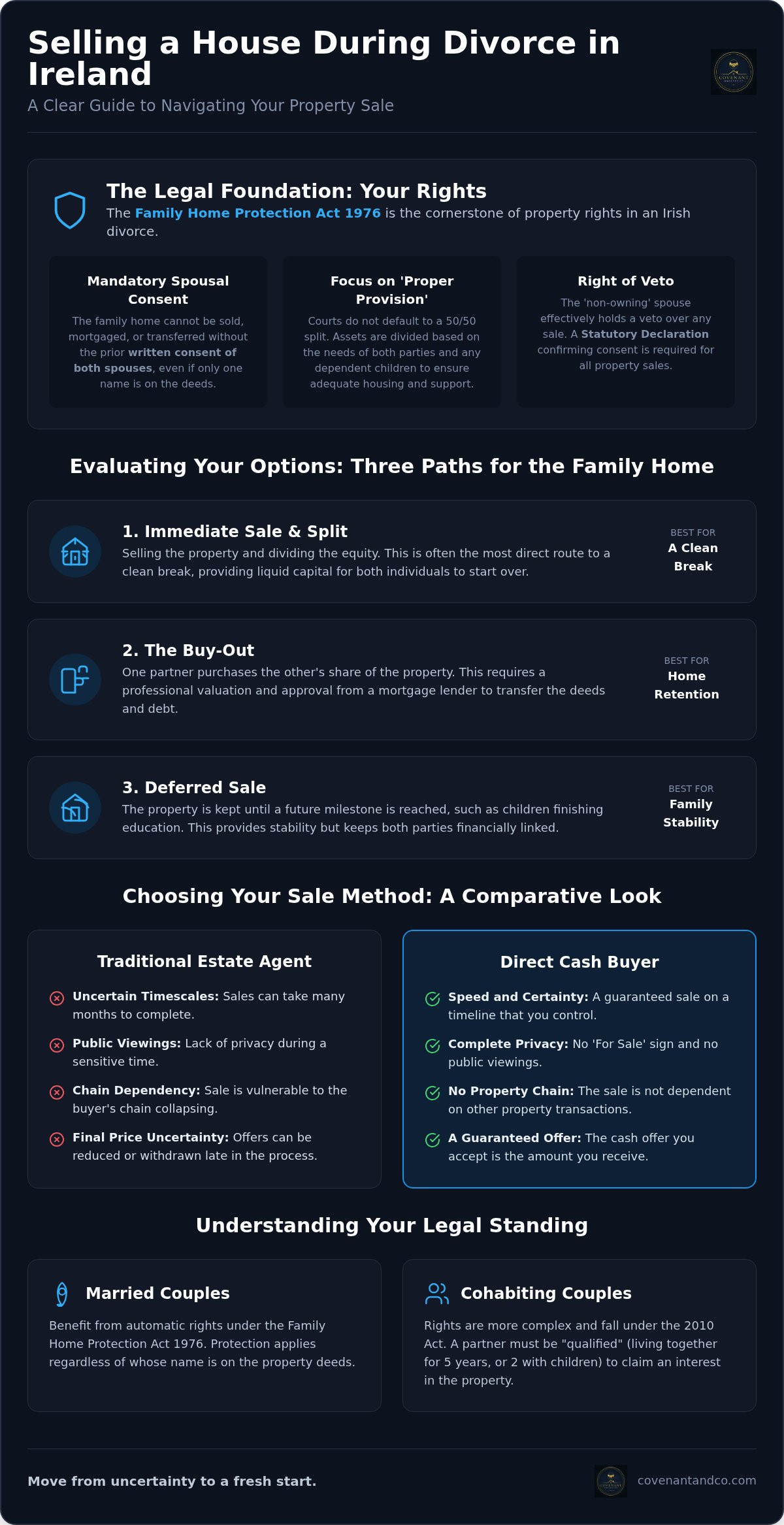
The Family Home Protection Act 1976 is the cornerstone of property rights for couples in Ireland. This law ensures that the family home cannot be sold, mortgaged, or transferred without the prior written consent of both spouses. It is a vital safeguard. Even if the property is held in one person's sole name, the "non-owning" spouse effectively holds a right of veto over any sale. This protection stems from a legal framework that has evolved significantly since the history of Irish divorce law began to prioritise the welfare of all family members over individual title deeds.
The law treats the home as a shared asset rather than a simple piece of real estate. If you intend to sell house due to divorce Ireland, you must recognise that the courts focus on "proper provision." This means assets are divided based on the needs of both parties and any dependent children, rather than a rigid 50/50 split. A High Court ruling in early 2026 reinforced this, reminding us that judges have broad discretion to ensure neither party is left without adequate housing or financial support.
Spousal Consent and the Selling Process
Every property sale in Ireland involves a Statutory Declaration. This document confirms that the property is either not a family home or that the necessary spousal consent has been granted. If one partner refuses to sign these consent forms, the sale cannot proceed through traditional channels. This often creates a stalemate during a sensitive time. In cases where consent is withheld "unreasonably," the other spouse can apply for a court order to dispense with the requirement. Most legal separation agreements now include a specific "agreement to sell" clause to prevent these delays, but obtaining this agreement early is essential for a clean break.
Cohabiting Couples vs Married Couples
Rights for cohabiting couples are different and often more complex. Unlike married couples, cohabitants do not have automatic rights under the 1976 Act. Instead, protection usually comes from the Civil Partnership and Certain Rights and Obligations of Cohabitants Act 2010. To claim an interest in a property, a cohabitant must typically prove they are "qualified," which usually requires living together for five years, or two years if they have children together. Because these rights aren't as straightforward as those in a marriage, seeking professional legal advice before listing the property is the only way to avoid future disputes.
Evaluating Your Options: How Property is Divided in Ireland
When you decide to sell house due to divorce Ireland, you generally face three distinct paths. Each has its own set of financial and emotional consequences. Choosing the right one depends on your current mortgage, your relationship with your former spouse, and your vision for the future. Clarity at this stage prevents long-term legal headaches.
- Immediate Sale: Selling the property now and splitting the equity is often the preferred choice for those seeking a clean break. It provides liquid capital for both parties to secure new accommodation and start over.
- The Buy-Out: One partner purchases the other’s share. This requires a professional valuation and a mortgage lender's approval to remove one name from the deeds and transfer the debt.
- Deferred Sale: This involves keeping the house until a specific milestone is reached, such as children finishing their education. Whilst it provides stability, it keeps both parties financially linked.
Most couples aim for a swift resolution to avoid the stress of a property sale dragging on for months. If you are looking for a way to move on without the delays of the open market, a direct cash purchase can offer the certainty needed to finalise your settlement quickly.
Property Adjustment Orders (PAOs)
A Property Adjustment Order is a court-mandated restructuring of property ownership. Under the Family Law (Divorce) Act, 1996, the court has the power to change who owns the home, regardless of whose name was originally on the deeds. Judges look at the length of the marriage, the financial and non-financial contributions of each spouse, and their future needs. They don't just look at who paid the mortgage; they look at who cared for the family and what each person needs to live a dignified life post-divorce.
The Impact of Dependent Children
Children are the court's primary concern in any Irish divorce. If children are under 18, or up to 23 if they remain in full-time education, the judge may grant the primary carer the right to reside in the family home. This is often called a "right to reside" order. It ensures the children’s lives aren't disrupted, but it can delay the final sale of the house for many years. You must balance the need for your children's stability with your own need for financial independence. Many couples find that selling now and using the equity to buy two smaller, separate homes is the most sustainable path for everyone involved.
Traditional Estate Agents vs. Direct Cash Buyers: A Comparative Look
Choosing how to sell your home is a major decision. Most people think of estate agents first. But is the open market the best choice when you need a clean break? When you sell house due to divorce Ireland, timing is everything. You might wonder, how long does it take to sell a house Ireland? On the open market, the process can be slow and unpredictable. This delay keeps you financially tied to your former partner for longer than necessary.
Sale chains are a constant risk in traditional transactions. If your buyer's own sale collapses, your divorce settlement stalls with it. This can lead to months of legal limbo and rising solicitor fees. You also face estate agent commissions, which in 2026 typically range from 1% to 2.5% plus VAT. When you add marketing costs and staging expenses, the equity you have left to split begins to shrink. A direct purchase removes these variables, offering a straightforward path to liquidity.
Privacy and Discretion
Privacy is often the biggest concern during a separation. A "For Sale" board on your lawn invites unwanted questions from neighbours. It signals a major life change to the whole street. Public viewings mean strangers walking through your home, critiquing your space whilst you are at your most vulnerable. Direct cash buyers offer a private alternative. There are no public listings and no "open house" events. You maintain your dignity and keep your personal circumstances confidential amongst your peers and community.
Certainty in Uncertain Times
Solicitors and courts require fixed figures to draft final orders. A guaranteed cash offer allows your legal team to finalise your separation agreement with absolute certainty. You don't have to guess what the final sale price might be after weeks of negotiations. You also gain control over the timeline. You can choose a closing date that suits both parties' moving plans, rather than being at the mercy of a buyer's mortgage approval. Eliminating the risk of a buyer pulling out at the last minute provides the peace of mind needed to start your new chapter.
Navigating the Sale Process: Managing Consent and Practicalities
Efficiency is your greatest ally when you decide to sell house due to divorce Ireland. The first step is always obtaining a professional valuation from a registered valuer. This figure provides the baseline for your separation agreement and ensures both parties have a realistic expectation of the equity available. You must also manage your joint mortgage obligations carefully. Until the house is sold and the mortgage is redeemed, both partners remain 100% liable for the repayments. A single missed payment can damage the credit ratings of both individuals, making it harder to secure a new home later.
Organising your paperwork early prevents last-minute delays that could frustrate a sensitive settlement. You will need to locate your title deeds and ensure the property is correctly registered with the Land Registry. A Building Energy Rating (BER) certificate is also a legal requirement for any sale in 2026. Choosing a solicitor who understands the intersection of family and property law is vital. They can ensure that the "agreement to sell" is drafted correctly within your legal separation or divorce papers, protecting your interests throughout the transaction.
Preparing the House for Sale
Deciding whether to invest in repairs is a common dilemma. Whilst a fresh coat of paint might attract higher bids, many couples prefer to sell "as is" to achieve a faster exit. Managing viewings is particularly challenging if one partner has already moved out. It requires constant coordination and can lead to friction if the property isn't kept in "show" condition. Many people find that selling a home without an estate agent through a direct purchase is the most practical way to avoid these logistical hurdles and maintain privacy.
Financial Planning for the Post-Sale Period
You must calculate your "net" equity accurately. This is the amount left after the mortgage is paid off, legal fees are settled, and any outstanding Local Property Tax (LPT) is cleared. Whilst property transfers between spouses under a court order are generally exempt from Capital Gains Tax (CGT), selling to a third party may have different implications if the property isn't your primary residence. The current CGT rate is 33%, so professional tax advice is essential. If you want to bypass the stress of repairs and public viewings, you can request a direct cash offer today to secure your financial future.
Achieving a Clean Break: The Benefits of a Direct Cash Sale
A divorce is often defined by its delays. Legal proceedings, financial assessments, and emotional adjustments take time. When you decide to sell house due to divorce Ireland, the last thing you need is a property sale that adds months of uncertainty to your life. A direct cash sale offers an empathetic alternative. It prioritises your peace of mind by removing the traditional obstacles of the open market. You don't have to worry about a buyer's mortgage falling through or a chain collapsing at the eleventh hour. It is a certain solution in an uncertain time.
Covenant Properties provides a streamlined path. We offer a transparent process where the offer you receive is the amount you get. There are no hidden fees to worry about. There are no estate agent commissions to deduct. Most importantly, there are no public viewings. You get to maintain your privacy whilst achieving the liquidity needed to finalise your legal settlement. This method moves you from a state of "what if" to a state of "what's next" with minimal friction. It is about speed, fairness, and clarity.
The Covenant Properties Approach
We understand the sensitivity of your situation. Our service is built on respect and professional integrity. We don't use high-pressure tactics. Instead, we provide a certain outcome on a timeline that works for both parties. By choosing a quick house sale in Ireland, you can stop the clock on mounting solicitor fees. You can avoid the financial drain of maintaining a joint property you no longer wish to share. It is a professional disposal designed for human circumstances.
Next Steps for a Stress-Free Exit
Starting the process is simple and carries no obligation. You can request a cash offer by providing a few basic details about your property. We then conduct a professional assessment without the need for public marketing or "For Sale" boards. Our timeline is brisk. We move from initial enquiry to completion in a fraction of the time required by traditional agents. This speed is especially vital if you need to avoid repossession or settle outstanding debts caused by the separation. It is time to clear the path for your new beginning. We are here to help you achieve that clean break.
Move Forward with Clarity and Certainty
Deciding to sell house due to divorce Ireland is a significant step toward your new beginning. You now have a clear understanding of the Family Home Protection Act and the various ways property is divided under 2026 regulations. Whether you choose a buy-out or an immediate sale, the goal is always a clean break that respects your privacy and your future needs.
A direct sale removes the traditional obstacles that often cause divorce settlements to stall. You can avoid the anxiety of public viewings and the risk of broken property chains. There are no estate agent fees or commissions to worry about; just a straightforward, transparent transaction on your own timeline. This approach ensures complete privacy whilst your legal proceedings are finalised, providing the certainty needed to move on.
Request a discreet cash offer for your property today to secure the resolution you deserve. You have the tools to navigate this change with confidence. Better days are ahead, and a certain sale is the first step toward reaching them.
Frequently Asked Questions
Can I sell the house without my ex-spouse’s consent in Ireland?
You cannot sell the family home without your ex-spouse's written consent under the Family Home Protection Act 1976. This rule applies even if the property is in your sole name. If your former partner refuses to sign the necessary documents, you must apply for a court order to dispense with their consent. This usually happens if a judge decides the refusal is unreasonable or intended to delay a fair settlement.
How is the equity in a house divided during a divorce?
Equity is not automatically split 50/50 in an Irish divorce. The courts aim for "proper provision," which means they look at the financial needs and resources of each person. Factors include the length of the marriage, contributions to the home, and the welfare of any children. Judges have broad powers to adjust ownership shares to ensure both parties can live with dignity after the separation is finalised.
Does it matter whose name is on the title deeds?
For a family home, it does not matter whose name is on the title deeds. Both spouses have protected rights regardless of legal ownership. Whilst having your name on the deeds provides some security, the law prioritises the family's housing needs over technical title. If you want to sell house due to divorce Ireland, both individuals must participate in the legal transfer, ensuring a clean break for everyone involved.
What happens if we cannot agree on a sale price?
If you cannot agree on a sale price, mediation is the most effective first step. Professional mediators help you reach a compromise without expensive court hearings. If an agreement remains impossible, the court can intervene to order a sale. In these cases, a judge might appoint an independent valuer or specify that the property must be sold to the highest bidder through a transparent and fair process.
Can I stay in the house if we have children?
You may be allowed to stay in the home if you are the primary carer for dependent children. Courts often grant a "right to reside" until the youngest child reaches 18, or 23 if they are in full-time education. This provides stability for the children, though it delays the final division of equity. Both parties must then decide if they can afford to maintain the mortgage payments during this period.
How long does a property sale take during a divorce?
A traditional property sale in Ireland often takes between four and nine months from listing to completion. When you sell house due to divorce Ireland, this timeline can be even longer if legal disputes arise. If you need a faster resolution, a direct cash purchase can be completed in a fraction of that time. This speed is vital for those who want to finalise their financial settlement and move on.
Do I have to pay Capital Gains Tax when selling the family home?
You generally don't pay Capital Gains Tax when selling your primary family home. This is known as Principal Private Residence relief. Additionally, transfers of property between spouses made under a court order are exempt from CGT. However, if the property is an investment or a second home, the 33% tax rate may apply. You should always consult a tax professional to understand your specific liabilities before completing a sale in 2026.
What are the benefits of selling to a cash buyer during a divorce?
Selling to a cash buyer like Covenant Properties offers certainty and speed. You avoid the stress of public viewings and "For Sale" boards, which protects your privacy during a sensitive time. Because there are no property chains or bank finance requirements, the risk of the sale collapsing is almost zero. You also save on estate agent fees and commissions, leaving more equity to be divided between you and your former partner.


