

What if the most effective way to stop a bank repossession isn't fighting a losing battle in court, but quietly walking away on your own terms? With 34,996 principal dwelling mortgage accounts in arrears as of early 2026, you're certainly not alone in this struggle. You might worry about the sheriff arriving or the public anxiety of looming court dates. Choosing to sell house to avoid repossession Ireland is not a sign of failure. It's a strategic decision to protect your credit rating and financial future before the bank takes control.
We know that the stress of debt makes it hard to see a clear path forward. You want to clear your mortgage entirely and protect your ability to rent or buy again in the future. In this guide, you'll discover how to bypass the public court system and maintain your privacy throughout the process. We'll examine the common myths of the Irish legal process and explain how a proactive exit allows you to move on with a clean credit slate and your dignity intact.
Key Takeaways
- Understand the Mortgage Arrears Resolution Process (MARP) and how it serves as your primary legal shield before court proceedings begin.
- Discover why choosing to sell house to avoid repossession Ireland through a private cash purchase protects your credit rating more effectively than a public auction.
- Debunk the common myth that negative equity prevents you from selling, and learn how to negotiate a voluntary exit with your lender.
- Compare the hidden costs of forced sales, such as receiver fees and legal bills, against the transparency of a direct, fee-free transaction.
- Learn the essential first step of requesting a redemption figure to establish exactly what's owed and regain control of your financial future.
Understanding Repossession in Ireland: Why It Isn’t Inevitable
Repossession is a legal process where a lender reclaims a property because the mortgage has fallen into arrears. For many Irish homeowners, the word itself feels like a final verdict. It isn't. In reality, repossession is a lengthy procedure with multiple opportunities for you to intervene. Understanding the foreclosure process provides a foundation for how lenders protect their interests, but Irish law includes specific safeguards for borrowers. The most important of these is the Mortgage Arrears Resolution Process (MARP). This is your first line of defence. Lenders are legally required to follow this framework to help you find a sustainable solution before they can even consider taking the house back.
It's a common misconception that once the bank starts talking about court, the house is already gone. This is false. Even if court proceedings have begun, you still own the legal title to your home. You remain the owner until a judge grants an order and that order is executed. This window of time is where a "Proactive Exit" becomes your strongest tool. Choosing to sell house to avoid repossession Ireland allows you to settle the debt on your own terms rather than waiting for the bank to force a sale at a public auction.
The Legal Timeline: From Arrears to Court
The process doesn't happen overnight. Once you've missed payments for 90 days, your account is officially in arrears. At this stage, the bank will ask you to complete a Standard Financial Statement (SFS). This document is a detailed breakdown of your income and spending. It's the basis for any resolution. While it feels intrusive, it's a vital part of the MARP. Ignoring letters or refusing to engage with the SFS is the only way to guarantee a bad outcome. Silence is interpreted as a lack of cooperation. This gives the lender the green light to proceed to the Circuit Court.
Your Right to Sell the Property Privately
You have a legal right to sell your property privately at any point before the final eviction. This remains true even if you're in significant debt or already facing a court date. A voluntary sale can often "stay" or stop legal proceedings. If you can show the court or the lender that a sale is progressing and will clear the debt, the legal process usually pauses. This gives you the chance to settle the mortgage and move on without a court record. The point of no return occurs the moment the Sheriff executes the possession order.
Debunking 5 Common Myths About Selling to Avoid Repossession
Misinformation is a heavy burden when you're already dealing with mortgage debt. Many homeowners hesitate to act because they believe they've lost all control over their property. The truth is often buried under complex legal jargon and fear. Whilst following official repossession guidelines is essential for understanding your rights, those rules don't always highlight the private alternatives available to you. Let's look at the reality of how to sell house to avoid repossession Ireland by clearing up five common myths.
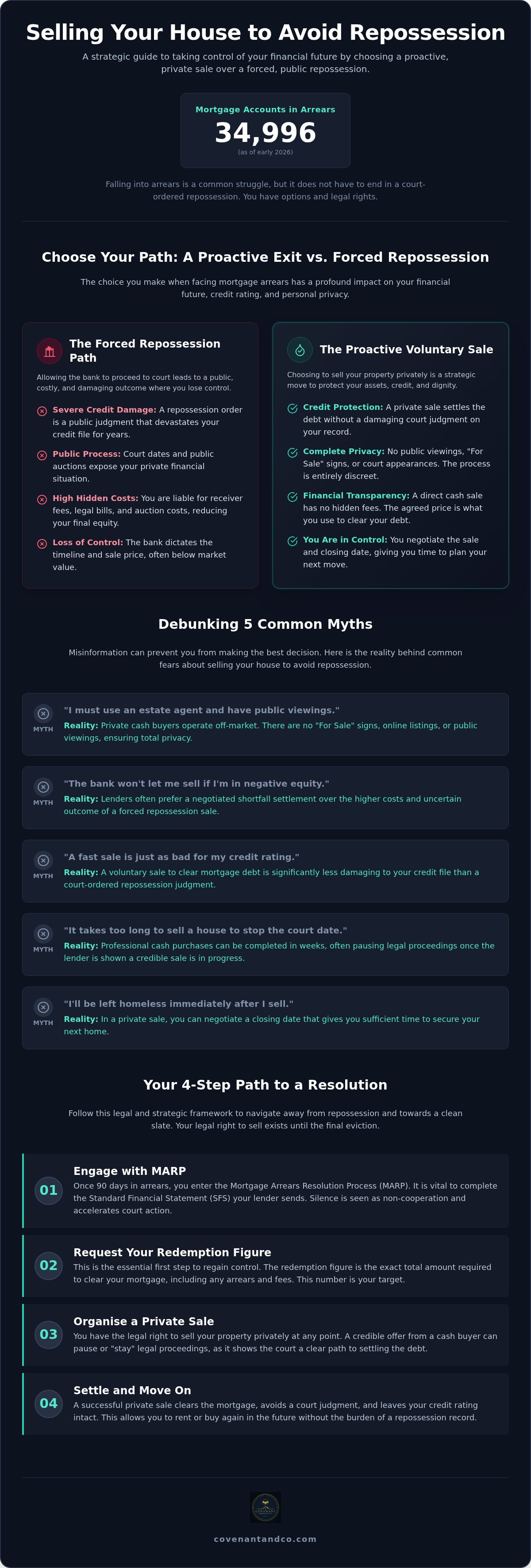
- Myth 1: "I have to use an estate agent and have public viewings." (Reality: Private cash buyers bypass the public market entirely.)
- Myth 2: "The bank won't let me sell if I'm in negative equity." (Reality: Lenders often prefer a negotiated settlement over the high costs of a forced sale.)
- Myth 3: "A fast sale will ruin my credit rating." (Reality: A voluntary sale is far less damaging than a court-ordered judgment.)
- Myth 4: "It takes too long to sell a house to stop the court." (Reality: Professional cash purchases can be completed in days or weeks.)
- Myth 5: "I'll be left homeless immediately if I sign." (Reality: You can negotiate a closing date that gives you time to find a new home.)
Myth: Public Viewings are Mandatory
Financial hardship is deeply personal. The thought of neighbours watching estate agents lead strangers through your home adds a layer of shame that nobody needs. Off-market cash buyers remove this obstacle. There are no "For Sale" signs on the lawn and no public listings online. This discreet approach protects your reputation amongst family and friends. It allows you to handle your business privately and move on without the local community knowing the details of your financial situation.
Myth: The Credit Rating Fallacy
A repossession order is a public court record that stays on your credit file for years. It makes renting a new apartment or applying for a basic loan nearly impossible. In contrast, selling the property allows the mortgage to be marked as "satisfied" or "settled." Future lenders favour those who took proactive steps to resolve their debt. Speed is also your friend here. By closing a sale quickly, you stop the accumulation of legal interest and penalties that would otherwise bloat your debt. If you're feeling overwhelmed, exploring a private cash offer can provide the clarity you need to see if a voluntary exit is possible.
Voluntary Sale vs. Forced Repossession: A Financial Comparison
Choosing to sell house to avoid repossession Ireland is often a matter of simple maths. When a bank takes control of a property, the financial outcome is rarely in the homeowner's favour. Forced sales are expensive; they involve layers of professional fees that the bank simply adds to your outstanding debt. By the time a property reaches a public auction, the amount you owe has likely ballooned far beyond the original mortgage balance. Accessing support for mortgage arrears early can help you understand these costs before they become insurmountable.
One of the most aggressive hidden costs is "Mora Interest." This is a penalty interest rate applied to your account once you've breached the mortgage contract. Whilst your standard interest continues, this extra charge accumulates daily. In a court process that can drag on for months, these penalties eat away at any remaining value in the property. In reality, the decision to sell house to avoid repossession Ireland provides a way to settle the debt before the bank adds their own legal fees to your balance, potentially allowing for a "full and final settlement."
The Cost of Court Proceedings
Many homeowners don't realise they're paying for the bank's legal team. In a repossession case, the lender's solicitor fees, court filing costs, and even the receiver's management fees are charged to your mortgage account. These costs aren't small. They can often reach five-figure sums. If the bank appoints a receiver to manage the property, their ongoing fees further deplete the equity. Choosing a private sale where the buyer handles their own costs means you avoid these mounting legal bills entirely.
Protecting Your Remaining Equity
Properties sold at distressed auctions typically fetch lower prices than those sold on the private market. Buyers at these auctions look for bargains, knowing the bank is motivated to sell quickly to recover its loan. This "repossession discount" can be as high as 20% to 30% below market value. A fast private sale "freezes" the debt by stopping the interest clock and avoiding the auction room floor. Every month in court is money taken from your potential equity. By acting before the final order, you preserve the chance to settle the debt and potentially keep some of your hard-earned capital for your next move.
How to Organise a Private Sale to Settle Your Mortgage Debt
Moving from understanding the theory to taking action requires a clear, methodical plan. If you decide to sell house to avoid repossession Ireland, you need a strategy that satisfies both your financial needs and the bank's legal requirements. This isn't about rushing into a bad deal. It's about creating a "circuit breaker" that stops the court process in its tracks and puts the power back in your hands. Following a structured sequence ensures no details are missed during this critical time.
- Step 1: Request a "Redemption Figure." Contact your lender to get the exact total required to clear the mortgage, including any accrued interest and legal fees.
- Step 2: Establish a Floor Price. Seek a no-obligation cash offer to understand the minimum value you can achieve in a fast, private transaction.
- Step 3: Consult a Solicitor. Ensure you have legal representation to review the sale contract and confirm it will satisfy the lender’s debt requirements.
- Step 4: Communicate "Sale Agreed" Status. Once an offer is accepted, your solicitor must notify the bank immediately to request a pause in any ongoing legal action.
- Step 5: Set a Closing Date. Choose a timeline that allows you to organise an orderly move without the pressure of a court deadline.
Communicating with Your Lender
The bank needs proof of progress. A verbal promise won't stop a court date. Once you have a buyer, your solicitor will issue a "Letter of Engagement." This document tells the bank that a professional is overseeing the transaction. You should explain that a cash sale offers significantly more certainty than a forced auction. Banks generally prefer the guaranteed recovery of funds over the unpredictable outcome of a court-mandated sale. This proactive communication keeps your MARP protections active whilst the legal paperwork progresses.
Choosing the Right Closing Timeline
Speed is vital, but so is your ability to move house with dignity. Traditional property sales often fail because of "chains," where your buyer needs to sell their own home before they can buy yours. A direct cash buyer removes this risk entirely. You can request a guaranteed cash offer to establish a firm timeline. This flexibility ensures you aren't rushing into a new rental or family home under the immediate threat of an eviction notice. It provides the clean break you need to leave the debt behind and start fresh.
Regaining Peace of Mind: The Covenant Properties Approach
Financial recovery begins with a single, decisive step. When you choose to sell house to avoid repossession Ireland, you need a partner who values your privacy as much as your time. We don't operate like a traditional estate agency. There are no public listings. No "For Sale" signs. No strangers walking through your home. Instead, we provide a direct, off-market purchase designed to settle your debt quickly and quietly. Our approach is built on transparency and respect, ensuring you feel supported rather than interrogated.
The traditional property market is often too slow for the timelines set by lenders. Chains break. Buyers lose their mortgage approval at the last minute. These delays are dangerous when you're facing a court-ordered deadline. Covenant Properties removes these obstacles by using private capital for every purchase. We offer a "Chain-Free" guarantee that provides certainty when you need it most. You receive a fair cash offer within 24-48 hours, allowing you to meet bank deadlines with a concrete solution. There are no estate agent fees or commissions to pay, which means more of the sale price goes toward clearing your mortgage debt.
A Stress-Free Alternative to the Open Market
Speed is your most valuable asset. The open market is a gamble that many homeowners in arrears simply cannot afford to take. Waiting months for a buyer to secure their own financing adds unnecessary anxiety to an already difficult situation. Our process is straightforward. We strip away the complexity of traditional sales to focus on a fast, reliable exit. By bypassing the hurdles of mortgage approvals and public viewings, we act as a circuit breaker for the repossession process. It's about moving from uncertainty to total clarity.
Moving Forward with Confidence
Our "Straight Shooter" philosophy means we deliver on our promises without hidden agendas. We provide honest offers and clear timelines from the very first conversation. We work directly with your solicitor to ensure the debt settlement is handled professionally and smoothly. This collaboration ensures that every legal requirement is met, protecting your credit rating for the future. You can request your free, no-obligation cash offer from Covenant Properties today. Take back control of your financial future and move on with a clean slate.
Take Control of Your Financial Future Today
Repossession isn't an inevitable end to your story. You have the legal right and the practical opportunity to intervene before the bank takes control. A voluntary sale allows you to settle your mortgage debt and protect your credit rating for the years ahead. By choosing to sell house to avoid repossession Ireland, you bypass the public stress of court dates and the mounting legal fees that come with a forced auction. It's a way to close this chapter on your own terms and move forward with your dignity intact.
We provide a straightforward path to a clean financial slate. Covenant Properties offers a professional and discreet service with no estate agent fees or commissions to deplete your equity. Our private capital ensures a guaranteed sale with no chain delays, letting you choose a closing date that actually works for your family. You can Get a Fair Cash Offer for Your House Within 24 Hours and begin your journey toward peace of mind. You don't have to face the bank alone. A fresh start is closer than you think.
Frequently Asked Questions
Can I sell my house if the bank has already started court proceedings?
Yes, you can sell your property even after court proceedings have begun. You remain the legal owner until a judge's order is actually executed by the Sheriff. Banks generally prefer a voluntary sale because it guarantees debt recovery without further legal costs. Providing proof of a "Sale Agreed" status to the court can often stay or pause the proceedings. It's a proactive way to resolve the situation before a final judgment is made.
Will selling my house to avoid repossession affect my credit score?
Selling your house is far less damaging to your credit score than a court-ordered repossession. A repossession stays on your record for years and can prevent you from renting or buying again. When you sell voluntarily, the mortgage is marked as "satisfied" or "settled." This shows future lenders that you took responsibility for the debt. It allows you to move on with a clean slate and maintain your financial reputation for future applications.
How long does it take to sell a house to a cash buyer in Ireland?
A professional cash purchase is significantly faster than the traditional market. You can often receive an offer within 24 to 48 hours of initial contact. Because there are no mortgage approvals or property chains involved, the entire legal process can be completed in a matter of weeks. This speed is vital when you are trying to sell house to avoid repossession Ireland before a looming court date or eviction deadline.
What happens if the sale price is less than my mortgage balance (negative equity)?
If you are in negative equity, you can still sell, but you must negotiate with your lender first. This is often called a "short sale" or a voluntary settlement. Banks are frequently willing to accept a slightly lower amount if it means avoiding the high costs of legal fees and public auctions. Your solicitor will work with the bank to ensure the sale proceeds are accepted as a settlement of the outstanding debt.
Do I need to tell my neighbours I am selling because of financial difficulty?
No, you don't have to disclose your financial situation to anyone. A private cash sale removes the need for "For Sale" signs, online listings, or public viewings. This off-market approach ensures that your neighbours and family remain unaware of your circumstances. It's a discreet way to handle your business with dignity. You can simply move out on your own terms when the sale completes, maintaining total privacy throughout the entire process.
What are the main costs I avoid by selling privately instead of through an agent?
Selling privately allows you to avoid several heavy costs. You won't pay estate agent commissions, which typically range from 1% to 2% of the sale price. You also skip marketing and photography fees. Most importantly, you avoid the bank's legal costs and receiver fees that are added to your debt during a forced repossession. These savings mean more of the property's value goes directly toward clearing your mortgage balance and settling the debt.
Can a cash sale stop the Sheriff from arriving?
Yes, a completed cash sale is the most effective way to stop the Sheriff. Once the mortgage is settled and the bank has received its funds, the legal basis for repossession disappears. The key is acting quickly to sell house to avoid repossession Ireland before the final execution of the court order. A fast, guaranteed transaction acts as a circuit breaker, providing the bank with the payment they require to cancel any scheduled eviction or property seizure.
Is it better to surrender the keys or sell the house myself?
It's almost always better to sell the house yourself. Surrendering the keys is often treated as a "voluntary repossession," which still leaves a major mark on your credit file. Furthermore, the bank will still sell the property at a public auction, often for a lower price, and you'll be liable for the remaining debt and legal fees. Selling yourself gives you control over the price, the timeline, and the final impact on your financial future.


