

If you’re searching for “Sell industrial unit quickly Ireland”, you may be balancing timing against price, certainty and the practical work of preparing a transaction. Speed depends not only on finding a buyer, but also on having clear property information and keeping decisions moving.
Start by deciding what matters most: a prompt process, privacy, broad exposure to buyers or a particular sale outcome. Then prepare the records that help someone understand the unit and compare the available sale routes against your priorities.
This 2026 guide covers practical preparation, the information buyers may need, and the differences between an open-market sale and a direct purchase. Tax and VAT treatment can depend on the property and transaction, so discuss your circumstances with your solicitor or tax adviser early.
Covenant Properties directly purchases commercial property, including industrial assets, across Ireland. A direct cash purchase is an alternative to public marketing. This guide explains how to prepare for a sale discussion and weigh the trade-offs between routes. No sale route removes the need to assess the property and progress the relevant transaction steps.
Key Takeaways
- Before you sell an industrial unit quickly in Ireland, rank your priorities, including timing, privacy, exposure and the outcome you want.
- Bring ownership, site and building information together, and set out current use, occupancy and any lease arrangements.
- Compare public marketing with a direct purchase to see which route best fits your circumstances.
- Move the sale forward in stages: choose a route, share relevant information and progress due diligence.
- Covenant Properties directly purchases industrial assets across Ireland, offering a practical direct-sale route to consider.
Want to sell an industrial unit quickly in Ireland? Start with the right priorities
A business relocation, a change in space requirements or a decision to dispose of an investment asset can make a sale feel urgent. Start by defining what a good outcome looks like for you. That makes it easier to choose a route and assess proposals without letting urgency make the decision for you.
Speed depends on more than how quickly a buyer shows interest. The clarity of the property information, the fit between the buyer and the unit, timely decisions and the steps needed to progress the transaction all matter. A clear, well-organised overview can help a prospective buyer assess the property, but every sale still involves questions and transaction requirements.
Separate your priorities before weighing an offer. Do you value a prompt process, privacy or broad exposure to potential buyers? These preferences can point towards different routes. Consider your expectations about price separately: wanting to move quickly does not by itself make an offer suitable, and public marketing does not guarantee a particular result.
A direct property sale is a transaction in which an owner discusses selling the property directly to a prospective buyer, rather than first marketing it publicly. Covenant Properties directly purchases commercial property, including industrial assets, across Ireland. For general context on the variety of sites and buildings in this category, see Industrial Buildings in the Republic of Ireland.
Write down your priorities and the compromises you would consider. An owner relocating operations might want to keep the process manageable, while an investor reviewing their assets may value the opportunity to seek public interest. Being clear about the difference helps keep discussions focused on your goals, not just on selling “quickly”.
- Speed: When would you ideally like to progress, and what decisions can you make promptly?
- Discretion: How important is limiting public marketing?
- Exposure: Do you want to invite interest through an open-market campaign?
- Price: What outcome would you consider acceptable, independently of timing?
What can make an industrial unit sale feel urgent?
Urgency can follow a business relocation, a change in the space operations require or a decision to sell surplus premises. An owner may also be reassessing an investment asset. Identify what is driving the decision and note any related deadlines, such as when operations need to move or when access to the unit is available. This helps you decide what needs attention first without assuming you must accept an offer that does not meet your objectives.
What does “quickly” mean in a property sale?
An early conversation is not the same as completing a sale. Initial discussions can establish whether there may be interest, while completion depends on progressing the transaction and its relevant checks. The timetable is affected by the information available, decisions by the people involved and the steps required for that sale. Treat speed as a priority to plan for, not as a promised completion date.
Prepare your Irish industrial unit for a smoother sale
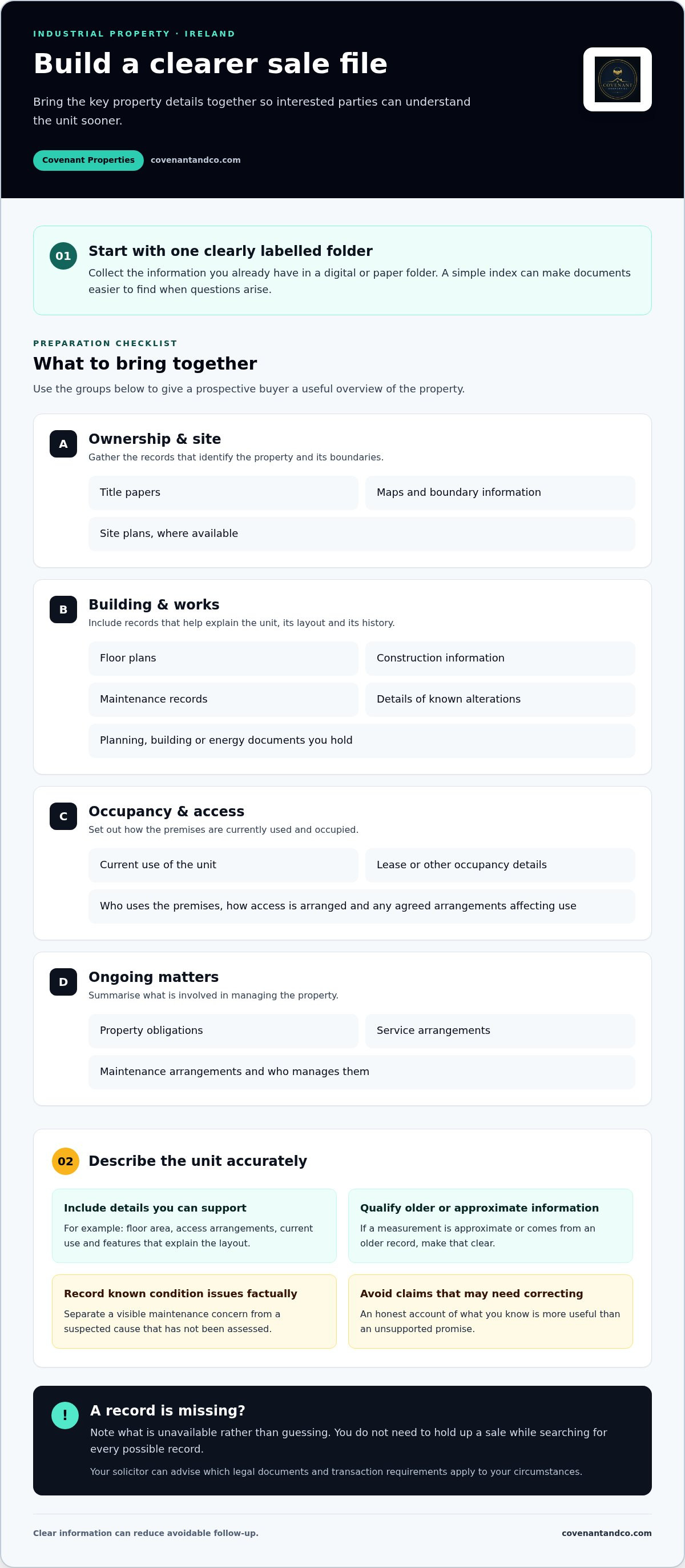
Gather the information you already have in one clearly labelled folder, either digital or paper. A simple index can help you find documents quickly when questions arise. You do not need to hold up a sale while searching for every possible record. Make a note of anything missing, rather than guessing or implying that a document is available.
Gather property and occupancy information
Start with ownership and title documents, site or boundary plans, floor plans and building information. Add records of alterations, maintenance and other work carried out, along with any planning, building or energy documents you hold. If the unit is occupied, include the lease or other occupancy details. Note who uses the premises, how access is arranged and whether any agreed arrangements affect use of the property.
Summarise ongoing property obligations and who manages them. Your solicitor can advise which legal documents and transaction requirements apply to your circumstances. Accurate, organised records can reduce avoidable follow-up and help interested parties understand the property sooner.
- Ownership and site: title papers, maps, boundary information and site plans, where available.
- Building: floor plans, construction or maintenance records and details of known alterations.
- Occupancy: current use, lease or occupancy arrangements, and any agreed access conditions.
- Ongoing matters: a clear summary of property obligations and relevant service or maintenance arrangements.
Present the unit clearly without overpromising
Describe the unit using details you can support, such as its floor area, access arrangements, current use and features that help explain its layout. If a measurement is approximate or comes from an older record, say so. Accurate, qualified information is more useful than a claim that may need correcting later.
Record known condition issues in factual language. Distinguish a visible maintenance concern from a suspected cause that has not been assessed. Your summary should give an honest picture of what you know, rather than suggesting that every issue must be repaired before you discuss a sale.
If you prepare sale materials, use clear photographs of the unit, its access points and relevant features, with a concise written description. Make sure the images and description reflect the current condition. For wider context, the Society of Chartered Surveyors Ireland’s Irish Commercial Property Market Trends 2026 report can help frame market discussions, but it does not replace accurate details about your own property.
Once your basic information is in order, you can explain the asset to prospective buyers, whether you are considering public marketing or a direct purchase. To explore the latter, share the unit’s details through a direct commercial property sale discussion.
Compare open-market and direct-sale routes for an industrial unit
Public marketing can present the unit to a broad pool of prospective buyers. A direct purchase is an alternative to public listings, in which a prospective buyer assesses the property for a potential purchase. Both routes require clear information about the unit and the work needed to progress a transaction.
If your priority is to sell an industrial unit quickly in Ireland, do not assume one route will always be faster. The right fit depends on the property, your circumstances and what you value, whether that is market exposure, a more private approach or the level of involvement you are comfortable with.
| Consideration | Open-market sale | Direct purchase |
|---|---|---|
| Exposure | Public marketing presents the unit to prospective buyers. | Less reliant on public listings; discussions are with a prospective direct buyer. |
| Process | May involve marketing, enquiries, viewings and offer discussions. | Centres on the buyer assessing the property for a potential purchase. |
| Owner involvement | You may need to coordinate access, respond to enquiries and consider offers. | You provide property information and engage in discussions about a potential sale. |
| Best suited to | Owners who want to seek interest through broad public exposure. | Owners who want to consider an alternative to public marketing. |
When might an open-market sale suit the owner?
Public marketing may suit you if reaching a broad range of prospective buyers is important. Listings give interested parties a way to find the unit and express interest, although neither the level of interest nor the final outcome can be assumed. Be prepared to coordinate access, manage enquiries and consider offers. The level of involvement depends on how the sale is arranged.
When might a direct purchase be worth considering?
A direct buyer assesses the unit and its details when considering a potential purchase. This route may suit you if you want to explore a sale without relying on public listings. It still involves discussion and transaction steps, and it does not guarantee a particular timetable or outcome. For more detail, see Sell Commercial Property Ireland: The 2026 Direct Sale Buying Guide.
Compare the routes against your priorities, not speed alone. Public marketing may suit a seller seeking broad exposure; another owner may prefer focused discussions about a direct acquisition. Consider the unit’s circumstances and the involvement each process may require. You can then weigh the trade-offs without treating either route as a guaranteed shortcut.
Follow these steps to move an industrial-unit sale forward
A practical sequence helps turn your preferred route into clear next actions. If you want to sell an industrial unit quickly in Ireland, focus on decisions you can control while allowing time for the checks and professional advice the sale requires.
- Define your priorities. Rank timing, discretion, market exposure and certainty. Note what is driving the sale, such as a business move, surplus space or an investment decision. Consider whether occupancy affects access or timing. Use these priorities to compare routes, rather than settling on a price before assessing the property and your options.
- Organise the sale conversation. Prepare a concise overview of the unit, its current use and occupancy, alongside the information you have gathered. Decide who will handle enquiries and how updates will be shared. A clear overview gives a prospective buyer a useful starting point and helps your solicitor and other relevant advisers understand the circumstances.
- Choose the route that fits. Decide whether public marketing and broad exposure match your priorities, or whether you want to explore a direct purchase. Consider practical requirements such as access, viewings and discussions. Compare these trade-offs before committing to an approach; the option that feels quickest is not automatically the best fit.
- Progress due diligence. As discussions advance, respond to reasonable requests for information and keep track of questions that need clarification. Your solicitor can guide legal review and conveyancing matters, while other relevant advisers can provide professional guidance within their areas. An early expression of interest does not mean the transaction is complete, so keep decisions and next actions clear.
Decide what matters most before approaching a buyer
Write your priorities in order, then consider them against the unit’s use and occupancy. For example, a tenant or ongoing operations may affect access and preferred timing. Be realistic about what you can control and what needs discussion. This helps you assess a potential route without treating speed as the only measure of a suitable sale.
Keep communication and next actions organised
Use one log to track questions, requested information, decisions and agreed next actions. Note who is responsible for each item and when you will follow up. This helps prevent details getting lost across emails and calls. Your solicitor should guide legal review and conveyancing. For a broader overview of practical preparation, The Fast-Track Property Sale Checklist: How to Sell Property Fast in Ireland (2026) offers related guidance.
Considering a direct route? Discuss a direct sale with Covenant Properties and share the key details of your industrial unit to start a conversation about a potential purchase.
Explore a direct cash purchase for your industrial unit with Covenant Properties
A direct cash purchase is another route to consider alongside public marketing. The process starts with a discussion about the property, not a promise of a particular price, timetable or outcome.
If “Sell industrial unit quickly Ireland” describes what you hope to do, focus on the next steps you can take. Share the unit’s location, current use and occupancy, along with your priorities. Covenant Properties can discuss the asset with you and consider it for a potential direct purchase. You can then weigh that possibility against your circumstances and other sale routes.
What to expect when discussing a direct sale
Keep the first conversation practical. Outline the unit and any occupancy or lease arrangements that may affect the sale, then explain what matters most to you, such as discretion, timing or avoiding public listings. Share the information you have and note any details you are still gathering. This gives the discussion useful context without requiring you to decide on a route in advance.
Covenant Properties considers commercial assets, including industrial units, for direct purchase. If the property may be a fit, the discussion can focus on its circumstances and whether a potential purchase makes sense for both sides. Any transaction still needs to progress through relevant checks and legal steps. Timing depends on the property and the process involved, so an initial conversation is not a completion estimate.
Choose the next step that fits your circumstances
Before moving forward, compare a direct purchase with the alternative you have considered. Ask yourself whether public exposure matters, how occupancy affects your plans and what you need from the sale beyond speed. A direct route may suit you if you prefer an alternative to public listings, but the right decision depends on your goals and the unit itself.
Keep your solicitor involved in legal and conveyancing matters. They can guide you through relevant documents and transaction steps, while you decide whether the proposed route and terms suit your situation. Take time to understand what is being discussed and raise any points you want clarified. The aim is to make a considered decision, not to rush into one.
To begin, share the basic details, explain your priorities and discuss whether a direct purchase could be relevant. You do not need to have every answer before you start. Start a conversation about your industrial unit.
Take a clear next step towards your sale
You can make progress without rushing your sale decision. Use your priorities to guide the next conversation and consider whether a direct route fits the outcome you want. If your goal is to sell an industrial unit quickly in Ireland, a focused discussion can turn a broad intention into a practical next step.
Covenant Properties considers commercial property, including industrial units, for direct purchase across Ireland. Outline the property and your circumstances, then decide whether to explore the possibility further. An initial conversation does not commit you to selling. Keep your solicitor involved as legal and conveyancing matters develop, and take the time you need to understand your options.
When you’re ready, Discuss selling your industrial unit directly with Covenant Properties. Share the key details and your priorities to start a conversation about a potential purchase.
Frequently Asked Questions
How can I sell an industrial unit quickly in Ireland?
To sell an industrial unit quickly in Ireland, reduce avoidable delays by setting out who can make decisions for the owner, especially if the property is company-owned. Agree how offers and requests for information will be handled, organise the property details you already have and respond clearly to questions. Compare public marketing with a direct purchase against your priorities. A solicitor can guide the legal process for your circumstances.
Can I sell an industrial unit directly for cash in Ireland?
Yes. Covenant Properties directly purchases commercial property, including industrial assets, for cash across Ireland. A direct sale starts with sharing details about the unit and discussing whether it may suit a potential purchase. It is an alternative to public marketing, not a guaranteed offer or completion date. Consider any proposed terms against your priorities and take advice from your solicitor before proceeding.
Is a direct sale faster than selling an industrial unit on the open market?
Not necessarily. A direct route does not rely on public listings to find a buyer, but the property still needs to be assessed and the transaction progressed. An open-market sale may involve waiting for enquiries and coordinating viewings, while a direct discussion involves different steps. Timing depends on the unit, the parties’ decisions and the legal work involved, so compare the processes rather than assuming one is always faster.
What documents should I prepare to sell an industrial unit?
Gather records that help establish who owns the property and how it is used. Depending on the circumstances, these may include title information, company ownership details, plans, building records and any lease or occupancy agreement. Keep copies together and note gaps rather than filling them with assumptions. Your solicitor can identify which documents are relevant to the transaction and advise on next steps.
Can I sell an industrial unit that is occupied by a tenant?
An occupied unit may still be considered for sale, but the lease and practical arrangements can affect how the transaction proceeds. Be ready to explain who occupies the premises, the broad terms of the arrangement and how access is managed. A sale does not automatically end an occupancy agreement. Ask your solicitor to review the lease and advise on the implications for the proposed sale and any communication with the tenant.
Do I need to repair an industrial unit before selling it?
Not in every case. Whether to carry out work depends on the unit’s condition, the nature of any issue and the route you choose. Make a factual note of known defects, maintenance concerns or areas that have not been assessed. Then weigh the likely benefit of addressing an issue against the time and disruption involved. Avoid describing suspected problems as confirmed findings; your solicitor or relevant adviser can guide transaction-related questions.
What can delay the sale of an industrial unit in Ireland?
Delays can arise if ownership or occupancy details are unclear, information about the property conflicts or key decisions take time. Questions about access, boundaries, alterations or lease terms may also need further investigation. Slow replies between the parties can add friction. Keep track of outstanding questions and involve your solicitor early so legal or conveyancing issues can be addressed through the proper process.


