

The highest asking price isn’t always the clearest route to a sale. A Commercial investment property sale Ireland involves more than choosing a figure: buyers will look at rental income, lease terms, occupancy and the condition of the asset. Together, these details shape its appeal and help explain what a sale may involve.
If you’re weighing up an open-market listing, concerned about unwanted attention or unsure how to compare an asking price with a direct offer, those questions are understandable. The right approach depends on the property, your priorities and the information available, not simply on the headline figure.
This guide explains how rent, lease commitments and property records can affect an income-producing asset’s appeal. It also compares an open-market sale with a direct acquisition, including the trade-offs around exposure, buyer discovery and process. Covenant Properties directly purchases commercial properties across Ireland, including office, retail and industrial assets. You’ll find practical steps for organising property information and assessing which sale route may suit your circumstances.
Key Takeaways
- A commercial investment property’s appeal depends on how rental income, occupancy, lease terms and condition fit together.
- For a Commercial investment property sale Ireland, separate documented income from projections and informal estimates.
- Compare an open-market listing with a direct acquisition by considering exposure, buyer discovery, negotiation and control of the process.
- Organise your priorities, property records and asset details, and clearly flag estimates or missing information.
- Covenant Properties directly acquires office, retail and industrial properties across Ireland as an alternative sale route.
Commercial investment property sale in Ireland: what owners are deciding
A commercial investment property is held to generate rental income, increase in investment value, or both. It might be a let office, a retail unit occupied by a tenant or an industrial building producing rent under a lease. A potential buyer will consider more than the building itself: its use, income position and prospects all contribute to how the asset is assessed.
This guide is for owners considering a sale, rather than buyers searching advertised listings. A Commercial investment property sale Ireland involves deciding how to bring the asset to a potential buyer. You might seek market exposure and possible competition through an open-market listing, or explore a direct acquisition. The routes differ in visibility, negotiation and how the process is managed.
No single route suits every property or owner. A tenanted asset with established income may attract different interest from vacant premises, while a specialist building may call for a more focused approach. Consider the property’s circumstances alongside your priorities and the terms you would be prepared to accept. The aim is to understand the trade-offs, not simply choose the route that sounds quickest or most familiar.
Which commercial assets can be investment properties?
Offices, retail premises and industrial buildings can all be held as investments, but the potential buyer pool and suitable sale route can vary by asset. A property producing rent under a lease differs from vacant premises with no current rental income. Owner-occupied business space is different again: it serves the owner’s operations rather than necessarily producing rent. For a broad view of property types, see Commercial buildings in the Republic of Ireland.
What does a seller need from the transaction?
Start by identifying what matters most: certainty, privacy, timing or broad market exposure. These priorities can pull in different directions. An owner who wants to limit public attention may favour a more private discussion, whilst another may value inviting interest from a wider field. Neither preference is automatically right for every asset.
The decision may also involve several people. Individual owners, co-owners and investment businesses can have different objectives, decision-making processes and views on acceptable terms. Set out what needs to be agreed before choosing a sale route. Then assess the asset: what income can you evidence, what do the lease and property records show, and what still needs clarification?
How leases, income and property records shape an investment sale
In a Commercial investment property sale Ireland, a buyer may assess rent, occupancy, lease terms and building condition as parts of the same picture. Rental income matters, but it doesn’t tell the whole story. Clear, organised records make an asset easier to understand than figures based on assumptions or paperwork scattered across different files.
An investment property’s income profile is the documented pattern of rent received, occupancy and lease commitments, viewed alongside costs and condition that affect the asset. Keep established facts separate from forecasts. For example, record rent actually received separately from a hoped-for rent increase, which should be labelled as a projection rather than current income. This makes the information clearer without suggesting that future income is assured.
How occupancy and lease terms affect buyer assessment
An occupied property may offer an existing rental stream, whilst a vacant one may give a buyer scope to consider a different use or letting plan. Neither position is automatically stronger. Organise information on occupancy, lease duration, rent review provisions and tenant responsibilities so the circumstances are clear. If you’re unsure how a lease clause affects a proposed sale, seek advice from an appropriate Irish property professional or solicitor.
Which financial and property records help explain the asset?
There isn’t one document list that fits every commercial property. Gather what’s relevant and available, and make any gaps clear. A concise file might include:
- A rent schedule showing tenants, rent due and lease dates, alongside payment records that distinguish amounts received from amounts outstanding.
- A clear account of operating expenses, with supporting records where available. Keep recurring costs separate from one-off repairs or estimates.
- Available information on title, planning and the property’s physical condition, such as maintenance history or reports already held.
- Notes identifying projections, informal estimates and missing records, rather than presenting them as verified facts.
Organising these records before a sale discussion helps show what is known and what may need further explanation. Requirements can depend on the property and circumstances, so this practical list is not a statement of mandatory Irish sale documents. For broader context on data and methods relating to the sector, the Central Statistics Office Ireland’s commercial property research provides a useful reference.
If you’re considering a direct acquisition, sharing the records you have can help frame a project-specific discussion with Covenant Properties’ commercial property team. Clear information supports a considered conversation, without requiring you to present estimates as settled facts.
Direct acquisition or open-market listing: compare the sale routes
A Commercial investment property sale Ireland can follow different routes, each with its own balance of visibility, buyer discovery and negotiation. An open-market listing makes the property publicly available to potential buyers. A direct acquisition discussion is with a buyer and doesn’t rely on public marketing. Neither route guarantees a particular price, level of interest or completion date. The right fit depends on the asset, your priorities and the terms agreed.
The comparison below describes general differences, not guaranteed outcomes. The practical process and terms depend on the property and the parties involved.
| Consideration | Open-market listing | Direct acquisition discussion |
|---|---|---|
| Exposure | Public marketing can make the property visible to a broad pool of potential buyers. | Can reduce reliance on public marketing, subject to the approach and terms agreed. |
| Buyer discovery | Interested parties may find the property through its listing and marketing. | The discussion is directly with a potential buyer. |
| Negotiation | Offers and discussions depend on the interest received and individual circumstances. | Terms are discussed directly and remain subject to agreement. |
| Process | The owner considers how to present the property publicly and handle interest. | The owner shares information for a project-specific discussion. |
When might an open-market sale suit an owner?
Public marketing may suit an owner who wants the property exposed to a broad pool of potential buyers and is comfortable with it being publicly visible. Greater visibility does not ensure more offers or a particular sale price. Interest, negotiation and completion depend on factors such as the asset, the parties and the terms they can agree. Consider how you want to present the property and how much public exposure you’re comfortable with before choosing this route.
When might a direct property acquisition suit an owner?
A direct sale may appeal if you’d prefer to discuss the asset with a buyer rather than rely on a public listing. Covenant Properties directly purchases commercial property for cash across Ireland, including office, retail and industrial assets. This is one possible route, not a universal best choice. Compare any proposed terms with your priorities for privacy, timing and certainty. The commercial property sale guide offers further context on a direct sale.
Market reports can help frame the wider context, but they can’t determine the right route for one particular asset. The Society of Chartered Surveyors Ireland Commercial Property Market Monitor provides broader insight into commercial property conditions. Consider that context alongside the property’s own facts and your preferred terms.
If a direct acquisition is one route you’re considering, you can share your commercial property details with Covenant Properties for a project-specific discussion. Set out what you know and what matters most, then assess the proposed terms against the alternatives.
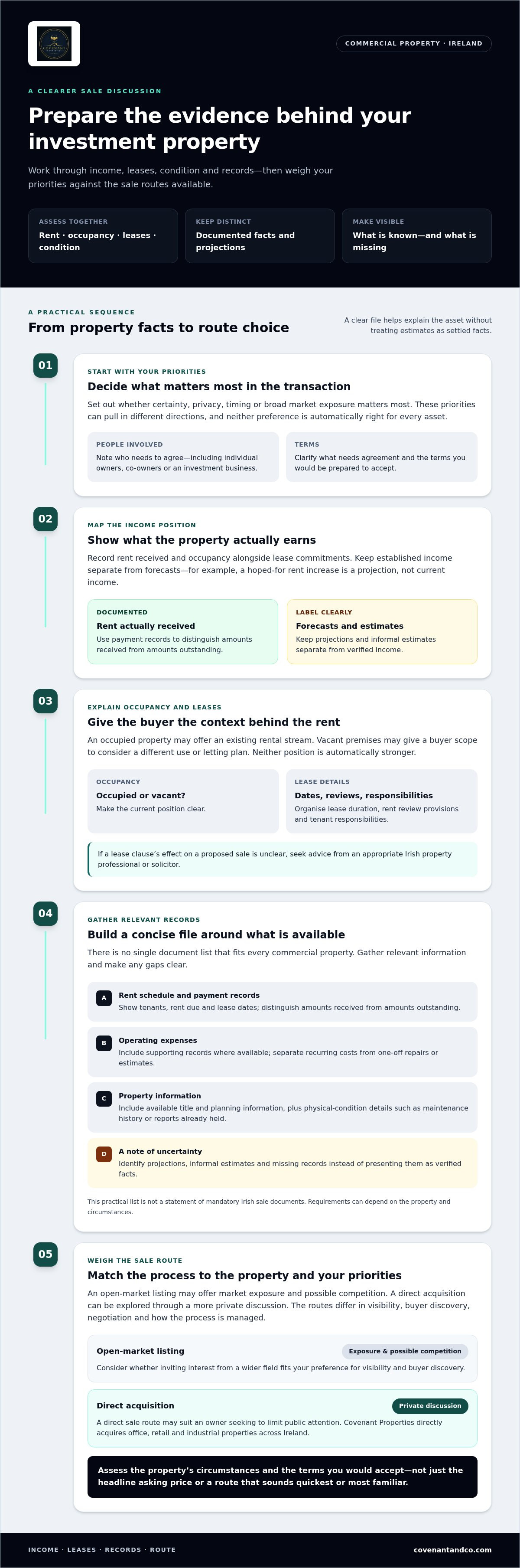
Prepare your commercial investment property for a clear sale discussion
Organising your information can make an initial sale discussion more useful. You don’t need to resolve every open question before starting, but separate what you know from what you’re estimating or still need to establish. This gives a potential buyer a clearer picture and helps you compare sale routes using consistent information.
Work through these steps in order:
- Define your priorities. Decide what matters most, such as privacy, market exposure, timing or the terms you would consider. Note who needs to be involved in the decision.
- Assemble available records. Gather relevant lease, income and property information, and keep original records together where practical.
- Describe the asset clearly. Summarise its type, occupancy, income history and known condition. Don’t present an estimate or forecast as an established fact.
- Compare sale routes. Consider how an open-market listing and a direct acquisition discussion fit your priorities, then assess any proposed terms in that context.
A broader preparation framework is available in this fast-track property sale checklist. The points below focus on preparing a commercial investment asset for a considered discussion.
Build a useful property and income summary
Keep the summary factual and easy to scan. Record whether the asset is an office, retail or industrial property, whether it’s occupied, and what lease information you have. Include available income history and identify which figures are documented. Add a short note on known maintenance issues and records relating to the property’s condition. If information is incomplete, say so plainly rather than filling the gaps with assumptions.
For example, distinguish rent received from rent due, and label a possible future increase as an estimate or projection. This helps anyone reviewing the summary tell current evidence apart from expectations. The aim isn’t to create a formal valuation. It’s to present a coherent starting point for a buyer to understand the asset and raise relevant questions.
Identify legal, tax and planning questions for professional review
Some questions need advice based on the property and the owner’s circumstances. Make a separate note of uncertainties around title, planning, tax treatment or lease interpretation, and discuss them with your solicitor or tax adviser. A general checklist is not a statement of Irish legal requirements. Professional advice can help clarify which issues apply to your transaction and what further information may be needed.
For a Commercial investment property sale Ireland, a clear summary won’t answer every due-diligence question, but it can keep the first conversation grounded in known facts. Share your commercial property information with Covenant Properties to begin a project-specific direct acquisition discussion.
Explore a direct sale with Covenant Properties
A direct acquisition is one option for owners considering a commercial property sale in Ireland. Covenant Properties directly purchases commercial properties for cash across Ireland, including office, retail and industrial assets. Rather than placing the property on public listings, an owner can share information for a considered, project-specific discussion with a potential buyer.
This route may suit owners who prefer to explore a sale without relying on public marketing. It won’t be right for every property or set of circumstances. The discussion focuses on understanding the asset, the owner’s objectives and any proposed terms, which can then be compared with other routes before a decision is made.
What information helps start a direct sale conversation?
You don’t need a polished sales pack to begin. A straightforward outline provides useful context and helps focus the discussion. Share what you know, distinguishing documented facts from estimates or details that still need clarification.
- Property type: Say whether the asset is an office, retail property or industrial building, and describe its current use.
- Occupancy: Explain whether it’s occupied or vacant, and summarise relevant lease details if available.
- Income and records: Include a broad account of rental income and any lease, payment or property records you hold. Make clear whether figures are verified or estimated.
- Your objectives: Outline what matters to you, such as limiting public exposure, understanding the process or considering particular sale terms.
Identify gaps rather than hide them. If a record is missing or a figure is an estimate, say so. That gives the conversation a clear starting point without presenting incomplete information as settled fact.
Choose a next step that fits your circumstances
Open-market marketing can make a property publicly visible to potential buyers. A direct acquisition discussion offers a different route, centred on sharing the asset’s details with a potential buyer rather than relying on public listings. Either way, the outcome depends on the property and the terms agreed. Consider how each route aligns with your priorities before deciding.
For a Commercial investment property sale Ireland, compare any direct proposal with the objectives you set at the outset. Consider the terms as a whole, including the process involved, and discuss legal or tax questions with your professional advisers. You don’t need to decide before understanding the options. A clear conversation can help you assess whether a direct purchase is worth considering for your asset.
Discuss your commercial property sale
Take the next step with a clear plan
A sale decision doesn’t have to begin with every detail settled. Start by identifying what would help you move forward: a clearer view of your options, a private discussion or a better understanding of the terms on offer. This gives the next conversation a useful focus, even if some records or questions still need attention.
For a Commercial investment property sale Ireland, Covenant Properties offers direct cash acquisition across Ireland, including office, retail and industrial property. A direct discussion lets you explore how this route may fit your circumstances. Share the property information you have and outline what matters to you. An initial conversation doesn’t commit you to proceeding.
Take the time you need to weigh any proposed terms against your priorities. A considered next step can bring greater clarity, whether you choose a direct acquisition or another sale route.
Discuss your commercial property sale
Frequently Asked Questions
Can I sell a commercial investment property in Ireland with tenants in place?
Yes, an occupied commercial property can be considered for sale. Make clear which areas are let, whether any space is vacant and what lease information is available. For example, if a tenant occupies only part of a building, explain that rather than describing the whole asset as fully let. Your solicitor can advise on how the specific lease affects the sale and any steps you may need to consider.
Is a direct cash sale the same as a guaranteed sale?
No. A direct cash sale means discussing a potential purchase with a buyer, not a promise that the transaction will complete. The property, due diligence and agreed terms all matter. If you receive a proposal, ask for its terms in writing and read them carefully before deciding. Your solicitor can help you understand contractual implications, and you can compare the proposal with your priorities before proceeding.
How much is my commercial investment property worth in Ireland?
There isn’t one figure that applies to every property. Value can depend on the asset’s condition, location, occupancy, income and lease arrangements, as well as other property-specific factors. For a Commercial investment property sale Ireland, treat online asking prices as advertised comparisons, not evidence of completed transactions. If you need an informed valuation for your circumstances, consider obtaining advice from an appropriately qualified property valuer.
What happens if a buyer raises issues during due diligence?
The parties may need to clarify a point, provide further records or discuss whether it affects the proposed terms. An issue doesn’t automatically mean the sale has failed. For example, a discrepancy between a rent schedule and payment records may prompt a request for clarification. Respond accurately, keep a record of information shared and refer legal or contractual questions to your solicitor before agreeing to changes.
Do I need to advertise my commercial investment property publicly to sell it?
No. Owners can consider public marketing or a direct discussion with a potential buyer. Public advertising may increase visibility, while a direct discussion doesn’t rely on a public listing. Neither route guarantees a particular outcome. Before choosing, consider who needs to know about the sale, how much exposure you’re comfortable with and how the proposed process and terms fit your circumstances.
Should I speak to a tax adviser before selling an investment property?
It can be sensible to seek tax advice before committing to a sale. The tax position may depend on the owner, how the property is held and the details of the transaction, so general information can’t determine your individual liability. A qualified Irish tax adviser can explain the relevant considerations. Your solicitor can separately advise on the legal documents and sale process.
Can a commercial investment property be sold if it is vacant?
Yes, a vacant commercial property can still be considered for sale. Be precise about when it became vacant, its previous use and any known maintenance issues. Information such as existing condition reports or records of past works may help explain the asset, if available. Don’t assume that vacancy alone determines its appeal. Property-specific planning, compliance or legal questions should be discussed with the appropriate professional.


