

If you’re searching “Sell retail unit for cash Ireland”, you may be looking for an alternative to listing on the open market, arranging viewings and handling buyer enquiries. A direct cash sale gives you another route to consider. Whether it suits you depends on the unit, your priorities and the terms proposed.
A cash buyer doesn’t need mortgage finance to fund the purchase, but that doesn’t make a sale automatic. The parties still need to agree terms and complete the relevant legal work. This matters particularly if the unit is tenanted, needs work or has title details that require clarification.
This guide explains what to expect, from sharing initial property details through to legal completion. It covers the unit, lease, condition and ownership information that can help a buyer assess the property, along with practical points to weigh before accepting an offer. Covenant Properties directly purchases retail and other commercial property across Ireland, offering owners an alternative to a public listing.
Key Takeaways
- Consider whether a direct sale fits your priorities around public exposure, buyer enquiries and your involvement in negotiations.
- A cash-sale discussion is a starting point, not instant payment or automatic completion. The next steps depend on the property and agreed terms.
- An open-market listing can reach a broader audience, but involves marketing and responding to enquiries.
- Gather practical information about ownership, title, condition, occupancy and available floor-area details before discussing the unit.
- Use this guide to decide whether “Sell retail unit for cash Ireland” fits your needs, then explore a direct purchase with Covenant Properties.
Is selling a retail unit for cash in Ireland right for you?
Selling a retail unit can be connected to a business decision, an investment plan or a need to release the asset. Before choosing a route, decide what matters most: reaching a wider pool of buyers, limiting public marketing, reducing your involvement in enquiries or discussing terms directly with a buyer. A cash offer is one option to assess, not an automatic shortcut.
A direct sale can reduce reliance on public marketing and open-market viewings. In exchange, you discuss the asset with a specific buyer rather than testing demand among a wider audience. Neither route suits every owner. Your priorities, the unit’s circumstances and the terms you are prepared to accept all matter.
What does a cash sale of a retail unit mean?
A cash buyer is a buyer who doesn’t need mortgage finance to fund the purchase. That removes a financing dependency, but not the legal work involved in transferring ownership. The parties still need to agree terms and progress the appropriate checks before a sale can complete.
An offer is a proposal to consider, not a completed transaction. Its terms may depend on due diligence, where relevant information about the property and ownership is reviewed. Occupancy, condition and title details can all be part of the assessment. If something needs clarification, it may affect the discussions or how the sale progresses.
A cash offer is a proposed purchase price, not a promise of immediate cleared funds. Payment is made as part of completion under the agreed transaction arrangements. Keep this distinction in mind if you are weighing an offer against a business deadline or another planned sale.
When might a direct sale suit a retail-unit owner?
A direct route may appeal if you want to discuss a sale with a buyer without first preparing a public listing or managing open-market enquiries. It may suit you if you value a direct conversation, want to limit public exposure or are considering a sale alongside other business or investment decisions. These are factors to weigh, not guarantees about the outcome or pace.
An owner who wants to test wider demand may prefer an open-market listing. Public marketing can put the unit in front of a broader pool of potential buyers, but it also involves marketing and responding to enquiries. A direct discussion may involve fewer public-facing steps, but that alone does not establish whether the proposed terms are right for you.
Before deciding how to Sell retail unit for cash Ireland, compare what matters most: wider market exposure, a direct buyer conversation, the level of involvement you are comfortable with and the terms you would need to proceed. Then consider the property. A vacant unit and one with an existing tenancy present different circumstances for a buyer to assess. The same is true of a unit that needs work or has ownership information requiring clarification.
There is no single best route for every owner. A direct purchase offers an alternative to the open market, while a listing may suit someone focused on broader market testing. Choose the route that fits your circumstances and gives you enough clarity to assess the proposed terms before proceeding.
How a cash sale of an Irish retail unit moves from enquiry to completion
A direct sale involves discussions and checks, not simply an offer followed by instant payment. For owners searching “Sell retail unit for cash Ireland”, understanding the stages can make it easier to prepare. A vacant shop, a tenanted unit and a property with title questions may each require different information.
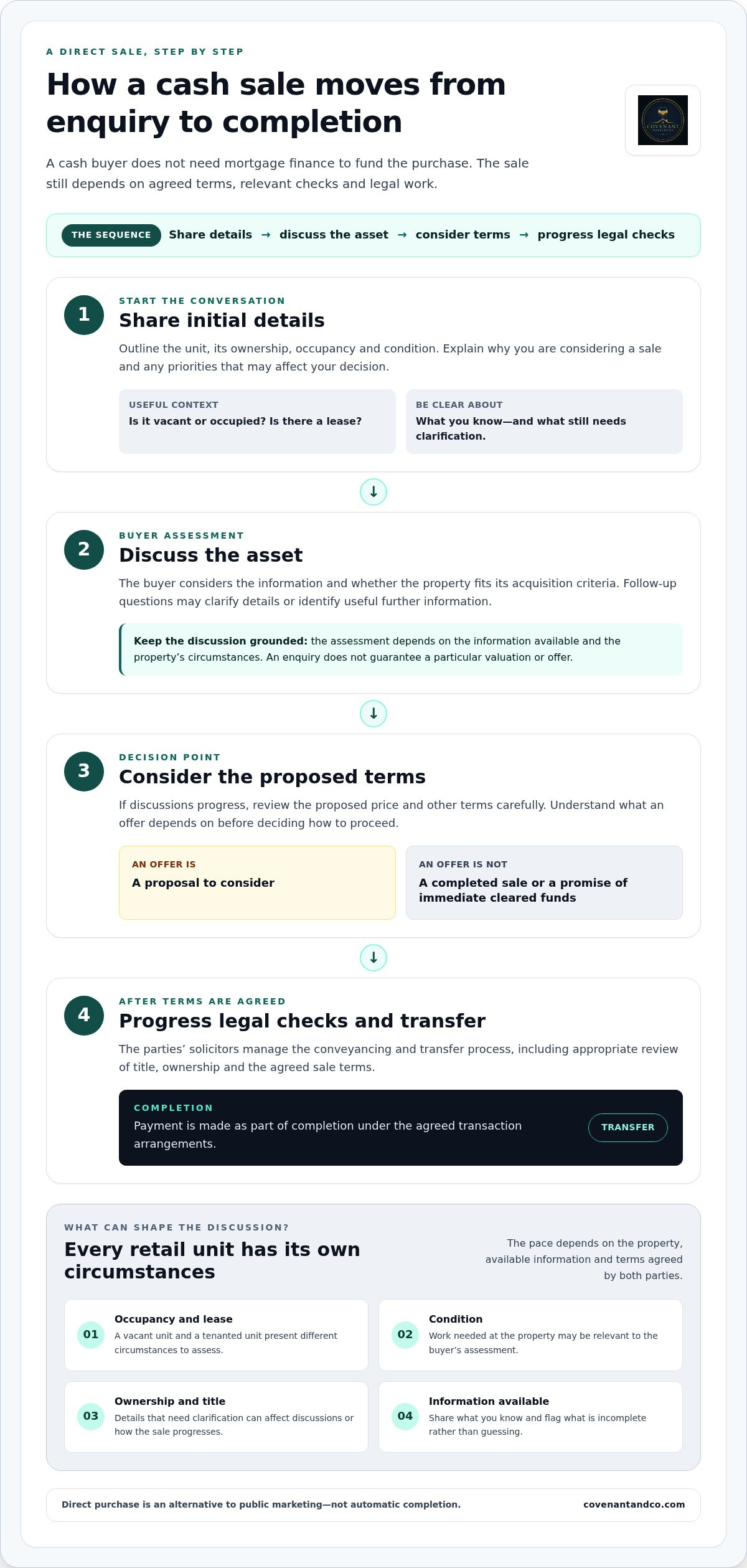
The broad sequence is straightforward, although the pace depends on the property, the information available and the terms both parties agree:
- Share initial details. Outline the unit, its ownership, occupancy and condition. Explain why you are considering a sale and any priorities that may affect your decision.
- Discuss the asset. The buyer considers the information and whether the property fits its acquisition criteria. Follow-up questions can clarify details or identify what further information would be useful.
- Consider proposed terms. If discussions progress, review the proposed price and other terms carefully. An offer is not a completed sale, so understand what it depends on before deciding how to proceed.
- Progress legal checks. Once terms are agreed, the parties’ solicitors manage the conveyancing and transfer process, including appropriate review of title, ownership and the agreed sale terms.
What happens after you share the retail-unit details?
The first conversation gives the buyer a clearer picture of the property. Useful context includes whether the unit is occupied, whether a lease is in place, its general condition and who owns it. Your reason for selling can also help frame the discussion, without obliging you to proceed. The buyer can then assess whether the asset fits its acquisition criteria. The assessment depends on the information and circumstances, so don’t assume that an enquiry will result in a particular valuation or offer.
If information is incomplete, say so rather than guessing. Being clear about what you know and what still needs clarification gives the discussion a sounder footing. Keep relevant property information together so you can refer to it when questions arise. The specific documents needed can become clearer as discussions develop.
What happens between an agreed offer and completion?
An agreed offer is progress, but it does not transfer ownership. Solicitors manage the legal conveyancing, review title and ownership information, and work through the agreed sale terms. Any relevant due diligence still needs to be addressed. The process and timing can vary with the property’s circumstances and the information available, so don’t treat an initial offer or verbal agreement as completed payment.
Cash funding can remove a mortgage-finance dependency, but it doesn’t remove legal due diligence. Keep that distinction in mind when considering the process. Covenant Properties purchases commercial property, including retail units, across Ireland. You can explore a direct commercial property purchase as an alternative to public marketing.
Cash buyer or open-market listing: compare the routes before deciding
Choosing between a direct buyer and a public listing comes down to what matters for your unit. An open-market listing can reach a broader audience, but involves marketing and buyer enquiries. A direct purchase gives you a defined buyer discussion, but does not guarantee a particular price or completion date.
Compare the practical differences with your own priorities in mind:
| Consideration | Direct cash purchase | Open-market listing |
|---|---|---|
| Public exposure | A buyer-led discussion can reduce reliance on public marketing. | The unit is marketed publicly to attract interest. |
| Buyer pool | You discuss the asset with a specific prospective buyer. | Marketing may reach a broader audience, though interest isn’t assured. |
| Negotiation path | Terms are discussed directly with the buyer. | Enquiries and offers may come from multiple interested parties. |
| Seller involvement | Involvement centres on the buyer discussion and property information. | You may need to engage with marketing and buyer enquiries. |
| Certainty | A direct discussion can clarify a buyer’s position, but price and timing aren’t guaranteed. | Market interest is tested, but the level of demand and eventual terms are uncertain. |
What can influence the offer for a retail unit?
A buyer’s assessment can reflect the property’s features and the information available. Size, layout and condition help describe the asset. Occupancy matters too: a vacant unit and one subject to a lease present different circumstances. Available lease information, including the agreed terms, can help explain the current position to a prospective buyer.
Permitted use, title details and relevant property records may also inform an assessment. These factors do not create a universal formula. They help build a clearer picture of the unit and its circumstances. Keep information accurate and flag anything that needs clarification to make the discussion more grounded.
Which route fits your priorities?
If you value a private, buyer-led discussion and an alternative to public marketing, a direct route may be worth exploring. It gives you a defined conversation about the asset and proposed terms, not a promise of a particular price or sale date.
If your priority is broad exposure and the chance to test market demand, an open-market listing may be a better match. Wider reach comes with the work of marketing the unit and responding to enquiries. Consider how much involvement you are comfortable with, alongside the importance of exposure and the terms you would need to accept.
Before deciding how to Sell retail unit for cash Ireland, weigh the route against the property details and your priorities, rather than relying on claims that speed or outcome is certain. If a one-to-one discussion feels like a suitable next step, you can discuss a direct retail-unit sale with Covenant Properties.
Prepare your retail unit details to make a cash-sale discussion clearer
A clear first picture helps a buyer understand the unit and what may need further discussion. You do not need to assemble every legal document before making an enquiry. Start with accurate information you already have, and distinguish it from formal records a solicitor may request later. This keeps the early conversation practical and avoids presenting assumptions as confirmed facts.
If you’re considering how to Sell retail unit for cash Ireland, organise the details below before discussing the property. Note where information is incomplete or out of date instead of filling gaps with estimates.
Retail-unit and occupancy information to organise
Begin with the unit’s current use and occupancy. State whether it is vacant, owner-occupied or let, and describe its layout, access and general condition in plain terms. For example, note a known maintenance issue without guessing what repairs may cost. If you have floor-area information, include its source or identify it as an available figure rather than a newly measured total.
- Occupancy: Record who occupies the unit and whether a tenancy is in place.
- Lease particulars: Gather available lease documents and note relevant terms, rent and review information as shown in the records.
- Physical details: Describe the layout, access, condition and any known maintenance issues.
- Floor area: Share available figures and supporting information, if you have them.
Keep descriptions factual. If lease or condition details need checking, say so. Separating confirmed facts from points still to establish helps a buyer ask useful follow-up questions.
Ownership and property records to gather
Collect the ownership and property identification information you can readily access. Note any known mortgage, charge or co-owner, since these may affect how a sale progresses. An initial discussion helps identify what information is available; it is not a substitute for a solicitor’s review or a complete legal investigation.
- Starting information: The property address, a description of the unit, available floor-area details and your understanding of ownership.
- Records for discussion: Available title or ownership papers, property plans or other records that identify the asset.
- Points to flag: Known charges, co-owners, lease arrangements, gaps in records or details that may need clarification.
A solicitor may later request formal documents and further information as part of conveyancing. What is needed depends on the property and transaction, so use this checklist to prepare for a conversation, not as a definitive document list.
With the retail-unit facts organised, you can have a more focused discussion with Covenant Properties, which directly purchases commercial property, including retail assets, across Ireland. Discuss a direct retail-unit sale when you’re ready to explore that route.
Explore a direct cash sale for your retail unit with Covenant Properties
If you’ve weighed a direct purchase against public marketing and gathered the key details, you can start with a straightforward discussion. Covenant Properties directly purchases commercial property, including retail units, across Ireland. This gives owners an alternative to listing publicly and handling enquiries from a wider pool of potential buyers.
Searching “Sell retail unit for cash Ireland” may bring up promises of speed or certainty. A more useful starting point is whether a direct buyer discussion fits your circumstances. The asset, information available and proposed terms all shape what happens next. Don’t assume a particular offer, sale outcome or completion date before those details are considered.
What to expect from a discussion with Covenant Properties
Begin by sharing basic information about the unit and the context for a possible sale. Explain whether it is vacant or occupied, outline any lease arrangements you know about and describe your preferred sale context. Flag details that are uncertain rather than trying to resolve every point before speaking.
Covenant Properties focuses on direct commercial property acquisition across Ireland. An initial discussion is an opportunity to consider the asset and your priorities, not an automatic or binding offer. If the conversation progresses, assess proposed terms in light of the property’s specific circumstances. Legal checks and the agreed transaction arrangements remain part of moving towards completion.
Take the next step when a direct sale fits
A direct route may suit you if you would rather speak with a buyer than begin with a public listing. It can be a more streamlined alternative for an owner considering a sale, but you still need to assess proposed terms carefully. Consider what matters most, including public exposure, your preferred level of involvement and the circumstances of the unit.
Before starting a conversation, prepare a clear account of what you know about the property and what you hope a sale will achieve. An enquiry does not commit you to proceeding. It gives you a way to explore whether a direct purchase may fit and to understand any proposed terms.
If a direct sale aligns with your priorities, discuss selling your retail unit for cash with Covenant Properties. Share the property details and your preferred sale context, then take time to consider any proposed terms. The decision to proceed remains yours.
Make your next move with confidence
A decision to sell is easier to approach when you know what a suitable outcome looks like. Consider the terms you would need, how much public exposure you are comfortable with and whether a direct buyer conversation fits your plans. You can explore the option before deciding whether to proceed. A discussion can help you understand whether a proposal fits your circumstances, without committing you to accept it.
If you’re considering how to Sell retail unit for cash Ireland, keep your priorities at the centre of the decision. Take time to weigh proposed terms and seek clarity on the points that matter to you. The choice to proceed remains yours.
Covenant Properties directly acquires commercial property, including retail units, across Ireland. Its direct-purchase approach offers an alternative to public listings for owners who want to explore a buyer-led route. To take a considered next step, discuss selling your retail unit directly with Covenant Properties.
Start with a conversation, then decide in your own time. A clear understanding of the proposal can help you move forward with confidence.
Frequently Asked Questions
Is a cash offer the same as receiving the sale proceeds immediately?
No. A cash offer describes a proposed purchase and the buyer’s funding route, not instant payment. The parties still need to agree terms and complete the relevant legal process before proceeds are released. If you’re searching “Sell retail unit for cash Ireland”, remember that the word “cash” alone does not set a completion date or confirm when funds will reach you.
Do I still need a solicitor to sell a retail unit for cash in Ireland?
Yes. A direct cash sale still involves transferring ownership, and solicitors normally manage the conveyancing for their clients. They can review the title, explain the legal effect of the sale terms and address requirements for completion. Before agreeing to proceed, make sure you understand what you’re accepting and obtain independent legal advice suited to your circumstances. A buyer’s cash funding doesn’t replace those legal steps.
What happens if there is a mortgage on my retail unit?
A mortgage or other charge doesn’t, by itself, determine whether a sale can proceed or what the terms would be. Tell your solicitor about any known charge early, and provide relevant lender or account details if requested. The solicitors can address how it is dealt with in the transaction. The outstanding balance and any lender requirements depend on your circumstances, so don’t assume all sale proceeds will be available to you.
Is a BER certificate needed when selling a commercial retail unit in Ireland?
It depends on the property and circumstances, so don’t assume every retail unit has the same requirement or exemption. Before marketing or completing a sale, check the current energy-performance rules that apply to the specific property. Have the unit’s available BER information to hand for discussion, but treat that as a starting point, not confirmation of compliance. A suitably qualified professional can help clarify the requirements for your situation.
Could VAT or capital gains tax apply to a retail-unit sale?
Possibly, but VAT and capital gains tax are separate matters, and their treatment depends on the property, transaction structure, ownership and your circumstances. For example, a company sale may raise different tax questions from a sale by an individual. Don’t assume a tax applies, or that it doesn’t. Before agreeing terms, ask an appropriately qualified tax adviser to review the facts and current Irish rules.
Can a company sell a retail unit it owns?
A company can consider disposing of property it owns, but decision-making authority and implications depend on its structure and circumstances. Check who is authorised to approve the sale and whether the company’s governing documents set out a process. The company should obtain legal and tax advice before completion. A company-owned unit may require different records and decision-making from a property held personally, so avoid assuming the same approach applies.
Can I sell a retail unit if I do not have all its property documents?
Missing documents don’t automatically determine whether a sale can proceed, but gaps may affect assessment and legal review. Start by listing the records you do have, such as ownership papers, plans or lease information, then note what is missing and whether you know why. Give that list to your solicitor so they can advise what is needed and how any gaps may be addressed for the particular property and transaction.


