

What makes a commercial property sale in Ireland more predictable: wider exposure, or a buyer-led process with a clear route forward? If you’re searching for “Certain commercial real estate sale Ireland”, the practical question is what certainty means. A direct offer can reduce uncertainty around viewings and competing bids, but it cannot guarantee completion or remove the checks involved in a sale.
It’s understandable to want confidence that a buyer will proceed after making an offer, particularly if delays or a sale falling through could disrupt your plans. The asking price is only one part of the decision. The sale route, the buyer’s process and the conditions attached to an offer matter too.
This guide explains what transaction certainty can and can’t mean, and compares a direct commercial property acquisition with an agent-led open-market sale or auction. It also sets out what to prepare before discussing a sale, including information about occupancy, income and known issues. Covenant Properties directly purchases commercial property across Ireland, giving owners another route to consider alongside a public listing.
Key Takeaways
- Learn what “Certain commercial real estate sale Ireland” can mean in practice, and why a clear process is different from a guaranteed outcome.
- Compare direct acquisition, open-market marketing and auction to see how each route handles exposure, buyer competition and uncertainty.
- Get a practical starting point for preparing ownership, title, occupancy, lease, plan and condition records.
- Understand the usual steps in a direct sale, from sharing property details to considering an offer and progressing agreed terms.
- See how Covenant Properties directly purchases commercial offices, retail and industrial properties across Ireland.
What makes a commercial property sale in Ireland feel certain?
A sale can feel more predictable when you know who is considering the property, what information they need, which terms are being discussed and what happens next. That clarity matters, but it is not the same as a guaranteed sale. A buyer may make an offer and later decide not to proceed after reviewing the property or its records. The legal checks and contract process must still be completed before ownership changes hands.
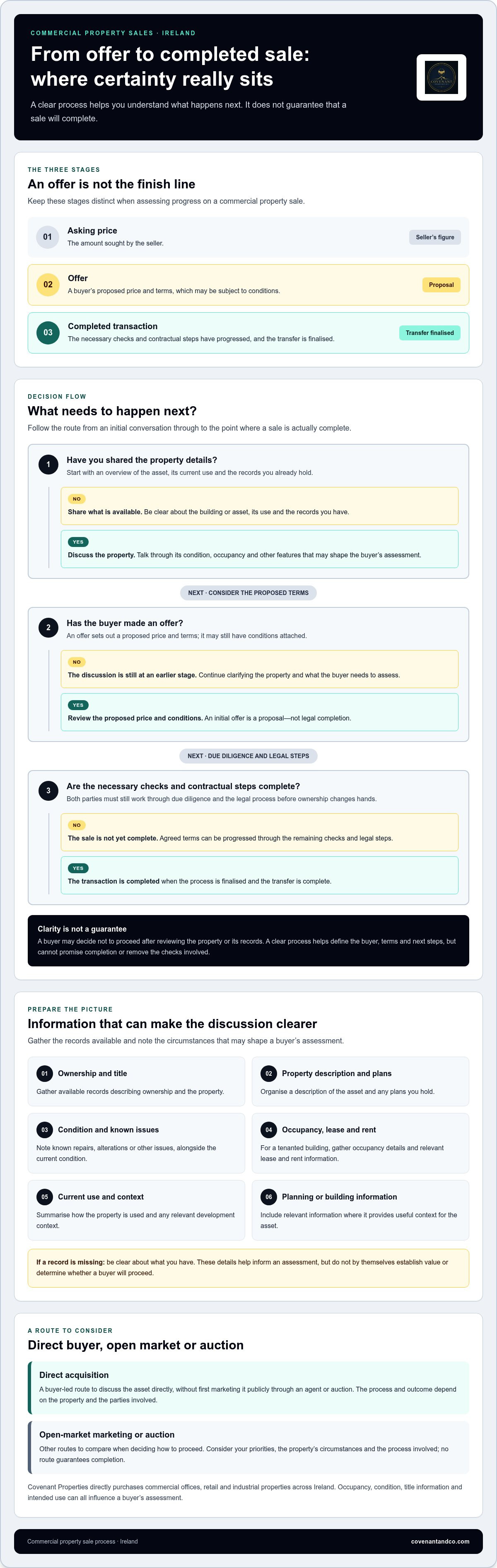
It helps to distinguish three stages. An asking price is the amount sought by the seller. An offer is a buyer’s proposed price and terms, which may be subject to conditions. A completed transaction is one that has progressed through the necessary checks and contractual steps, with the transfer finalised. Treating these as separate stages helps prevent an offer being mistaken for a finished sale.
For anyone searching for a Certain commercial real estate sale Ireland, the useful question is not simply whether a buyer has expressed interest. Consider whether both sides understand the process, the conditions and the next steps. Transaction certainty means clarity about the buyer, agreed terms and route to completion, not a promise that completion is guaranteed.
What does certainty mean when selling a commercial property?
In a buyer-led process, clarity means knowing what the buyer is assessing, what information is available and which matters remain unresolved. The definition of commercial property covers property used for business purposes, but each asset has its own features and sale considerations. Even when terms are clearly discussed, due diligence and contract completion remain important. A clear process reduces ambiguity; it does not make an offer unconditional or remove the possibility that a sale may not proceed.
The property’s circumstances shape what a buyer needs to understand. For a vacant building, this may include its condition and handover. For a tenanted property, occupancy and lease information can form part of the assessment. A complex asset may require closer review of ownership records and supporting documents. For a development-related property, its intended use and development context may also be relevant. These details help define the questions to resolve before deciding how to proceed.
Which commercial properties might suit a direct sale?
Covenant Properties directly purchases commercial offices, retail and industrial properties across Ireland. A direct sale gives an owner a buyer-led route to consider, but no one route suits every seller or asset. Occupancy, condition, title information and intended use can all influence a buyer’s assessment. Sharing those details helps make the discussion specific to the property, without determining the outcome in advance.
Before comparing sale routes, note the features most likely to shape the conversation:
- Vacant or occupied: Record who uses the property and gather relevant lease details.
- Condition: Make a clear note of known repairs, alterations or other issues.
- Ownership and title: Gather available records describing ownership and the property.
- Use or development context: Summarise the current use and any relevant background information.
This is a starting point, not a universal list of requirements. Organising the information you have can make an initial discussion clearer and help you decide whether a direct buyer, open-market marketing or another route better fits your priorities.
How a direct commercial property sale in Ireland can proceed
A direct sale gives an owner and prospective buyer the opportunity to discuss the asset without first marketing it publicly through an agent or auction. The details depend on the property and the parties involved, so use the outline below as a practical guide, not a fixed sequence or promise of completion. A search for “Certain commercial real estate sale Ireland” often reflects a wish to understand what happens after the first conversation.
The process can be viewed in four broad stages:
- Share property details. Provide an overview of the building or asset, its current use and the records you already hold.
- Discuss the property. Talk through its condition, occupancy and other features that may shape the buyer’s assessment.
- Consider an offer. Review the proposed price and any conditions. An initial offer is a proposal, not legal completion.
- Progress agreed terms. If both parties wish to proceed, they can work through due diligence and the legal steps towards a sale.
What information helps a buyer assess a commercial property?
Organised records help a buyer build a clearer picture of the asset. Gather available ownership and title information, a description of the property, plans and details of its current condition. For a tenanted building, occupancy details and relevant lease and rent information can explain how the property is used and what income arrangements are in place.
Planning or building information can provide useful context when relevant to the asset. These documents do not, by themselves, establish a property’s value or determine whether a buyer will proceed. The assessment may depend on the property, its title and the information available. If a record is missing, be clear about what you have rather than assuming every possible document is needed at the outset.
Market context can inform a seller’s thinking, though it cannot replace an assessment of a specific property. The Society of Chartered Surveyors Ireland publishes Irish commercial property market trends, which can provide broader context alongside the asset-specific details.
From initial discussion to agreed sale terms
If the buyer is interested, the parties can clarify what the offer includes, whether conditions apply and what each side understands the next steps to be. Set out the points under discussion clearly. This makes it easier to distinguish what has been proposed from what still needs agreement, without mistaking early interest for a completed sale.
During due diligence, relevant information is reviewed and questions about the property or title can be addressed. The parties’ solicitors handle conveyancing and legal documentation, including the steps needed to progress the transfer. The details and order can vary between transactions, so there is no single completion timetable for every commercial property sale.
In brief: share information, discuss the asset and consider proposed terms. If both sides decide to continue, their solicitors can progress the legal work. Owners considering a direct buyer can explore Covenant Properties’ commercial property acquisition as one possible route.
Direct buyer, open market or auction: compare commercial sale routes
Choosing a sale route means weighing reach against control, competition and uncertainty. A direct buyer provides a more contained process, while open-market marketing presents the property to a wider pool of potential buyers. An auction follows a distinct format, with its own conditions and timetable. None removes the need to assess the terms and the likelihood of a transaction proceeding.
Use this comparison as a starting point. The experience can vary depending on the property, market interest and terms proposed.
| Route | Exposure | Process and competition | Uncertainty to consider |
|---|---|---|---|
| Direct acquisition | Discussion is with a prospective buyer rather than through a public listing campaign. | A more contained, buyer-led conversation may suit owners who value a focused process. There may be less open competition between multiple prospective buyers. | The offer and any conditions still need to be assessed. A direct approach does not guarantee that the transaction will complete. |
| Open-market marketing | A listing can present the property to a broader group of potential buyers. | Marketing and negotiations may involve enquiries and competing interest. The seller’s experience depends on the response the property receives. | More exposure does not itself guarantee a higher achieved price or a completed sale. Interest, offers and agreed terms can differ. |
| Auction | The property is offered to prospective bidders through an auction process. | Bidding takes place within the auction format and is governed by its stated terms and conditions. | The result depends on bidding and the applicable sale conditions. The format may not suit every property or seller’s priorities. |
When might a direct commercial property sale fit?
A direct route may be worth considering if you prefer to discuss the asset with a prospective buyer in a more contained process, rather than begin with public marketing. That preference alone does not establish the best financial outcome. Consider what matters most: the potential reach of a campaign, the nature of the property, your preferred level of process control and how you weigh an offer against continued exposure. Covenant Properties directly purchases commercial property across Ireland, including office, retail and industrial assets. Whether this route fits depends on your circumstances and the property.
What should sellers weigh against open-market exposure?
Open-market exposure can bring a property to more potential buyers, but marketing, viewings and negotiations happen before a transaction is complete. A direct offer may reduce the need for public marketing, yet it should be compared carefully with the alternatives. Look beyond the proposed figure: what conditions apply, what remains unresolved and how clear are the next steps? An asking price is not the same as an achieved sale price.
Broader economic conditions can influence buyer appetite, but they do not predict the outcome for an individual asset. The Irish economic overview and commercial real estate provides context on the national market, not a valuation or sale forecast for a particular property. For a closer look at the buyer-led route, see this direct sale guide to selling commercial property in Ireland. Compare the routes against your priorities, the property’s circumstances and the terms on the table.
Prepare for a commercial property sale with this Ireland-focused checklist
Good preparation makes an initial sale discussion more useful. It helps a prospective buyer understand what the property is, how it is used and what information is available. Not every document below will be needed in every transaction. Start by gathering relevant records, noting what is missing and keeping descriptions accurate.
If you’re researching a “Certain commercial real estate sale Ireland”, use this checklist as a practical starting point, not a guarantee of an offer or completion.
Property, title and occupancy information to organise
Group records by topic so that details are easy to find and gaps are visible. Depending on the asset, useful information may include:
- Ownership and title: Available title documents and records that describe ownership of the property.
- Property details: The address, current use and a clear description of the building or site.
- Plans: Available site, floor or other relevant plans that show the property’s layout or extent.
- Occupancy and leases: For occupied assets, note who occupies the property and organise relevant lease terms and rent information.
- Condition: Record known repairs, defects, alterations or other condition issues accurately.
- Ongoing commitments: Make a note of relevant agreements or commitments connected with the property.
Keep records together, digitally or in a clearly organised folder. If information is incomplete or a detail is uncertain, mark that clearly instead of presenting an assumption as fact. This gives a buyer a more useful picture and keeps early discussions grounded.
Where the asset includes land, its value and context may need separate consideration. The guide to valuing land for sale in Ireland may help owners understand what can affect a land assessment.
Questions to resolve before agreeing terms
Before deciding whether to proceed, make sure the proposed terms are clear. Do you understand the price being discussed, any conditions attached to it and the intended next steps? An offer may not be the final agreement, so distinguish what has been proposed from what has been formally agreed.
Tax, VAT and planning consequences depend on the property and the seller’s circumstances. A general checklist cannot resolve questions specific to your transaction. Independent legal and tax advice can help you understand the implications before you commit to terms. The parties’ solicitors can address the legal documentation and conveyancing process.
Preparation cannot remove every uncertainty, but it can help you have a more informed conversation about the asset. If you’re considering a direct sale, discuss selling your commercial property to Covenant Properties.
How Covenant Properties approaches a direct commercial property sale
For owners considering a direct route, it helps to know who is on the other side of the conversation. Covenant Properties directly purchases commercial property for cash across Ireland. It buys offices, retail and industrial assets, from individual buildings to complex property assets. It is the buyer, not a property portal displaying listings or an estate agency marketing a property on the open market.
A direct purchase is a different route to consider, not a guaranteed result. Any potential sale depends on the property, the information available and the terms agreed between the parties. A clear discussion can help you understand whether there may be a way forward, without making assumptions about price or completion.
A direct purchaser for commercial property owners
Some owners value the option of speaking directly with a prospective buyer instead of beginning with open-market marketing. That can make the conversation more contained, although it does not remove the need to review the property and agree terms. Whether it suits you depends on your priorities and the asset. A direct offer is one route to assess alongside other sale options, not automatically the strongest financial outcome.
Offices, retail premises and industrial properties each have different characteristics. Occupancy, condition, title information and intended use can shape how a buyer considers an asset. Covenant Properties’ direct acquisition activity covers commercial property across Ireland, from individual buildings to more complex assets. The discussion centres on the property and the seller’s circumstances, rather than a public listing process.
Start a conversation about your commercial property
You can begin by sharing the asset type, its current use and the outcome you hope to achieve. For example, explain whether the property is occupied, whether you’re weighing a direct sale against public marketing, or whether you have a particular decision to make about the asset. You do not need to assume every detail or record will be ready before an initial conversation.
Next steps depend on the property and your circumstances. Relevant details can frame a discussion, and any proposed terms can then be considered on their own merits. A conversation is a way to understand the asset and possible next steps, not a commitment to sell or a promise that an offer will be made or a transaction completed.
People searching for a “Certain commercial real estate sale Ireland” are often looking for fewer unknowns. A direct buyer can provide a clear point of contact and a focused route to discuss the asset, but certainty still depends on the terms, information and legal steps involved. Compare the route with your priorities and decide whether it fits.
If you’re considering this option, discuss a commercial property sale with Covenant Properties. Share the basic details of the asset and your preferred outcome as a first step, without assuming you have already decided to proceed.
Choose the route that fits your next move
A commercial sale is also a decision about what you need the next stage to look like. Is your priority wider buyer exposure, a more contained conversation, or a sale format with defined conditions? There is no single answer for every owner. The phrase “Certain commercial real estate sale Ireland” may capture a wish for reassurance, but the most useful certainty comes from understanding what has been agreed, what remains open and whether the route fits your plans.
Before taking a step, consider what would make an offer workable, which conditions matter and what information you still need to decide with confidence. Your priorities may also reflect a wider change, such as releasing capital or reorganising your business interests. Weigh those aims against the sale route. An initial conversation does not commit you to a sale.
If a direct route is worth exploring, discuss a commercial property sale with Covenant Properties. Start with your priorities and the details you have to hand. Clear questions can make the next decision more manageable.
Frequently Asked Questions
Can a commercial property sale in Ireland be guaranteed?
No. A sale should not be described as guaranteed until the relevant conditions are met and the transaction completes. A direct purchaser can provide a clear route for discussing a sale, but due diligence, agreed terms and legal conveyancing still matter. If you’re searching “Certain commercial real estate sale Ireland”, think of certainty as understanding what must happen next, not receiving an unconditional promise. Ask your solicitor to explain the contract conditions and requirements for completion.
Can I sell a commercial property in Ireland with a tenant in place?
Yes, a commercial property may be sold with a tenant in place, but the lease and occupancy arrangements can affect a buyer’s assessment. Organise the lease, rent details and relevant correspondence, including records of agreed changes. This helps clarify the tenant’s position and the income arrangements. Proposed terms depend on the property and circumstances, so get legal advice on the lease and any obligations before agreeing to a sale.
Do I need planning permission to sell commercial property in Ireland?
Not automatically. Selling a property does not by itself mean you need new planning permission, though its planning history and permitted use may matter to a buyer. Gather available planning documents and records, such as correspondence or decisions relating to the property. Do not assume that a current or intended use has a particular planning status without checking the details. For a specific property, seek guidance from a suitably qualified planning or legal professional.
How is a commercial property’s sale value assessed in Ireland?
It depends on the individual property. A buyer may consider its condition, location, use, occupancy, income and legal position. An asking price is not the same as an agreed offer or the price achieved at completion. If you need a formal valuation or have accounting or tax questions, speak to an appropriately qualified adviser. Consider any direct buyer’s offer alongside your objectives, the proposed conditions and other routes available to you.
Does selling a commercial property in Ireland involve VAT or capital gains tax?
It may, but the tax treatment depends on the property, how it is owned and the details of the transaction. VAT and capital gains tax are separate considerations, and the relevant treatment cannot be determined from the asking price alone. Before accepting terms or proceeding, provide your accountant or tax adviser with the transaction details and ask them to assess your circumstances. This general information is not tax advice and cannot establish what applies to your sale.
Can I sell a commercial property in Ireland if it needs repairs?
Yes, a property needing repairs may still be considered for sale. Carrying out work first is not automatically the only route. Describe known issues accurately and gather relevant records, such as survey findings, repair documents or details of work already completed. A buyer will assess the property in its current circumstances, and proposed terms may reflect that assessment. If a condition issue raises legal or safety concerns, seek appropriate professional advice before deciding how to proceed.


