

What if avoiding an estate-agent fee doesn’t mean avoiding every cost of selling? If “Property sale without agent fees Ireland” is what you’re looking for, compare the full picture, not just the commission you might save.
You can sell privately or explore a direct sale to a cash property buyer. Either way, a solicitor is still needed to handle the legal transfer, and other costs may apply depending on your property and circumstances.
This guide covers the practical routes to selling without an estate agent, the costs that may remain and what to clarify before accepting a direct offer. It also explains how to weigh the convenience of a cash purchase against the price you might achieve through an open-market sale. Covenant Properties buys residential properties directly for cash across Ireland, giving sellers an alternative to an estate-agent-led sale. Compare each route against your priorities before deciding which suits you.
Key Takeaways
- A Property sale without agent fees Ireland may reduce agent-related costs, but other expenses can still apply.
- Compare a direct buyer, private sale and agent-led sale by considering control, marketing effort, viewings and the overall terms.
- Check which property, mortgage or tax-related costs could affect the amount you receive.
- Gather key details about ownership, occupancy, condition and property documents to help progress a direct sale.
- Consider whether a cash purchase from Covenant Properties fits your priorities as an alternative to an estate-agent-led listing.
Selling property in Ireland without agent fees: what does it mean?
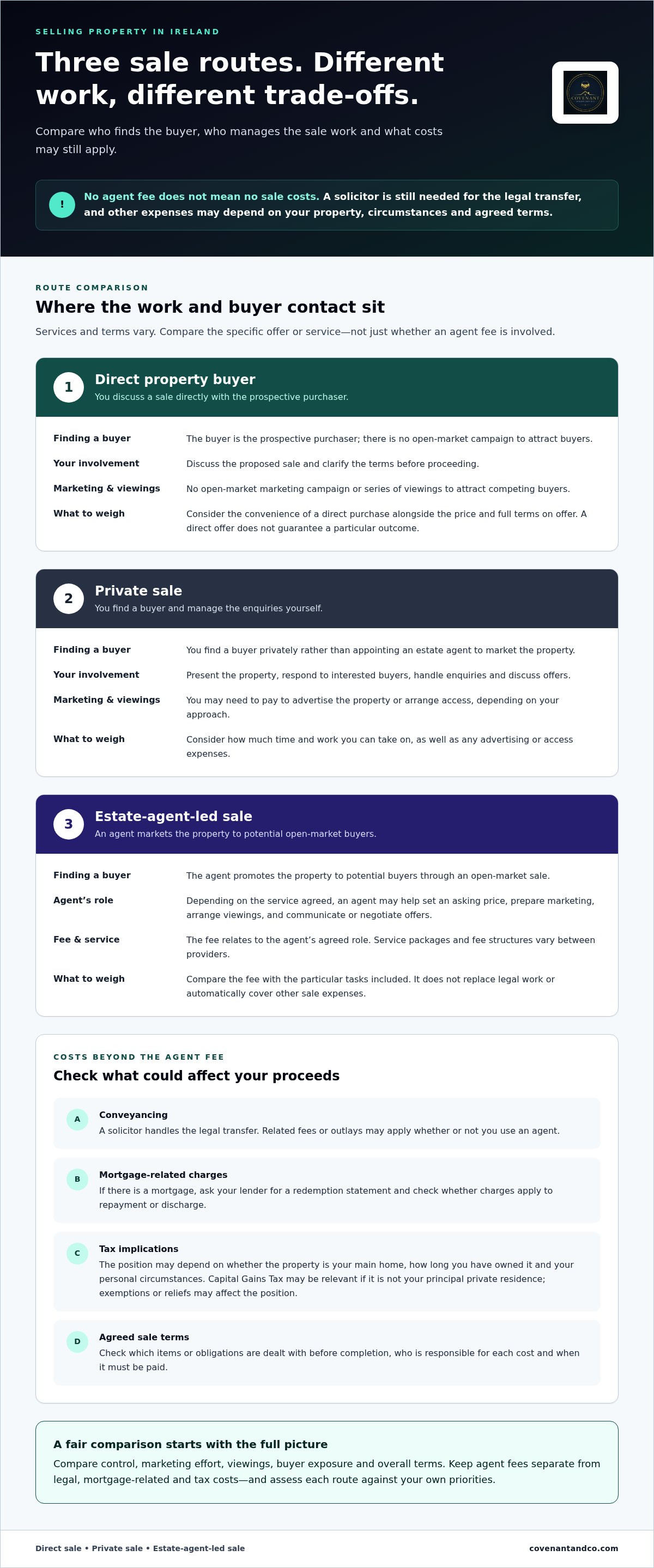
A Property sale without agent fees Ireland means selling without appointing an estate agent to market and manage the transaction. You may find a buyer privately or agree a sale directly with a property buyer. Either way, removing the agent removes their role and fee, not every task or expense involved in transferring ownership.
No agent fee does not automatically mean no sale costs. Legal work and other expenses may still arise, depending on the property, your circumstances and the agreed terms. An agent’s fee pays for particular services; other costs relate to separate parts of the sale.
What an estate-agent fee usually covers
An estate agent may help set an asking price, prepare marketing, promote the property, arrange viewings and communicate or negotiate offers. The work depends on the service agreed, so compare the fee with the specific tasks included. There isn’t one fee structure or service package that applies to every provider in Ireland.
In an agent-led sale, the agent markets the property to potential open-market buyers. The fee relates to that role. It doesn’t replace the legal work needed to transfer ownership or automatically cover every other expense that might arise during the transaction.
What changes when you sell directly
Selling directly removes the estate agent from the sale process. In a private sale, you find a buyer and handle enquiries yourself. With a direct property buyer, you discuss a sale with the buyer rather than marketing your home to open-market purchasers. It’s a different route, not an estate-agent service under another name.
The main difference is who handles the work. In a private sale, you present the property, respond to interested buyers and discuss offers. In a direct sale, the buyer is the prospective purchaser, so there’s no open-market campaign or series of viewings to attract competing buyers. Consider how much involvement you want and how you’ll assess the proposed terms.
Whichever route you choose, make sure the agreed terms are clear before proceeding. A solicitor is essential for the legal transfer of ownership in Ireland, so selling without an agent doesn’t mean completing the legal process without professional conveyancing. For general background on the legal concepts involved, see real estate law principles. This is a broad overview, not guidance specific to Irish property law.
In practical terms, “direct” describes how the buyer and seller connect, not a shortcut around the formal transfer. Next, identify which costs may apply to your sale and compare the overall terms of each route.
Which costs may remain when you sell without an estate agent?
Removing an estate agent changes one part of the sale, not the whole cost picture. A Property sale without agent fees Ireland may avoid an agent’s commission or fee, but conveyancing, mortgage-related charges or tax obligations could still affect your proceeds. The costs depend on the property, your circumstances and the transaction terms.
An avoided agent fee is separate from costs that arise independently of agency. Keep those categories distinct when comparing routes. Look at the overall terms rather than treating the absence of commission as a guaranteed saving.
Costs that may be avoided or reduced
If you sell without appointing an estate agent, you may avoid paying for the agent’s services. Marketing and viewings still depend on the route: a private seller may pay to advertise the property or arrange access, while a direct buyer purchases from the owner rather than marketing the home to open-market buyers. Weigh any potential saving against the work and expenses you take on yourself, as well as the full sale terms.
Costs to consider separately from agent fees
Conveyancing is separate from agency. A solicitor handles the legal transfer, and related fees or outlays may apply whether or not you use an agent. If there’s a mortgage on the property, request a redemption statement from your lender and check whether charges apply to repaying or discharging it. The amounts and requirements depend on your loan and circumstances.
Tax also needs an individual assessment. A sale may have tax implications depending on factors such as whether the property is your main home, how long you’ve owned it and your personal circumstances. Capital Gains Tax may be relevant for a property that isn’t your principal private residence, but exemptions or reliefs can affect the position. Tax rules can change, so check current Revenue guidance and get advice suited to your situation before relying on an estimate.
Other transaction details can affect your final proceeds. The agreed terms, for example, may set out which items or obligations are dealt with before completion. Ask for costs to be identified clearly, including who is responsible for each one and when it must be paid. That gives you a more useful comparison than looking at an agent fee in isolation.
For a wider comparison of possible sale expenses and routes, see this Irish property sale cost guide. If a direct purchase is one option you’re weighing, explore Covenant Properties’ direct cash property purchase as an alternative to an agent-led listing.
Direct buyer, private sale or estate agent: compare the trade-offs
The right route depends on what matters most to you: control, exposure to buyers, time spent managing the process or the terms on offer. A direct buyer and an open-market sale aren’t like-for-like. One is a proposal from a purchaser; the other tests interest from buyers reached through marketing. Neither guarantees a particular outcome.
Use this comparison to see where the work and decisions sit. Services and terms can vary, so assess the details of the specific sale rather than relying on the route’s label alone.
| Factor | Direct buyer | Private sale | Estate-agent sale |
|---|---|---|---|
| Control | Discuss terms directly with the prospective buyer. | You manage the sale and deal with interested buyers. | You make key decisions, with an agent supporting the process. |
| Marketing effort | No open-market campaign to organise. | You arrange how the property is advertised and presented. | The agent handles agreed marketing activity. |
| Viewings | No campaign of buyer viewings to coordinate. | You arrange access and meet or communicate with buyers. | The agent can arrange and manage viewings. |
| Negotiation | You discuss the proposed terms with the buyer. | You handle offers and negotiations yourself. | The agent can present and negotiate offers on your behalf. |
| Transaction certainty | Depends on the agreed terms and the buyer’s ability to proceed. | Depends on the buyer and how the sale progresses. | Marketing may attract interest, but a sale still depends on a suitable buyer and agreed terms. |
When a direct property buyer may suit your priorities
A direct buyer may suit owners who prefer discussing a sale with a prospective purchaser rather than preparing for an open-market campaign and managing multiple enquiries. Covenant Properties buys residential property directly for cash, offering an alternative for sellers who value a more streamlined process. Assess any offer and proposed terms on their own merits. A direct route doesn’t guarantee a particular price, speed or completion date.
When private or agent-led selling may fit better
Private selling gives you direct control, but you take on buyer contact, marketing decisions, viewings and negotiation. An agent-led sale includes services such as marketing and negotiating offers, which may reduce the work you manage yourself. If reaching open-market buyers matters to you, weigh that potential exposure against the fee and responsibilities involved.
For a fuller route-by-route assessment, use this agent-free sale comparison guide. Compare the proposed net outcome, the work you’ll handle and the terms, not just whether an agent fee applies. If you’re considering a direct purchase, explore Covenant Properties’ direct property purchase alongside the alternatives.
How to sell your property directly without agent fees
A direct sale is easier to follow when you know what happens at each stage. The process usually moves from sharing property information to discussing the sale, reviewing proposed terms and progressing the legal transfer. For a Property sale without agent fees Ireland, clarity matters at every step. The process and timing depend on the property and the terms agreed with the buyer.
Prepare the property information for an initial discussion
Start with a clear overview of the property. Note its type, general condition, occupancy and ownership details, and gather relevant documents or records you already have. These might include title information, planning documents or a BER certificate, where applicable. You don’t need to renovate, stage or publicly list the property to begin a direct conversation. Accurate details help the buyer understand what is being considered.
From there, expect the discussion to develop in stages:
- Share the details. Describe the property, its condition and whether it’s occupied. Be open about features or issues that could affect a buyer’s view of it.
- Discuss the sale. Explain your circumstances and what you need from a sale. Clarify how the direct purchase will be considered and what information may be needed next.
- Review proposed terms. Consider the proposed price, any conditions, what is included in the sale and the next steps. Take time to understand the terms before deciding whether to proceed.
- Progress the legal transfer. If you agree to move ahead, conveyancing addresses contracts, title and the formal transfer of ownership. Your solicitor can explain the legal steps and documents relevant to your sale.
Review the offer and progress the sale
Read the proposal as a whole, not just the price. Check any conditions, responsibilities and assumptions about the property, and make sure the next steps are clear. A conversation or offer doesn’t complete a sale. Contract and title matters must progress through conveyancing, with your solicitor guiding the transfer. The route and timing can vary with the property and transaction.
Keep relevant records organised and raise discrepancies early, such as differences between your understanding of the property and the documents available. This can help avoid confusion as the legal work progresses. A direct buyer purchases from you rather than marketing the home to open-market buyers, but the sale still needs clear terms and a formal legal transfer.
For more on what sellers can expect from this route, explore the cash property buyer guide. If you’re considering selling directly, explore a direct property sale with Covenant Properties, which purchases residential property for cash across Ireland.
Explore a direct property sale with Covenant Properties
If you’re considering a Property sale without agent fees Ireland, Covenant Properties offers an alternative to marketing your home through an estate agent. The business buys residential and commercial property, land and development sites directly for cash across Ireland. A direct purchase may suit owners who would rather discuss a sale with a prospective buyer than organise an open-market listing.
What a direct sale to Covenant Properties involves
Covenant Properties is a private investment group representing local Irish investors. It acquires property directly from owners rather than advertising it to attract other buyers. A cash purchase is based on the property, transaction and terms agreed between the parties. Consider the proposal on its own merits and decide whether it fits your circumstances.
The direct route can suit owners who want to explore a sale without preparing for public marketing or managing viewing requests. It also lets you discuss your property and circumstances directly with a potential purchaser. The decision remains yours. Take time to understand the proposed terms, your responsibilities and any costs that may still apply to the sale.
Covenant Properties acquires different types of property, including homes, commercial buildings, land and development sites. For a residential owner, this means discussing a direct purchase rather than an estate-agent-led campaign. Each transaction depends on the property and agreed terms, and the legal transfer still progresses through conveyancing.
Take the next step at your own pace
An initial discussion can start with a straightforward outline of the property. Share its type, occupancy and condition, along with any relevant information or records you already have. Clear details make the conversation more useful, and an initial enquiry doesn’t commit you to selling.
Use the conversation to understand the proposed route and what the next steps could involve. If you receive terms, review them and compare them with your priorities. Ask for clarity on anything you don’t understand before deciding whether to proceed. A considered decision is better than choosing a route simply because it appears to remove one fee.
If a direct purchase sounds worth exploring, discuss selling your property directly with Covenant Properties. Share the details at a pace that feels comfortable, then decide whether the proposed approach is right for you.
Choose the sale route that feels right for you
Start by deciding what a good outcome means for you. Is it having more control over the process, reaching open-market buyers or exploring a direct conversation with a purchaser? Use those priorities to weigh each option, then review any proposed terms before you commit.
A Property sale without agent fees Ireland can be practical, but the right choice depends on your property, circumstances and comfort with the work involved. Start by understanding the available routes and consider whether one suits your plans.
If you’d like to explore a direct sale, discuss your property with Covenant Properties. Share the details of your property and take the next step towards deciding whether a direct purchase suits you.
Frequently Asked Questions
Can I sell my property in Ireland without an estate agent?
Yes. There’s no legal requirement to use an estate agent to sell a property in Ireland. You can find a buyer privately or discuss a direct purchase. You’ll still need a solicitor to handle the legal transfer of ownership. Before agreeing a sale, make sure you understand who the buyer is, what is being offered and which conditions apply.
Does selling without an agent mean there are no property sale costs?
No. Avoiding an agent may remove their fee, but separate expenses can still arise. For example, you may need to pay for legal conveyancing, and a mortgage may involve redemption or discharge costs. Tax could also be relevant, depending on your circumstances and the property. List the likely costs for your sale rather than assuming the amount saved on an agent is your total saving.
Do I need a solicitor to sell property in Ireland without an estate agent?
Yes. A solicitor is needed to manage the legal transfer of ownership, even if you find the buyer yourself. They can deal with contracts and title matters and explain which documents are needed for your transaction. Engaging a solicitor early can help identify missing paperwork or issues that need attention before the sale progresses. The precise requirements depend on the property and your circumstances.
Can I sell a property with a mortgage without using an estate agent?
Yes, having a mortgage doesn’t by itself prevent you from selling without an estate agent. Contact your lender for a current redemption figure and ask whether any charges apply to repaying the loan. Your solicitor can coordinate the mortgage discharge as part of conveyancing. If the sale proceeds may not cover what you owe, speak to your lender and solicitor before committing to terms.
Is a cash property sale always faster than selling through an estate agent?
No. A cash purchase isn’t automatically faster or certain to complete sooner. Timing can depend on the buyer’s checks, the property’s title and documents, the parties’ readiness and the legal work required. A cash buyer may remove the need for the buyer to arrange a mortgage, but other steps remain. Treat any proposed timing as part of the sale terms, not as a guaranteed outcome.
How is a property valued if I sell without an estate agent?
Start by comparing recent sales of similar homes using Ireland’s Property Price Register, then account for differences such as condition, size and features. The register is a useful reference, not a formal valuation, and recorded sale prices don’t tell the whole story about each property. A direct buyer may assess the property differently from an open-market buyer, so consider how the proposed price fits your priorities and alternatives.
Can I sell commercial property or land without an estate agent in Ireland?
Yes. Owners can explore a private sale or direct purchase for commercial property or land, as well as for a home. The relevant information may differ: for a site, planning history, boundaries and title records could matter; for commercial premises, occupancy and lease details may be relevant. Covenant Properties purchases commercial property, land and development sites directly. The legal and financial details depend on the asset and agreed terms.


