

In Ireland's non-binding property market, accepting an offer doesn't mean your home is sold; it often just means you've entered a fragile queue. If you want genuine certainty, exploring a no chain property sale Ireland gives you a direct path away from the endless delays and fragile links of conventional chains.
Few things are more exhausting than waiting in sale-agreed limbo. You watch weeks slip by, paying ongoing mortgage and maintenance costs whilst an unseen buyer down the line sorts their mortgage drawdown or title queries. The fear of a deal collapsing after months of waiting is entirely justified, especially when estate agents and institutions offer little clear communication.
You shouldn't have to put your future on hold for someone else's transaction. In this guide, you'll discover how chain-free property sales work, why typical sales fall apart, and how to lock in a dependable completion date tailored to your moving schedule. We'll outline practical ways to bypass third-party delays, protect your legal costs, and achieve complete peace of mind.
Key Takeaways
- Understand how a no chain property sale Ireland removes reliance on secondary buyers, eliminating the primary cause of deal collapses.
- Discover why Ireland's non-binding 'sale agreed' stage leaves sellers exposed to sudden loan offer expirations and protracted conveyancing delays.
- Compare the hidden financial drains of open-ended property chains against the predictable timelines of an independent transaction.
- Learn proactive legal preparations you can undertake early to verify buyer funding and keep your transaction moving smoothly.
- Explore how direct cash purchase options offer definitive closing certainty without the need for public open viewings or estate agent chains.
What Is a No Chain Property Sale in Ireland?
In Irish conveyancing, a no chain property sale Ireland vendors seek describes a transaction with zero dependencies on other property deals. Neither the buyer nor the seller needs to complete a secondary purchase to close this agreement. It represents an isolated, self-contained contract that progresses on its own merits.
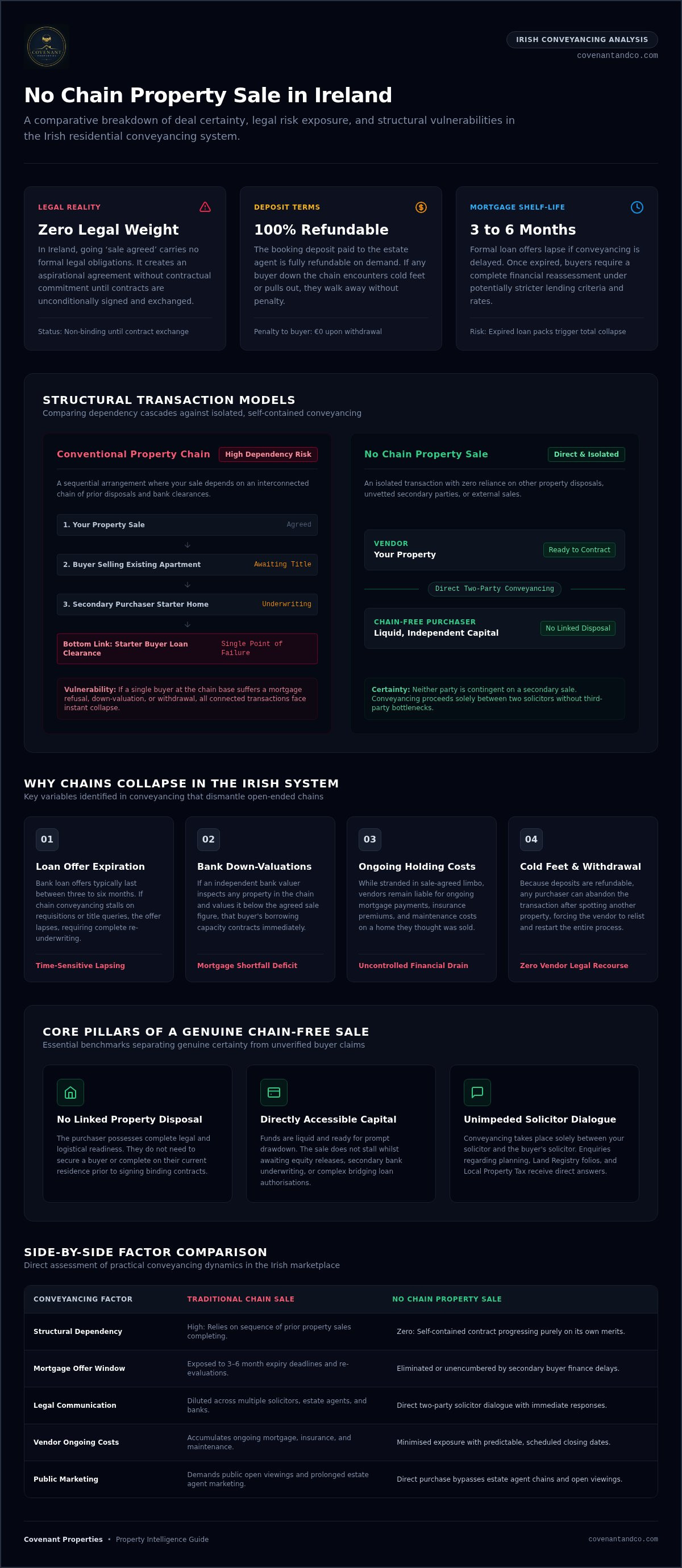
Most conventional purchases depend on an intricate sequence of events. A classic property chain forms whenever a transaction relies on prior sales completing first. For vendors, a chain-free agreement provides the gold standard of deal certainty. It eliminates reliance on strangers, unvetted solicitors, and distant mortgage lenders who have no direct stake in your home.
Critically, you must distinguish between genuinely chain-free buyers and those who merely claim to be. A buyer may not have a house to sell, yet they might still depend on complex mortgage approvals, loan offers with tight expiry windows, or gift deposits from relatives. A true chain-free transaction involves unencumbered funds ready for immediate drawdown.
Understanding Property Chains in the Irish Market
Chains develop when individual housing moves overlap. You agree to sell your home to a buyer. That buyer must first sell their apartment to an incoming purchaser, who in turn requires clearance on their starter home. Upward chains stretch toward your future home; downward chains extend behind your current buyer. If a single link snaps, every connected deal faces instant collapse.
Key Characteristics of a Chain-Free Transaction
Chain-free sales strip out unnecessary layers of administrative friction. When you secure a genuine chain-free deal, the legal and financial dynamics shift in your favour:
- No linked property disposal: The purchaser possesses full legal and logistical readiness. They don't need to locate a buyer for their current home before signing binding contracts with you.
- Directly accessible capital: Funds are liquid and readily available. The transaction doesn't stall whilst awaiting equity releases, secondary bank underwriting, or bridging loan sign-offs.
- Unimpeded solicitor communication: Conveyancing moves solely between your solicitor and the buyer's solicitor. Queries on planning, land registry folios, or local property tax receive direct answers without third-party bottlenecks.
By removing these external variables, a no chain property sale Ireland homeowners opt for turns an unpredictable waiting game into a straightforward, manageable legal process.
Why Property Chains Collapse in the Irish Conveyancing System
Going 'sale agreed' feels like the finish line, but under Irish property law, it carries zero legal weight. In a standard chain, weeks often stretch into months while solicitors raise requisitions on title and buyers await formal loan packs. As time drags on, vendors remain saddled with ongoing mortgage repayments, insurance premiums, and maintenance costs on a home they thought was effectively sold.
When multiple transactions rely on each other, any slight hitch triggers a domino effect. Securing a no chain property sale Ireland vendors rely on eliminates these systemic vulnerabilities entirely, replacing prolonged exposure with contractual certainty.
The Vulnerability of the Sale Agreed Stage
Until contracts are formally signed and unconditionally exchanged, a property sale in Ireland is purely aspirational. The booking deposit paid to the estate agent is fully refundable on demand. If a purchaser down the chain spots another home, changes their mind, or faces sudden cold feet, they can withdraw without penalty. Sellers are left holding the keys, forced to relist and start the entire conveyancing journey over again.
Lending Delays and Mortgage Approval Issues
Finance forms the weakest link in any residential chain. Even buyers who hold approval in principle face significant hurdles before securing a binding letter of offer. According to latest property price data, shifting market conditions mean lenders constantly scrutinise valuations and buyer eligibility:
- Expiry of loan offers: Mortgage offers typically last between three to six months. If chain conveyancing stalls, the offer lapses, requiring full financial reassessment under potentially stricter terms.
- Down-valuations: If an independent bank valuer deems any home in the chain worth less than the agreed price, that buyer's borrowing power shrinks instantly.
- Chain-base refusals: A mortgage decline for a first-time buyer at the very bottom of the chain brings the entire multi-property sequence crashing down.
Title Complexities and Probate Delays
Survey defects and legal snags compound these lending hazards. Minor extensions built decades ago without formal planning exemption certificates can stop a chain dead in its tracks. Similarly, vendors selling inherited assets who go sale agreed before receiving their final grant of probate trap everyone else in indefinite limbo.
Rather than leaving your timelines to chance, exploring how to sell property fast in Ireland can help you sidestep these conveyancing pitfalls. For those seeking absolute clarity without chain-related dropouts, discussing options with Covenant Properties offers a direct, hassle-free path to a reliable sale.
Chain Sale vs. No Chain Sale: Key Differences Compared
Choosing between a standard buyer and an unlinked purchaser fundamentally reshapes your selling experience. While an open-market offer might look appealing on paper, the presence of an extended chain introduces friction that erodes your control over the move. Securing a no chain property sale Ireland vendors prefer replaces multi-party negotiations with straightforward, independent execution.
Vendor autonomy changes dramatically when secondary buyers vanish from the equation. In a conventional setup, chained buyers often use minor structural survey findings to renegotiate late in the process, knowing you risk losing your forward purchase if you refuse. Direct, chain-free buyers generally assess the asset upfront and proceed without leveraging external transaction pressures against you.
Timeline Comparison: From Acceptance to Completion
Standard open-market conveyancing in Ireland usually requires 8 to 12 weeks just to reach contract exchange under optimal conditions. When multiple interconnected transactions must align, that timeline easily doubles or triples. Solicitors must wait for counterpart funds to clear before releasing title deeds down the line.
In contrast, an independent sale moves at the direct pace of your legal representatives. Once contracts and folios are issued, exchange can occur in weeks rather than months. Many sellers discover that choosing to sell home without estate agent Ireland services eliminates traditional open-market lag, allowing completion dates to align precisely with personal moving plans.
Fall-Through Risk and Cost Exposure
The financial impact of a protracted transaction is rarely calculated until it is too late. Every additional month spent waiting for third-party approvals drains household finances through preventable holding expenses:
- Ongoing utility and insurance costs: Standing utility charges, local property tax liabilities, and standard structural insurance policies accumulate steadily whilst the property remains tied up in conveyancing.
- Mortgage interest accumulation: Month after month of delayed completion forces you to service interest charges that could otherwise be redirected to your next step.
- Abortive legal outlays: Standard solicitor conveyancing fees typically range between €1,500 and €2,500 plus VAT and outlays. When a chained deal breaks down, those fees are largely forfeit, requiring fresh expenditure to start again.
A chain-free transaction closes these exposure windows. You protect your capital, establish an enforceable moving schedule, and avoid the recurring financial drain of an open-ended conveyancing process.
How Irish Vendors Can Secure a Chain-Free Property Sale
Taking proactive charge of your legal paperwork and buyer screening transforms how quickly your sale completes. Rather than passively waiting for an estate agent to bring forward potential offers, smart sellers build the foundation for a no chain property sale Ireland conveyancing demands before the property is ever shown.
Clarity begins with preparation. By assembling essential documents early, setting strict contractual milestones, and verifying the buyer's financial position, you preserve legal momentum from day one. You also gain the freedom to reject conditional offers that risk tethering your timeline to someone else's moving plans.
Assembling an Early Legal Pack with Your Solicitor
Conveyancing delays often happen on the vendor's side of the table. Instruct your solicitor to retrieve title deeds from your lending institution immediately, as this process alone can take four to six weeks. Ensure your legal pack contains:
- Clear title folios: Certified copies from the Land Registry or Registry of Deeds establishing undisputed ownership.
- Statutory certificates: A valid Building Energy Rating (BER) assessment along with up-to-date Local Property Tax (LPT) receipt confirmation.
- Planning and boundary compliance: Certificates of compliance for any prior structural alterations or extensions, alongside verified boundary maps.
Vetting Prospective Buyers and Funding Methods
Never rely solely on an informal verbal offer. If you market openly, mandate that any bidder provides certified bank proof of funds or a fully validated, in-date mortgage loan approval. Confirm in writing whether they must dispose of an existing property before signing contracts. A slightly higher bid tied to an unlisted starter home is almost always riskier than a clean, independent cash offer ready to complete immediately.
Choosing Direct Cash Purchase Alternatives
You can bypass the unpredictability of the open market entirely. Working with an established national corporate buyer removes staging demands, multiple weekend viewings, and intrusive marketing boards. It also eliminates estate agency commissions that normally run between 1% and 2.5% of the purchase price, plus VAT.
Understanding the full range of alternative routes detailed in this guide to sell house fast Ireland properties helps you weigh your options clearly. If you want genuine closing certainty without chained dependencies or public viewings, you can request a direct cash offer from Covenant Properties and choose your exact closing date.
Completing Your Sale Seamlessly with Covenant Properties
Selling your home shouldn't mean enduring months of nervous second-guessing. At Covenant Properties, we operate as an established national direct cash buyer, providing Irish vendors with a dependable alternative to conventional agency routes. If you need a true no chain property sale Ireland homeowners can rely on, our direct acquisition model removes external dependencies from the equation permanently.
We work across Ireland, purchasing residential properties, commercial units, and development land assets directly. Our model suits individuals who value time, clarity, and discretion over open-market theatre. Whether you're managing an inherited asset, downsizing, or simply prefer to avoid public viewings, we keep the process calm, transparent, and completely free from high-pressure tactics.
A Straightforward, Chain-Free Acquisition Model
Traditional sales stumble because buyers rely on bank sign-offs and linked disposals. We fund purchases through our own independent capital reserves. Because we don't depend on institutional mortgages or external loan facilities, our transactions aren't subject to lending delays, loan expirations, or third-party down-valuations.
You avoid the intrusion of public open viewings, online portal listings, and 'for sale' signs outside your door. As experienced cash buyers for houses in Ireland, we acquire properties directly in any condition, sparing you the hassle of carrying out cosmetic repairs or remedial works before closing.
Total Control Over Your Completion Timeline
Selling on the open market leaves your moving date in someone else's hands. With Covenant Properties, you regain full control. We give vendors the autonomy to choose the closing schedule that fits their unique situation:
- Flexible completion dates: Need a swift closing to release equity, or extra time to organise your onward move? You set the date that works for you.
- Independent legal representation: Conveyancing is handled directly through your own chosen solicitor, ensuring every step remains transparent, professional, and properly protected.
- Guaranteed completion: Once terms are accepted and contracts are drafted, your sale moves forward without the risk of a secondary buyer walking away.
If you're ready to secure a predictable, chain-free transaction without the delays of estate agency chains, reach out for a straightforward, no-obligation conversation today.
Secure Your Move with Complete Certainty
Selling your home shouldn't leave you stranded in legal limbo. Traditional property chains introduce severe vulnerabilities, from sudden loan offer expirations to escalating holding costs and abortive solicitor fees. Choosing a no chain property sale Ireland vendors can rely on protects your hard-earned equity and restores absolute certainty to your moving schedule.
True peace of mind comes from eliminating external variables. Covenant Properties offers a straightforward, dependable alternative through direct cash acquisitions across Ireland. Backed by independent capital reserves, we eliminate mortgage underwriting delays and avoid invasive public viewings entirely. We purchase residential properties in any condition, giving you the flexibility to select an exact completion date that suits your onward plans.
You don't have to wait months for an unpredictable sequence of buyers to align. Request a discreet, no-obligation cash offer for your Irish property today and take the next confident step toward a smooth, chain-free completion.
Frequently Asked Questions
What does 'no chain' mean when selling a property in Ireland?
A 'no chain' sale means the transaction progresses entirely independently, without relying on the purchase or disposal of another home to close. Neither the buyer nor the seller is waiting on secondary transactions. For vendors, a no chain property sale Ireland transaction removes upward and downward dependencies. It isolates your timeline, ensuring the conveyancing phase leads directly to completion without reliance on third-party buyers.
Why is a chain-free buyer considered better than a buyer in a chain?
A chain-free buyer offers higher transaction certainty and a vastly reduced risk of contract collapse. Because they don't need to sell an existing property first, there's no danger of an unvetted deal failing behind them. Their funds are immediately accessible. This eliminates common stumbling blocks like delayed equity releases, prolonged mortgage reassessments, or chain-wide down-valuations that frequently trap standard buyers.
Can a property sale still fall through if it is chain-free?
Yes, a chain-free sale can still collapse, although the risk is substantially lower than in a conventional chain. Until contracts are unconditionally signed and exchanged, either party can withdraw. Deals typically falter if a buyer has sudden cold feet, uncovers unexpected structural defects, or encounters unresolved planning discrepancies. Partnering with a reliable direct cash buyer removes mortgage-related dropouts entirely.
How long does a no chain property sale typically take in Ireland?
A no chain property sale Ireland homeowners agree can conclude in as little as two to four weeks when legal title deeds are assembled upfront. Conventional sales routinely drag out over 8 to 12 weeks just to reach contract signing. By removing linked dependencies and institutional lender queries, conveyancing solicitors can focus solely on drafting contracts and closing the transaction promptly.
Is 'sale agreed' legally binding in the Irish property market?
No, the 'sale agreed' status carries zero legal standing under Irish law. Any booking deposit paid to an estate agent remains fully refundable upon request. Neither the vendor nor the purchaser is legally bound to proceed until both sides have signed unconditional contracts and exchanged legal deposits through their respective solicitors.
Can I sell my property without a chain if I still have an outstanding mortgage?
Yes, you can easily complete a chain-free sale with an existing mortgage registered against your property. Your solicitor simply requests a redemption figure from your lending institution prior to closing. Once the purchaser's funds arrive on the completion day, your solicitor clears the remaining loan balance directly, releasing the title charge and transferring the remaining balance to you.
What documents are required to ensure a smooth chain-free conveyancing process?
You need your title deeds, planning certificates, and statutory property records organised early. Essential paperwork includes Land Registry folios, certificates of compliance with planning permissions and building regulations, an up-to-date Building Energy Rating (BER) certificate, and verified Local Property Tax (LPT) payment receipts. Having these documents ready prevents requisitions on title from slowing down your completion.


