

Could a planning discrepancy stop your sale, or simply change the route you take? If you’re searching for “Residential property with planning issues Ireland”, the uncertainty is understandable. Missing permission, an extension that differs from approved plans or incomplete building records can prompt questions during a sale. The issue alone doesn’t determine the outcome. Its nature, history and supporting evidence matter.
Start by establishing what was built, what permission was granted and which records are available. This helps separate a missing document from a possible planning discrepancy and shows what may need further investigation or professional advice. Avoid assuming that one solution fits every property.
This guide explains what planning issues can mean for a residential sale in Ireland, what to establish first and how to compare your options. It covers preparing for an open-market sale, investigating the planning position and considering direct acquisition as another route. The aim is to help you weigh each option against your circumstances and the property’s documented position.
Key Takeaways
- A planning discrepancy is a question to clarify, not automatic proof that a residential sale cannot proceed.
- For a residential property with planning issues in Ireland, identify what work was done and gather available permissions, decisions and building records.
- Missing documents can leave buyers, lenders and others with unanswered questions, even before the planning position is clear.
- Compare further investigation, an applicable planning route and an open-market sale against your circumstances and the evidence available.
- A direct cash sale is another route to consider. Weigh it against your priorities and the property’s documented position.
What counts as a residential property with planning issues in Ireland?
Finding a possible planning discrepancy can feel worrying, especially if you’re preparing to sell. First identify the concern. A search for “Residential property with planning issues Ireland” may bring up anything from missing paperwork to work that appears different from approved plans. Neither, on its own, proves that a sale is impossible.
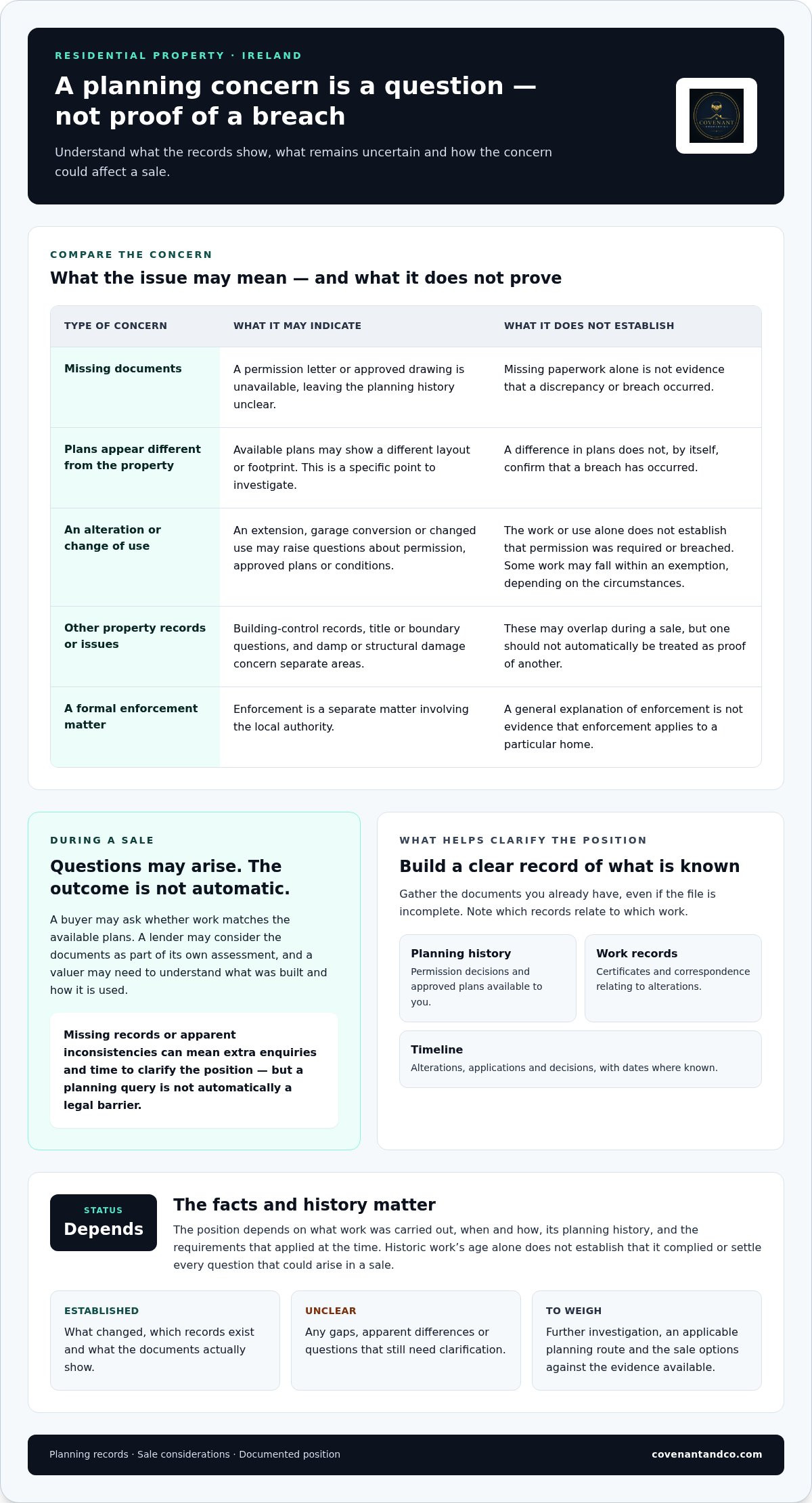
A planning concern is an unanswered question or discrepancy about a property’s planning history; it is not, by itself, confirmation that a breach has occurred. Planning matters are dealt with by the local authorities in Ireland. The records and facts relating to the particular home need to be understood before drawing conclusions.
Planning is only one part of a property’s overall position. Building-control records concern a separate area. Title or boundary questions relate to ownership and the extent of the land, while damp or structural damage are property-condition concerns. These issues can overlap during a sale, but one should not automatically be treated as proof of another.
Which planning issues might affect an Irish home sale?
An extension, garage conversion or change of use may prompt questions about whether permission was required, whether it was granted, or whether the completed work matches approved plans or conditions. The details matter. A room being used differently from its original purpose, for example, raises a question about use but does not by itself establish that planning permission was needed or breached.
Missing documents are not the same as evidence of a discrepancy. The absence of a permission letter or approved drawing may simply leave the planning history unclear. If available plans appear to show a different layout or footprint from the property, that is a specific point to investigate. Relevant records may include planning decisions, drawings, correspondence and documents relating to the work.
Is every planning discrepancy a breach?
No single answer applies to every home. The position depends on what work was carried out, when and how it was done, its planning history, and the requirements that applied at the time. Some work may fall within an exemption, depending on the relevant conditions and circumstances. Don’t assume that an extension, conversion or other change was unauthorised simply because paperwork is missing.
Historic work also needs careful consideration. Its age alone doesn’t establish that it complied with planning requirements or settle every question that could arise in a sale. Separate what is known from what is uncertain: what changed, which records exist and what still needs clarification. This gives you a clearer basis for weighing the sale options below.
How can planning issues affect a residential property sale in Ireland?
A planning question may lead to extra enquiries during a sale, but it doesn’t automatically prevent a transaction. A buyer may want to know whether an extension matches the available plans. A lender may consider the property’s documents as part of its own assessment, while a valuer may need to understand what was built and how it is used. The effect depends on the concern, the evidence, the buyer’s circumstances and professional review.
Documented facts give everyone a firmer basis for decisions than assumptions about what a planning discrepancy means. Missing paperwork can create uncertainty even where it hasn’t been established that the work required permission or failed to comply. A formal enforcement matter is separate. This guide to planning enforcement explains how a local authority describes and approaches enforcement. It is not evidence that enforcement applies to a particular home.
What documents can help clarify the property’s planning history?
Bring together the records you already have, even if the file is incomplete. Include planning decisions, approved drawings, certificates, relevant correspondence and records of alterations with dates. Note which documents relate to which works. A clearly organised file helps a solicitor or other relevant professional identify what is established and what still needs checking. Document names and procedures can vary, so a missing item alone does not prove a breach.
- Permission decisions and any approved plans available to you
- Certificates and correspondence relating to the works
- A timeline of alterations, applications and decisions, with dates where known
Can a planning issue delay or prevent a sale?
It may prompt further questions or influence a buyer’s decision. If records are missing or plans appear inconsistent with the property, the parties may need time to clarify the position. A buyer’s lender or solicitor may also raise questions, depending on the circumstances. But a planning query is not automatically a legal barrier, and it doesn’t mean every buyer will withdraw or that a mortgage cannot be obtained. Be precise: distinguish confirmed facts from unresolved concerns.
For anyone searching “Residential property with planning issues Ireland”, the practical point is that transaction impact varies. The type of work, the evidence available and the outcome of any professional review all matter. Once you have a clearer picture, compare an open-market sale with other routes. A residential property cash purchase from Covenant Properties is another option to weigh against your circumstances and the property’s documented position.
What are the options for a home with unresolved planning concerns?
There isn’t one route that suits every homeowner. The next step depends on what the concern relates to, what records are available and whether you want to investigate before marketing the property. For a residential property with planning issues in Ireland, compare the options before committing to a particular course.
When might an owner investigate or seek to regularise work?
Establish what was approved, what was built and what has been recorded. If the evidence points to a possible planning issue, an applicable formal route, such as an application for retention permission, may be considered. It isn’t automatic: eligibility, requirements and the likely outcome depend on the property and current rules. An application may not be accepted or resolve every concern, so treat this as a route to explore, not a guaranteed fix.
The importance of planning compliance is discussed in guidance attributed to the Law Society of Ireland. It provides further context on why planning records can matter in a sale. For advice on a specific property, seek appropriate professional guidance.
How do open-market and direct-sale routes differ?
An open-market sale exposes the property to prospective buyers, who may make enquiries about its planning history. A direct acquisition offers a different route to consider. Covenant Properties directly acquires residential property, and the property’s circumstances and documented position are relevant to the transaction. Neither route guarantees a particular buyer response or outcome.
| Route | Purpose and possible benefit | Uncertainty and factors to weigh |
|---|---|---|
| Further investigation | Clarify what was permitted, completed and recorded before choosing a sale route. | Records may be incomplete; the time and findings depend on the issue and evidence. |
| Applicable planning route | Seek a formal decision or address a concern where a route is available. | Current requirements apply, and an application or decision isn’t guaranteed to resolve the matter. |
| Open-market sale | Market the home to prospective buyers and assess their interest. | Buyer appetite, enquiries and sale terms depend on the property and its circumstances. |
| Direct acquisition | Discuss a direct sale as an alternative to public marketing. | Any potential transaction depends on the property’s documented position and individual circumstances. |
To understand how a direct route compares with a conventional sale, read this guide to cash buyers for houses. Use it as a starting point, then weigh each option against your priorities and the facts established about the home.
What should you do before deciding how to sell?
Turn the concern into a clear set of facts and questions before choosing a route. If you’re researching “Residential property with planning issues Ireland”, a simple process can separate what’s known from what needs checking. It also gives you a more useful basis for comparing further investigation, possible planning steps and sale options.
- Describe the concern. Note which part of the property or which use has raised a question. Don’t label it a breach unless that has been established.
- Gather available records. Collect relevant decisions, plans, correspondence, certificates and records of alterations.
- List what remains unclear. Record missing documents and unanswered questions separately from confirmed information.
- Compare your options. Weigh the practical demands and uncertainty of investigating further, pursuing an applicable planning route or selling in the property’s current condition.
How should you organise planning and property documents?
Keep the material in one folder, whether digital or on paper. Add a short timeline showing when work was carried out, any applications made, decisions received and documents created. Mark estimated dates as estimates, especially if they rely on memory. Review the planning information held by the relevant local authority, and check its current register access procedures rather than assuming every historic document is available online.
Label each point as a confirmed fact, an owner recollection or something that still needs verification. For example, “rear room added, date recalled as around 2018” is clearer than presenting an uncertain date as definite. List a missing plan as an unavailable document; its absence doesn’t establish what the plan would have shown.
How can you compare the next steps calmly?
Each route has different demands. Further investigation may clarify the facts, but can involve gathering records and waiting for answers. A formal planning route may be relevant in some cases, though its suitability and outcome depend on the circumstances and current rules. Selling as-is may avoid waiting for a resolution, but buyer questions and interest can vary. Compare the likely effort, uncertainty and timing without assuming one route is automatically best.
Your priorities matter too. Consider how much certainty you want before marketing, how much time you can devote to enquiries and whether you’re open to a direct sale as an alternative to broad market exposure. For a wider overview of sale considerations, read this guide to selling a house fast in Ireland.
If direct acquisition is one route you’re weighing, Covenant Properties’ direct property sale service provides an alternative to open-market marketing. The property’s circumstances and documented position remain central to the transaction.
Could a direct property sale suit a home with planning issues?
A direct sale is worth comparing if you’d prefer to discuss the property with a potential buyer rather than begin with public marketing. Covenant Properties acquires residential property directly across Ireland. The property’s circumstances and documented position are relevant to the transaction.
Be clear about what this option does and doesn’t change. A direct cash acquisition offers an alternative sale route, but it doesn’t grant planning permission, confirm that work is compliant or resolve an outstanding planning question. Those matters remain separate from the sale discussion. Keep the property’s documented position at the centre of any comparison.
What can an owner expect from a direct-sale discussion?
A useful starting point is a straightforward account of the property, ownership, the planning concern and the records you have. Explain what is established, what you recall and what remains unclear. For example, distinguish an available planning decision from a drawing you believe relates to later work. This gives the discussion a factual basis without presenting an assumption as a confirmed planning outcome.
Any potential acquisition depends on the specific property and transaction assessment. The discussion can help you understand whether a direct route fits your circumstances and weigh it against other options. It isn’t a substitute for professional planning or legal advice, and it shouldn’t be treated as a way to regularise work.
When might a direct route be worth considering?
If you’d prefer not to start with open-market exposure, or want an alternative to repeated buyer enquiries, a direct-sale discussion may be relevant. The potential benefit is a more direct transaction process. Whether that trade-off makes sense depends on your priorities, the records available and how you want to handle the planning uncertainty.
There’s no need to assume one route is right before you understand the facts. Compare direct acquisition with further investigation and an open-market sale. Consider what each route could involve, where uncertainty remains and what matters most to you. For owners searching “Residential property with planning issues Ireland”, a calm decision starts by separating the sale choice from the planning question.
To compare a direct route with your other options, discuss a direct sale for your property with Covenant Properties. Share the relevant facts and available records, then weigh the option against your needs. It is a sale discussion, not a planning resolution.
Choose your next step with confidence
A planning concern doesn’t decide the outcome of a sale. Establish what is known, gather the relevant records and identify which questions still need answers. For a residential property with planning issues in Ireland, those facts can help you compare further investigation, an open-market sale and direct acquisition without assuming one route suits every home.
Covenant Properties directly acquires residential property across Ireland. It also acquires land and development sites with or without planning permission. A direct cash sale is an alternative to public marketing, but the property and transaction determine whether it proceeds. It doesn’t resolve a planning matter.
To discuss a direct sale for your property, contact Covenant Properties. Outline your circumstances and available records, then weigh this option alongside the others. Take the decision one clear step at a time.
Frequently Asked Questions
Can you sell a house with planning issues in Ireland?
Yes, a planning concern doesn’t automatically make a house impossible to sell. The effect depends on the issue, the records available and how prospective buyers and their advisers view the property. If you’re searching “Residential property with planning issues Ireland”, start by separating confirmed facts from unanswered questions. Gather relevant decisions, plans and correspondence, then compare further investigation, an open-market sale and direct acquisition.
What happens if an extension does not have planning permission?
First establish whether permission was required and whether the extension falls within an applicable exemption. Missing permission documents alone don’t confirm that the extension is unauthorised. If permission was required but not obtained, the planning position may need further investigation, and a formal route such as an application for retention permission may be relevant. Its suitability and outcome depend on the circumstances and current rules, so don’t assume an application will resolve the matter.
Can I sell a house while a planning issue is unresolved?
It may be possible, but an unresolved question can prompt further enquiries and affect a buyer’s decision. The buyer’s solicitor may ask for records or clarification, and missing information may make the transaction harder to assess. Outcomes vary with the issue, evidence and buyer. Be accurate about what is known and what remains unclear, and consider case-specific professional advice before deciding whether to investigate further or proceed with a sale.
Do planning issues always stop a buyer getting a mortgage?
No. A planning concern doesn’t automatically prevent a buyer from obtaining a mortgage. A lender may assess the property and its records as part of its own lending decision, and requirements can differ between lenders and cases. Unclear documents or a confirmed planning concern may lead to additional questions, but they don’t establish a universal outcome. The buyer should discuss their application with their lender while the property’s facts are clarified separately.
What is retention permission in Ireland?
Retention permission is a planning application seeking permission to retain development that has already been carried out, where such an application is applicable. It isn’t the same as assuming that past work is approved: the relevant authority considers the application under the rules and circumstances that apply. Permission isn’t guaranteed, and applying may not settle every concern relating to a property. Get advice on the specific planning position before relying on this route.
Should I fix a planning issue before selling my home?
Not in every case. First establish what the concern is, gather the documents you have and identify what still needs verification. Then compare the practical demands and uncertainty of further investigation or a relevant planning route with selling in the property’s current position. The right choice depends on the facts, your priorities and professional advice. Avoid describing the issue as resolved, or as a confirmed breach, unless the evidence supports that statement.
Can a cash buyer purchase a property with planning issues?
A direct cash sale is a route to consider, but the specific property and transaction determine whether it proceeds. Covenant Properties directly acquires residential property, and the property’s circumstances and documented position are relevant. A direct purchase doesn’t grant planning permission or resolve an outstanding planning matter. Share the available records and nature of the concern when weighing this route against an open-market sale.


