

What if accessing funds from your property didn’t mean waiting months for the open market? If you’re searching for “Property sale for rapid funds Ireland”, a direct cash sale may offer a more certain route, without public viewings, an estate agent listing or a chain of buyers whose plans can change.
It’s understandable to hesitate before choosing a traditional sale. In Ireland, the process can take around 4 to 7 months from deciding to sell to closing, and “sale agreed” isn’t binding until contracts are signed. A cash sale may move faster, but there’s a trade-off: a traditional sale may achieve a higher headline price. The right route depends on whether speed and certainty matter more to you.
This guide explains how a direct property sale works, what to check before accepting an offer and how Covenant Properties’ cash purchase route can provide an alternative to public marketing. You’ll also learn what still happens during conveyancing, so you can compare your options and make an informed decision about selling your property and accessing the proceeds.
Key Takeaways
- Learn how a Property sale for rapid funds Ireland can offer a direct route to liquidity, and what to weigh against a traditional sale.
- Compare agent led marketing with a direct cash purchase, including publicity, commissions and certainty.
- Consider when a rapid sale may suit an inherited property or commercial asset, and which circumstances need careful attention.
- Understand the key steps in a direct sale, from sharing property details to reviewing an offer and arranging conveyancing.
- See how Covenant Properties’ direct purchase model covers residential property, commercial property and land across Ireland.
The Landscape of Property Sale for Rapid Funds Ireland (2026)
A property can hold substantial value without providing cash when you need it. That’s the liquidity gap: funds are tied up in an asset, while urgent costs, business decisions or estate matters may require money sooner. A Property sale for rapid funds Ireland can offer another route, but it’s important to understand what speed and certainty can realistically mean.
The Irish market has experienced sharp shifts before. The history of the Irish property market, including the Celtic Tiger boom and subsequent crash, is a reminder that market conditions and buyer confidence can change. In 2026, sellers still need to weigh the potential for a higher headline price through open market exposure against the time and uncertainty that process can involve.
Why the Traditional Market Can Be Difficult for Sellers Who Need Speed
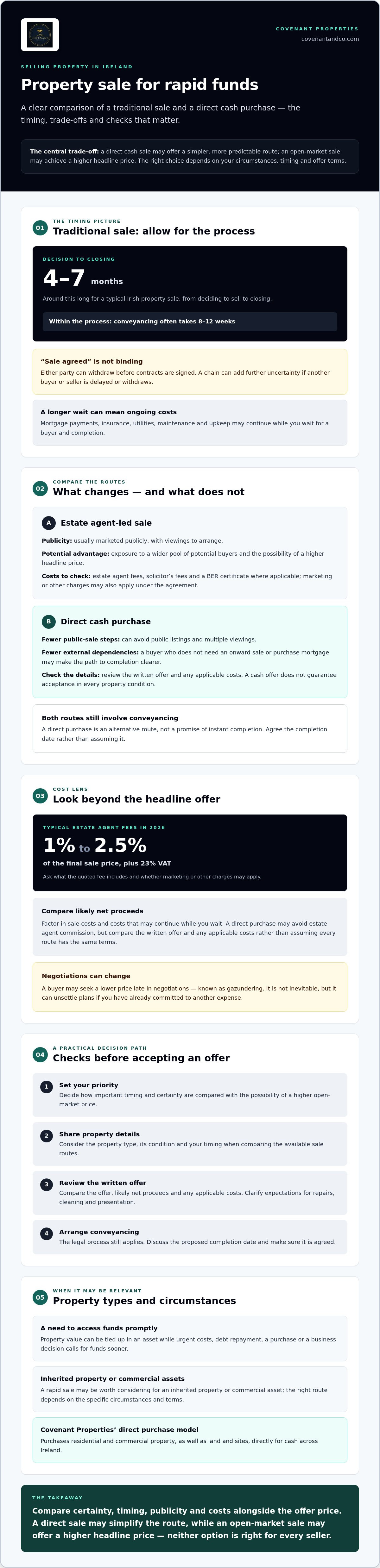
A typical Irish property sale takes around 4 to 7 months from the decision to sell to closing. Even after a property is sale agreed, conveyancing often takes 8 to 12 weeks. And sale agreed isn’t legally binding: either party can withdraw before contracts are signed. This can make it difficult to plan around a fixed date if you need the proceeds for a purchase, debt repayment or business decision.
A chain adds another point of uncertainty. If a buyer needs to sell their own property, delays or a withdrawal elsewhere can disrupt your plans. A longer marketing period may also mean continuing costs, such as maintenance and bills, alongside sale expenses. When comparing routes, factor in estate agent fees, solicitor’s fees and a BER certificate, where applicable.
Direct Cash Purchase: An Alternative Route
A direct cash buyer removes some of the steps associated with public listings, viewings and a buyer’s mortgage approval. If the buyer doesn’t need an onward sale or a purchase mortgage, there can be fewer external dependencies. This may make the path to completion clearer, although the legal process still applies and the completion date should be agreed rather than assumed.
For a seller who needs funds promptly, the certainty of a buyer’s funding can matter as much as speed. A direct purchase is an alternative sale route, not a promise that every sale will complete instantly or suit every owner. Weigh the trade-off openly: a traditional sale may achieve a higher price, while a direct offer may prioritise a simpler, more predictable transaction.
Covenant Properties purchases residential and commercial property, as well as land and sites, directly for cash across Ireland. This gives owners an option to consider when selling a home, disposing of a commercial asset or releasing value from land. The right route depends on your circumstances, timing and the terms of the offer.
Direct Cash Buyers vs. Traditional Estate Agents: A Comparison
Choosing how to sell means comparing more than the offer price. Consider what you may receive after costs, how much public exposure you’re comfortable with and how dependable the buyer’s funding is. The Central Statistics Office’s latest property price data can help you understand market movements, but it can’t predict your individual sale price or how long a particular transaction will take.
Calculating the True Cost of an Estate Agent Sale
In 2026, estate agent fees typically range from 1% to 2.5% of the final sale price, plus 23% VAT. Ask what the quoted fee includes and whether marketing or other charges may apply under your agreement. Then estimate your likely net proceeds after sale costs. A direct purchase may avoid estate agent commission, but compare the written offer and any applicable costs rather than assuming every route has the same terms.
Time has a cost, too. Mortgage payments, insurance, utilities and upkeep may continue while you wait for a buyer and completion. A buyer may also seek a lower price late in negotiations, a practice known as gazundering. It isn’t inevitable, but it can unsettle financial plans if you’ve already committed to another expense.
Publicity, Property Condition and Completion
An estate agent sale usually involves marketing the property publicly and arranging viewings. That can expose it to a wider pool of potential buyers, but it takes preparation and means managing access. A private direct sale can avoid public listings and multiple viewings. Clarify what the buyer expects regarding repairs, cleaning and presentation. A cash offer doesn’t automatically mean the property will be accepted in every condition.
There’s also an important distinction between a cash buyer and a no chain buyer. A no chain buyer doesn’t need to sell another property first, but may still rely on mortgage approval. A cash buyer doesn’t need purchase mortgage funding, reducing the risk of a lender declining the loan. Neither label guarantees a completion date. Ask about proof of funds, conditions, conveyancing and the proposed timetable.
For a Property sale for rapid funds Ireland, compare likely net proceeds and the reliability of the route, not just the headline offer. Covenant Properties purchases residential and commercial property, as well as land and sites, directly for cash. If you’re weighing up options for a home, see this guide to selling a home without an estate agent. You can also review the direct property purchase option and check the proposed terms against your needs.
Strategic Scenarios: When to Choose a Rapid Property Sale
A faster sale can help when holding an asset is creating practical or financial pressure, but the right route depends on your authority to sell, the property’s condition and the terms offered. A direct buyer may simplify the sale itself. It can’t remove separate legal steps or guarantee that funds will be available by a particular date, so confirm the process with your solicitor before making plans around the proceeds.
Inherited Property and Probate Sales
An inherited home can involve several beneficiaries, an executor and decisions about repairs, upkeep or distribution of the estate. Selling in its existing condition may avoid preparing an older property for public viewings, although the buyer’s offer will reflect its condition. A cash offer can give executors a clearer buyer and sale figure to consider when planning estate distribution, once they have authority to sell and conveyancing can proceed.
Probate and the property sale are related, but they aren’t the same process. A direct offer may help establish a route for disposing of the asset; it doesn’t bypass the legal steps required to confirm who can sell it. Executors should check the position with their solicitor and ensure beneficiaries understand the proposed terms.
Commercial and Land Asset Disposal
For a business, selling an office, retail or industrial property can release capital for reinvestment or support an orderly liquidation. A direct purchase offers an alternative to public marketing, which may suit owners seeking a more private disposal route. Covenant Properties purchases commercial property, land and sites directly for cash. Find further context in this guide to selling commercial property in Ireland.
Landowners may also consider a sale where a site is being held without planning permission. Don’t assume permission will be obtained or included as part of a sale. Establish what information and title documents a buyer needs, and make sure the offer reflects the site as it stands. A direct sale may turn an asset into funds for another project, subject to due diligence and conveyancing.
Financial Pressure and Property Decisions
If mortgage arrears or other urgent commitments are making it difficult to hold a property, a sale may be one option to discuss promptly with your lender and solicitor. Compare the proposed net proceeds and timetable with your obligations. A cash purchase may reduce reliance on a buyer’s mortgage or chain, but it can’t guarantee that repossession will be avoided or that funds will arrive before a deadline.
In each scenario, a Property sale for rapid funds Ireland is a decision about timing, certainty and value. Get the offer and conditions in writing, understand what must happen before completion and check that the route fits your circumstances before proceeding.
Steps to Securing Rapid Funds Through a Direct Sale
A direct sale can remove some market delays, but it still follows a legal process. In Ireland, a solicitor must handle conveyancing. To help keep matters moving, share accurate property details early, instruct your solicitor promptly and agree a realistic completion date with the buyer.
- Make an initial enquiry. Give a clear outline of the property, its condition and any known issues. For commercial property or land, include relevant details about the asset and any documents you already hold.
- Review the offer. Ask how the buyer reached the proposed figure, what conditions apply and whether the valuation or offer creates any obligation. Take time to understand the terms before deciding.
- Instruct your solicitor. Once you accept the terms, your solicitor can handle the legal work, check title and raise or respond to enquiries.
- Agree completion and transfer. Your solicitor will coordinate the closing steps. Sale proceeds are transferred as part of completion, subject to the transaction’s legal and financial arrangements.
Preparing for a Fast Legal Process
Preparation can prevent avoidable pauses. Ask your solicitor what they need for your specific property and locate relevant paperwork early. This may include title deeds or folio details, planning and building records, details of any mortgage, and documents relating to the property’s boundaries or management. Requirements depend on the circumstances, so use your solicitor’s list rather than treating this as exhaustive.
If a lender, solicitor or another party holds the title deeds, ask where they are and what is needed to release them. Having them ready may help your solicitor begin checks sooner. A direct buyer can liaise with your solicitor, but can’t replace their legal work or control every enquiry, third party or registration step.
From Offer to Completion: What to Expect
A cash transaction may complete in weeks, often faster than a traditional sale, but there’s no single timetable for every property. Title issues, missing information and conveyancing can all affect progress. Discuss the target date early and confirm it with both solicitors. You may be able to agree a closing date that suits your plans, but don’t rely on it until the necessary steps are complete.
For a Property sale for rapid funds Ireland, a clear offer is only the start. Use this fast property sale checklist to prepare, then discuss a direct cash purchase of your property with Covenant Properties.
Covenant Properties: Certainty in an Uncertain Market
A direct sale should be clear from the first conversation. You need to understand what is being considered, how an offer has been reached and what steps remain before completion. Covenant Properties is an Irish firm that purchases property and land directly for cash, offering an alternative to listing with an estate agent and managing public viewings.
A Clear and Direct Purchase Process
Covenant Properties considers residential property, commercial property, and land and sites across Ireland. Its direct purchase model offers an alternative to marketing through an estate agent. This may make the route worth considering if you’re disposing of a commercial asset or want to understand your options without first preparing a public listing.
Ask how the offer reflects the asset’s condition and circumstances, what could affect the transaction, and which costs or conditions apply. Don’t assume a particular fee arrangement or completion date: request the details in writing, then review them with your solicitor. A direct cash purchase can provide greater certainty about the buyer’s funding, but the sale still depends on legal checks and agreed terms.
If you’re considering a Property sale for rapid funds Ireland, the best route is the one that fits your priorities. A direct offer may suit an owner who values a simpler process and less public exposure. An open market sale may be more appropriate if achieving the highest possible headline price is the main aim. Compare likely net proceeds, timing and conditions before deciding.
Start Your Direct Sale Today
To begin, share the basic details of the asset and what you hope to achieve. It can help to have the property type, its condition, relevant ownership or title information, and your preferred timing to hand. You don’t need to have every answer ready; your solicitor can advise on documents and legal questions as the process develops.
- Residential property: outline the home’s condition and any known issues.
- Commercial property: describe the asset and your reason for considering a sale.
- Land or a site: provide the details and documents you have available.
Take time to consider any proposal. Check the offer, conditions and expected steps, and don’t rely on funds being available until completion is confirmed through the legal process. A calm, informed decision is more useful than a rushed promise.
If a direct route may suit your circumstances, discuss a cash offer with Covenant Properties and find out whether your residential property, commercial property or land may be considered for purchase.
Choose the Property Sale Route That Fits Your Priorities
A Property sale for rapid funds Ireland can be a practical option when timing and a dependable buyer matter more than testing the open market for the highest possible price. A direct cash purchase can remove the buyer’s mortgage and property chain from the equation, but conveyancing still takes place, and the terms and completion date should be confirmed with your solicitor.
Covenant Properties purchases residential property, commercial property and land directly for cash across Ireland. Whether you’re considering a home sale, a commercial disposal or releasing value from a site, take time to review the offer, conditions and likely net proceeds. Clear information helps you make a decision that suits your circumstances.
If a direct sale sounds right for you, discuss a direct cash offer with Covenant Properties. Start with a straightforward conversation, understand the proposed next steps and move forward with greater clarity.
Frequently Asked Questions
How quickly can I really get funds from a property sale in Ireland?
There’s no fixed timeframe, but a direct cash purchase may complete in weeks if the buyer’s funds are available and legal checks progress smoothly. The money is generally transferred as part of completion, not when you first receive or accept an offer. Title issues, missing documents, mortgage arrangements and other legal enquiries can affect timing. Ask for a proposed schedule and confirm it with your solicitor before relying on a particular date. A Property sale for rapid funds Ireland may improve certainty, but can’t remove every delay.
Do I still need a solicitor if I sell my property for cash?
Yes. You’ll still need a solicitor to handle conveyancing, review the title and manage the legal transfer. A cash buyer may remove reliance on mortgage approval for the purchase, but doesn’t remove the legal work required to sell. Instruct your solicitor early and ask what documents they need. They can explain any issues affecting your property and help you understand the sale conditions before you commit to a completion date.
Will a direct buyer purchase a property in poor condition or with sitting tenants?
Possibly, but acceptance depends on the buyer’s assessment and the specific circumstances. Be upfront about repairs needed, occupancy, tenancy arrangements and any known issues. Don’t assume a cash buyer will accept a property in every condition or with tenants in place. Ask whether the offer is based on the property being vacant or occupied, what information is required and whether any conditions apply. Your solicitor can advise on tenancy and sale obligations.
How do you calculate the cash offer for my property or land?
The offer should reflect the asset and its circumstances, but the precise assessment can vary. For a home or commercial property, relevant considerations may include condition, title information and comparable market evidence. For land, details such as site boundaries, title and planning position may be relevant. Share accurate information and ask how the proposed figure was reached, what assumptions it relies on and whether conditions could change the offer.
Is a direct property sale more discreet than using an estate agent?
It can be. A private direct sale can avoid public listings and multiple viewings, which may suit owners who prefer less exposure. Discretion doesn’t mean skipping checks: the buyer and your solicitor will still need appropriate property and ownership information. Ask who will receive the details you provide, how the sale will be handled and whether any public marketing is planned before proceeding.
Can I sell commercial units or undeveloped land for rapid funds?
Yes, Covenant Properties purchases commercial property and land or development sites across Ireland. Its commercial property acquisitions include office, retail and industrial assets, while land may be considered with or without planning permission. Each proposal depends on the property or site details and the terms agreed. Provide the information you have, including title and planning documents, and confirm with your solicitor what is needed to progress a sale.
What are the main costs involved in a direct cash sale compared to the open market?
A direct sale may avoid estate agent commission and public marketing costs, but it isn’t automatically cost free. You’ll still need to account for your solicitor’s conveyancing fees and any relevant outlays, along with mortgage repayment or other costs that apply to your circumstances. With an open market sale, ask the agent to set out commission, VAT and any marketing charges. Compare likely net proceeds, not just the headline offer.
What happens if I have an existing mortgage on the property I want to sell fast?
You can still explore a sale, but tell your solicitor and the buyer about the mortgage early. Your solicitor can contact the lender to establish the amount needed to repay it and arrange for the outstanding balance to be dealt with as part of completion. Any remaining proceeds are then handled through the conveyancing process. Ask your lender and solicitor about repayment conditions or any shortfall before agreeing your plans.


