

What if the 1.5% quote on your contract is actually just the tip of a very expensive iceberg? When you research estate agent commission Ireland rates, the figures often look simple. You expect a fair fee for a professional service. Yet, many sellers quickly find themselves overwhelmed by a wave of unexpected outlays. It is exhausting to track marketing budgets, professional photography, and signage fees whilst your home sits on the market for months. You should not have to guess how much of your equity will remain once the dust settles.
You deserve a transparent view of what selling your property really costs in 2026. This guide promises to reveal the hidden extras behind standard rates, from the 23% VAT trap to the legal outlays that catch most people off guard. We break down every cost item by item so you can plan with confidence. You will also discover a way to bypass the stress of public viewings and the uncertainty of the open market. We provide a clear path to a faster, more certain exit strategy that prioritises your peace of mind and puts you back in control.
Key Takeaways
- Realise that estate agent commission Ireland rates are only the starting point; you must add 23% VAT to calculate the actual invoice total.
- Identify the hidden marketing outlays and legal extras that often remain undisclosed until you are deep into the selling process.
- Understand the "waiting tax," which includes the ongoing mortgage and maintenance costs incurred whilst waiting for a traditional sale to close.
- Learn why higher commission percentages do not always translate to a better final sale price for the property owner.
- Discover how a direct cash purchase removes the need for agents, viewings, and chains, providing a faster and more certain exit.
Estate Agent Commission in Ireland: Why 1% is Rarely the Full Story
Most sellers focus on the headline figure when choosing an agent. In 2026, estate agent commission Ireland rates typically sit between 1% and 2.5% of the final gross sale price. While this sounds like a small slice of the pie, it is important to understand "equity erosion." The agent takes their percentage from the total sale price, not from your actual profit. If you have a significant mortgage remaining, that 1.5% fee could represent a much larger portion of the cash you actually take home.
The recorded sale price used for these calculations is the same figure eventually processed by Tailte Éireann for property registration. Agents do not factor in your outstanding bank debt or the costs you have already invested in the property. You are paying a fee based on the property's total value, which makes the "real" cost of the service much higher than it appears on paper.
The Standard Commission Landscape in 2026
Market competition amongst agents heavily influences these headline rates. In busy urban areas, you might find rates as low as 1% due to the high volume of sales. In rural regions, where properties may take longer to shift, 2% to 2.5% remains the standard. You will generally choose between two types of contracts:
- Sole Agency: One agent has the exclusive right to sell your home. This is the most common and affordable option.
- Multiple Agency: Several agents compete to find a buyer. You only pay the one who succeeds, but the commission rate is significantly higher to cover the agent's risk.
Choosing the cheapest agent can be a false economy. An agent charging 1% who lacks the motivation or skill to negotiate might settle for a lower offer. If an expert charging 2% secures a price that is €15,000 higher, the "expensive" agent actually puts more money in your pocket.
The Percentage Model vs. Fixed Fees
The percentage model is the traditional way of doing business. It is supposed to incentivise the agent to work harder for a higher price. If the house sells for more, they earn more. However, the rise of fixed-fee online agents has challenged this. These services offer a flat rate regardless of the property value, which can save you money on high-value homes.
There is a significant catch with fixed-fee models. Many require payment upfront or shortly after listing. If your property fails to sell or if you decide to take it off the market, you may still be liable for the full fee. Traditional estate agent commission Ireland models usually operate on a "no sale, no fee" basis, providing a level of protection if the market proves difficult.
The Hidden Extras: VAT, Marketing, and the Cost of Listing
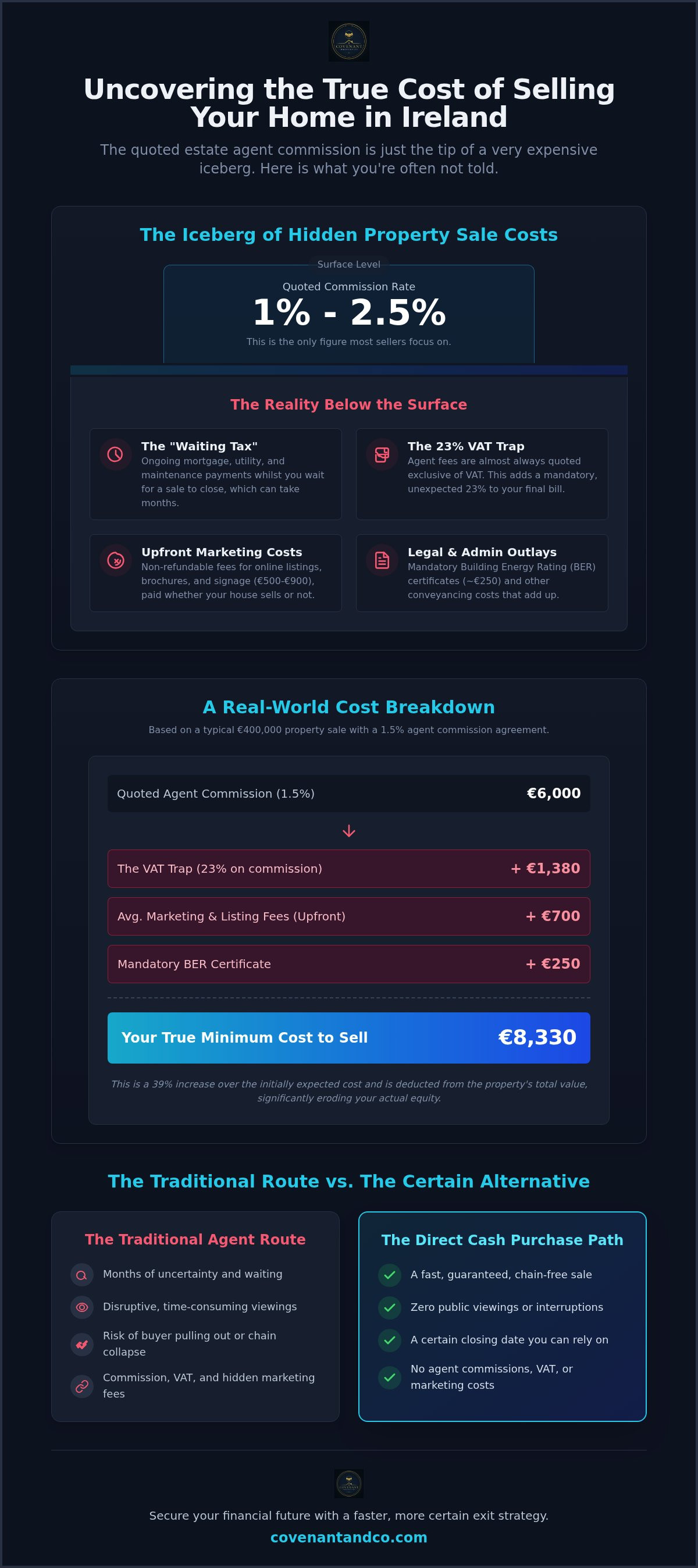
You might assume the commission percentage covers the entire cost of the agent's work. It rarely does. The most significant shock for many sellers is the 23% VAT trap. Estate agents usually quote their fees exclusive of VAT. If your estate agent commission Ireland agreement states a 1.5% fee on a €400,000 sale, you expect to pay €6,000. In reality, the 23% VAT adds another €1,380 to your bill. This silent profit killer is a mandatory tax that the agent must collect, but it comes directly out of your pocket.
Beyond the commission, you must budget for mandatory certificates and presentation costs. A Building Energy Rating (BER) certificate is required by law before you can even list the property. This typically costs approximately €250. Professional photography and floorplans are also standard requirements for a modern listing. Whilst some agents include these in their fee, many bill them as separate extras. These presentation costs ensure your home looks its best, but they are upfront expenses you must pay before a single viewer walks through the door.
The Reality of Marketing Outlays
Marketing fees represent a significant financial risk. To get your property seen, it must appear on major portals like Daft.ie and MyHome.ie. These listing fees, combined with professional brochures and signage, typically range from €500 to €900. The Property Services Regulatory Authority (PSRA) mandates that all such charges must be clearly disclosed in your Letter of Engagement.
The danger lies in the non-refundable nature of these costs. Most agents require marketing fees to be paid upfront or upon listing. If you decide not to sell, or if the property remains on the market for six months without an offer, you do not get this money back. You are essentially gambling with your own cash to attract interest. For those who prefer to avoid these upfront risks, a direct property purchase removes the need for marketing budgets and public portals entirely.
Legal and Conveyancing Fees
Selling a property involves a separate legal process that your estate agent does not handle. You will need to hire a solicitor to manage the conveyancing. For a straightforward sale in 2026, legal fees typically range between €1,500 and €1,700. Just like the agent's fee, these are subject to 23% VAT.
You must also account for outlays. These are third-party costs your solicitor pays on your behalf, such as land registry searches and closing documents. These outlays usually add another €150 to €300 to your final legal bill. When you add the agent's commission, the VAT, the marketing, and the legal fees, the "true" cost of selling often reaches 3% to 4% of your property's value. Understanding these numbers early helps you avoid the anxiety of a shrinking profit margin at the finish line.
Many sellers believe that paying a higher estate agent commission Ireland rate guarantees better service or a higher sale price. It is a logical assumption. If the agent earns more, they should work harder. However, the percentage model actually creates a subtle conflict of interest. While you want the absolute maximum price for your property, your agent is often prioritising a fast, guaranteed sale. If you look at an official overview of property transaction costs, you will see that commission is just one piece of a complex puzzle.
Consider the maths. If an agent negotiates for an extra two weeks to get you €5,000 more, they only earn a tiny fraction of that increase. At a 1.5% commission rate, that extra €5,000 for you only nets the agent an additional €75. From their perspective, the time and effort required to secure that extra money are often not worth the reward. They would rather close the sale today and move on to the next listing. This is the reality of the volume-based property market.
Analysing the Agent Incentives
There is a distinct difference between getting a sale and getting the best price. Agents are incentivised to drive volume. This often leads to "under-quoting," where a property is listed at a lower price to attract a crowd of bidders. While this creates a buzz, it doesn't always lead to the highest final offer. It simply ensures the property sells quickly. For the seller, this can lead to "viewing fatigue." You spend weeks cleaning, tidying, and leaving your home for strangers, only to be pressured to accept the first decent offer just to make the process stop.
The "No Sale, No Fee" model also has a dark side. If your property proves difficult to sell due to legal complexities or market conditions, the agent might quietly deprioritise it. They won't tell you they've given up. They will simply stop suggesting it to active buyers. Their resources are better spent on properties that sell themselves. You are left in limbo, paying mortgage interest and maintenance whilst your listing goes stale.
The Risk of Public Viewings
Public listings can actually reduce your negotiating power. Once a property has been on the market for more than six weeks, buyers start to ask what is wrong with it. They smell blood in the water. They know you are likely getting tired of the process. This psychological pressure often forces sellers to settle for less than the property is worth. If you want to avoid this cycle, you can learn how to sell a house without viewings in Ireland using a direct purchase model. This approach removes the strangers from your hallway and the anxiety from your timeline. It replaces public performance with a private, certain transaction.
Calculating the True Cost: Estate Agent Fees vs Direct Cash Sales
When calculating estate agent commission Ireland, most sellers stop at the percentage on the contract. They forget the "Waiting Tax." If your sale takes six months to complete, you are still paying the mortgage interest. You are still paying for a property you no longer want. This is money that will never return to your pocket. It is a silent drain on your final profit that traditional calculations often ignore.
A chain break is more than just a disappointment; it is a financial setback. In the Irish market, approximately one in three sales hit a snag before completion. If a buyer pulls out at the last minute, you may have to pay your solicitor for the aborted work. You will certainly have to pay for fresh marketing. In a fluctuating 2026 market, the price you were promised six months ago might no longer be available. Certainty is a financial asset that protects your equity from market shifts.
The Impact of Sale Duration
In 2026, the average property sale in Ireland takes between six and nine months to move from listing to keys-in-hand. During this period, you remain responsible for Local Property Tax (LPT), building insurance, and standing charges for utilities. These costs accumulate quietly whilst you wait for a buyer's mortgage approval. The holding cost of an empty property in 2026 is the total sum of non-recoverable expenses incurred to maintain a property from the date of listing until the final transfer of funds. If you are paying €1,200 a month in mortgage interest and maintenance, a six-month wait costs you €7,200 before you even pay the agent's invoice.
Comparing the Exit Routes
Choosing between an agent and a cash buyer is about balancing a potential headline price against guaranteed speed. An estate agent offers the chance of a high price, but it comes with high fees, 23% VAT, and low certainty. A direct cash buyer offers a fair price with zero commission and 100% certainty. The timeline for a cash purchase is often as short as 14 days, which eliminates the waiting tax entirely. You can read a detailed breakdown of these paths in our guide on Selling in Ireland 2026: Cash Buyer vs Estate Agent.
If you want to avoid the "commission trap" and the ongoing costs of a slow sale, a direct purchase offers a clean break. You get a clear figure and a fixed closing date that suits your schedule. To see how this works for your specific situation, you can request a direct cash offer today and move forward with total clarity.
Covenant Properties: The Certain Alternative to Traditional Commissions
Traditional selling is often a performance. You clean, you wait, and you hope a buyer's mortgage approval remains valid until the finish line. Covenant Properties offers a different path. We provide direct cash purchases for residential, commercial, and land assets across Ireland. By selling directly to us, you bypass the need for an agent entirely. This means you skip the estate agent commission Ireland fees and the associated 23% VAT that eats into your equity. You move from a state of uncertainty to one of total clarity.
Our "Zero Commission" promise is straightforward. What we offer is exactly what you receive at closing. There are no hidden marketing outlays, no professional photography bills, and no portal listing fees. This transparency removes the financial anxiety that often accompanies a traditional sale. You get a clear, certain figure from the start. We prioritise your peace of mind by stripping away the bureaucratic obstacles that slow down traditional transactions.
Our Direct Purchase Process
Our process is designed for speed and discretion. We provide a cash offer within 24 hours of a site visit. There are no public viewings and no brochures. Your property never appears on Daft.ie or MyHome.ie, ensuring your sale remains private. This approach is the favourite choice for inherited or probate properties. Families often prefer a quiet, respectful transaction without the circus of an open market listing or the stress of managing dozens of strangers walking through a loved one's home.
We handle the complexity so you don't have to. Whether you are selling a family home, a commercial unit, or a plot of land, we act as a seasoned partner. We remain unfazed by legal density or difficult market conditions. Our goal is to provide a smooth, frictionless exit that respects your circumstances and your time.
Take Control of Your Property Sale
Taking control of your sale means choosing a timeline that works for you. You don't have to wait for a buyer in a chain to sell their own house. You choose the closing date. We offer flexible arrangements that allow you to move when you are ready, not when a bank says you can. If you want to compare the different routes available to you, read our Sell Home Without Estate Agent Ireland: The 2026 Comparison Guide.
Avoid the "commission trap" and the long timelines of the open market. You can secure a certain sale without the traditional obstacles. Get a no-obligation cash offer for your property today and discover how simple a property sale can be.
Secure Your Financial Future and Final Profit
The traditional property market in 2026 remains a complex landscape of hidden outlays and mounting holding costs. The headline estate agent commission Ireland rate is rarely the final figure on your invoice. Between the 23% VAT trap, non-refundable marketing fees, and the "waiting tax" of a six-month sale timeline, your equity can erode whilst you wait for a buyer. You deserve a path that offers transparency and certainty from the very first day.
Choosing a direct purchase allows you to bypass the anxiety of public viewings and the risk of broken property chains. We provide a straightforward cash purchase for residential, commercial, and land assets with no estate agent commission or hidden fees. You get a guaranteed sale on a timeline that you control. It's time to move forward without the stress of the open market. Request a direct cash offer for your property today and take the first step toward a clean, professional exit. Your peace of mind is our priority, and we are ready to help you close this chapter with confidence.
Frequently Asked Questions
How much is the average estate agent commission in Ireland in 2026?
The average commission typically ranges from 1% to 2.5% of the final sale price. In urban centres, you might find rates closer to 1%, whilst rural properties often attract a 2% to 2.5% fee. This percentage is calculated on the gross sale price. It is important to remember that this figure does not include VAT or marketing outlays. These additional costs will increase your total bill significantly at the end of the transaction.
Is VAT included in the estate agent commission quote?
No, VAT is almost never included in the initial commission quote provided by an agent. In Ireland, the standard VAT rate for estate agent services is 23%. This tax is applied to both the commission and any marketing fees. For example, a €5,000 commission fee will actually cost you €6,150 once the VAT is added. Always check your letter of engagement to ensure you have budgeted for this mandatory tax before signing.
What are the typical marketing costs when selling a house in Ireland?
Marketing costs usually range from €500 to €900 for a standard residential sale. These fees cover professional photography, floorplans, signage, and listings on major property portals like Daft.ie and MyHome.ie. Agents often require these fees to be paid upfront or shortly after the property is listed. These costs are non-refundable, even if the property does not sell or you decide to take it off the market for personal reasons.
Can I negotiate the commission rate with my estate agent?
Yes, you can certainly negotiate the commission rate with your estate agent. Many agents are willing to discuss their fees to secure a listing, especially for high-value properties or in competitive areas. You might also negotiate a fixed-fee model instead of a percentage. However, be aware that a lower fee might result in a smaller marketing budget or less individual attention from the agent during the critical negotiation process with potential buyers.
What happens to the commission if my property sale falls through?
If the sale falls through, you typically don't owe the commission fee under a "no sale, no fee" agreement. However, you will likely still be liable for any marketing outlays already spent. This includes the costs for photography, brochures, and online portal listings. Your solicitor may also charge for the legal work completed up to that point. It is vital to clarify these specific terms before signing any contract with a traditional agent.
Are there any hidden fees when using a "No Sale, No Fee" agent?
The primary hidden fees in "no sale, no fee" agreements are the marketing outlays and professional services. Whilst you don't pay the estate agent commission Ireland fee if there is no sale, you still pay for the BER certificate and the marketing package. Some agents also charge a withdrawal fee if you remove the property from the market before the contract ends. Always read the fine print regarding non-refundable expenses and administrative charges.
Is it cheaper to sell a house without an estate agent in Ireland?
Selling without an agent saves you the commission fee, which can be thousands of euros. However, you still have to pay for marketing, professional photography, and legal fees yourself. You also take on the burden of managing all viewings, vetting buyers, and negotiating the price. For many, the time and stress involved outweigh the savings. A direct cash purchase offers a way to save on commission whilst also removing the work and uncertainty.
How does a direct cash offer compare to an estate agent valuation?
An estate agent valuation is an estimate of what the property might achieve on the open market. It is not a guaranteed price. In contrast, a direct cash offer from Covenant Properties is a firm, certain figure. Whilst an agent valuation might be higher, it doesn't account for commission, VAT, or the "waiting tax" of a long sale. A cash offer provides a 14-day timeline and total financial certainty without any hidden fees or chains.


