

Could selling your commercial building directly reduce the need for public marketing and give you a clearer view of the next steps? If “Direct commercial building sale Ireland” is what brought you here, you’re likely weighing an alternative to a drawn-out or complicated sale.
A direct sale still involves assessing the property, sharing clear information and completing legal work. The right route depends on the building and your priorities, not simply on the promise of a quick sale.
This 2026 guide explains the process, from an initial discussion with a buyer through to completion. You’ll learn what information can help a buyer assess an office, retail or industrial property, how to prepare useful details and what to consider when deciding whether a direct purchase suits you. Covenant Properties directly purchases commercial property across Ireland, including buildings and development sites. Use this guide to prepare for an informed conversation and decide on a next step that fits your circumstances.
Key Takeaways
- A Direct commercial building sale Ireland route means discussing a sale directly with a prospective purchaser rather than marketing the building publicly.
- The process typically involves an initial discussion, property assessment, offer discussions and conveyancing. The steps and timing depend on the property and transaction.
- Compare a direct sale with public marketing by considering exposure, competition, process and how involved you want to be.
- Gather core details about ownership, occupancy, floor area, current use and known condition. Separate documented facts from estimates.
- Covenant Properties directly purchases office, retail and industrial properties from owners across Ireland.
Is a direct commercial building sale in Ireland right for your situation?
A direct commercial building sale is a sale discussed between an owner and a prospective purchaser, without first marketing the building publicly. The initial conversation can establish whether there is a basis to proceed, but it doesn’t replace property assessment, agreement on terms or the legal transfer.
This section focuses on buildings such as offices, shops and industrial premises, rather than residential property or land-only sales. A site with no building is a different type of asset, even though an owner may also consider selling it directly. Mixed-use properties, buildings with several occupiers and assets with unusual features may need closer assessment before either side can judge whether a purchase is suitable.
What counts as a commercial building?
Start with the building’s current use. An office used for business operations, a retail unit serving customers and an industrial building used for production or storage are familiar examples. Current use may not tell the whole story: a property combining commercial and other uses, or one with complicated occupancy or condition details, may need further review. Keep a building sale distinct from a land-only or development-site sale.
When might an owner consider a direct sale?
An owner may value privacy, want to limit public marketing or prefer to speak directly with a prospective purchaser. Having a clear point of contact and defined next steps may also appeal. These priorities don’t necessarily indicate financial pressure or urgency. You may simply prefer a focused conversation about a particular building and its circumstances.
There are trade-offs. Public marketing can put a property in front of multiple potential buyers and may encourage competitive bidding, but it also involves presenting the building to the market. A direct discussion centres on one prospective purchaser at a time. That can make the conversation more focused, but it doesn’t provide broad exposure by itself.
It’s also useful to distinguish a sale route from an auction or a letting. An open-market listing presents a property publicly to attract interest. An auction is a sale process involving bidding. Letting grants someone use of a property under agreed terms; it isn’t a transfer of ownership. Consider the outcome you want before comparing these different routes.
The phrase Direct commercial building sale Ireland describes a route, not a promise about price, buyer response or completion date. Whether it fits depends on your priorities, the asset and the circumstances of the transaction. Consider how important privacy is, whether you want broad market exposure, how involved you want to be and how clearly you can explain the building’s situation to a prospective purchaser. A direct purchase may suit you if focused discussions match those priorities. If reaching a wider pool of potential buyers matters more, public marketing may be a better fit.
How a direct commercial property sale moves from first discussion to offer
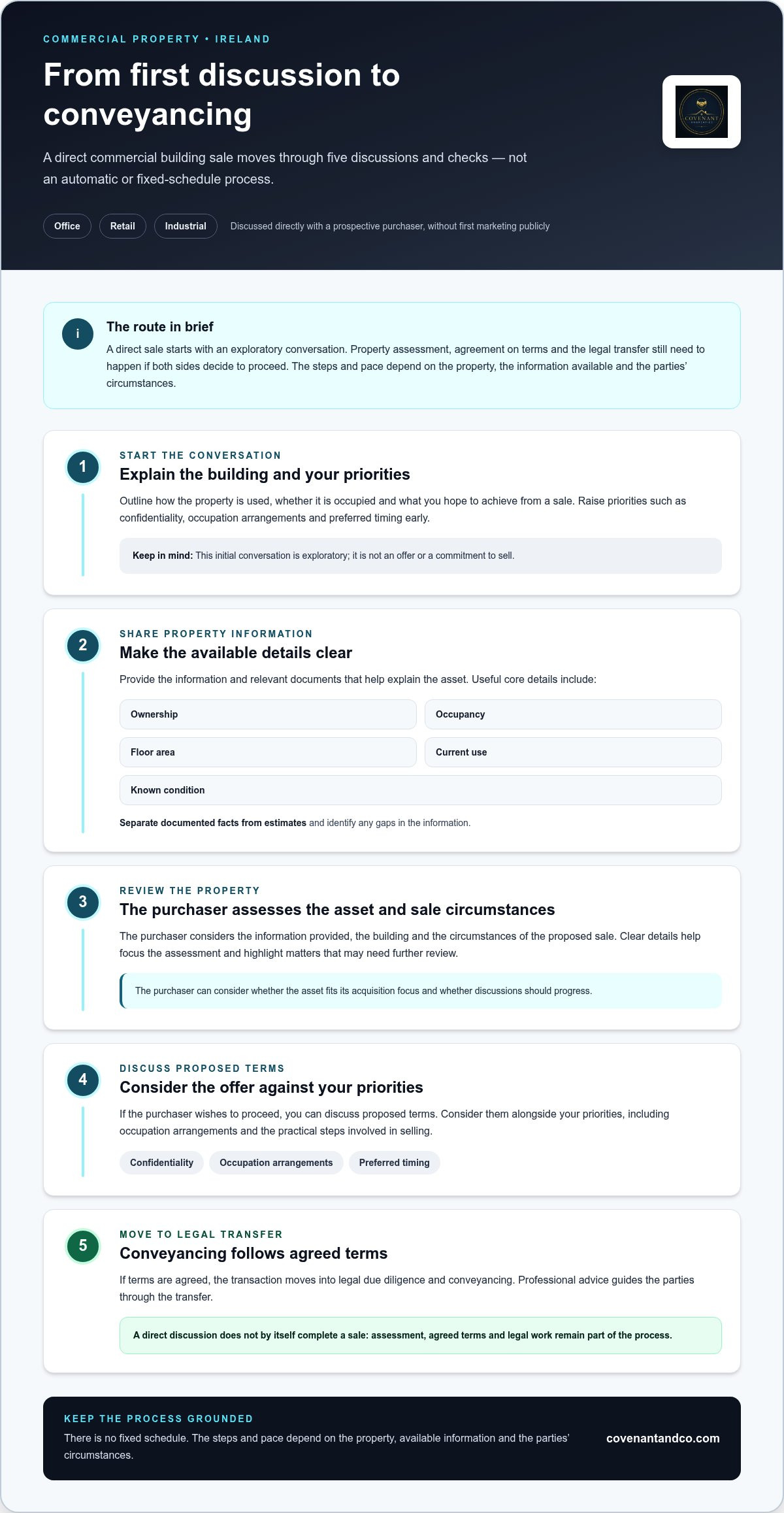
A direct commercial acquisition is discussed between a property owner and a prospective purchaser, without first marketing the building publicly. It involves conversations and checks, not an automatic route to a completed sale. There is no fixed schedule: the steps and pace depend on the property, the information available and the parties’ circumstances.
For context, the Society of Chartered Surveyors Ireland’s Commercial Property Market Monitor Ireland provides a wider view of market conditions. It may help you understand the market backdrop, but a report can’t determine the terms for an individual building.
What happens in the initial property discussion?
Begin with the essentials: explain how the building is used, whether it’s occupied and what you hope to achieve from a sale. Raise priorities such as confidentiality, occupation arrangements and preferred timing early. This helps keep them in view as discussions progress. The purchaser can then consider whether the asset fits its acquisition focus. An initial conversation is exploratory; it isn’t an offer or a commitment to sell.
How do assessment and offer discussions progress?
If both sides want to explore the sale, the purchaser will need enough detail to assess the building and understand the proposed transaction. This may include property information and relevant documents. Keep facts distinct from estimates and identify any gaps. Clear information helps focus the assessment and highlight matters that may need further review.
- Initial discussion. Outline the building, its use and occupancy, your broad objectives and any priorities around privacy or timing.
- Property information. Share the available details and documents that help explain the asset. This gives the purchaser a basis for review.
- Assessment. The purchaser considers the information provided, the building and the circumstances of the proposed sale. This helps establish whether discussions should progress.
- Offer discussion. If the purchaser wishes to proceed, you can discuss proposed terms. Consider them against your priorities, including occupation arrangements and the practical steps involved in selling.
- Conveyancing. If terms are agreed, the transaction moves into legal due diligence and conveyancing, with professional advice guiding the parties through the transfer.
Keep communication open as the sale progresses. If an important detail changes, such as a tenant’s position or your preferred timing, raise it promptly. Both sides can then consider its effect before moving further.
A Direct commercial building sale Ireland process works best when the owner and prospective purchaser have a clear picture of the asset and proposed terms. Owners considering this route can discuss a commercial property purchase with Covenant Properties, with their priorities at the centre of the conversation.
Direct sale or open market: compare the route against your priorities
Neither route guarantees a higher value, quicker sale or more favourable terms. The difference is how you approach prospective buyers and manage the sale. Public marketing may reach a broader pool, while direct discussions focus on a prospective purchaser. The building’s condition, occupancy and title information can shape either conversation.
| Consideration | Direct sale | Open-market sale |
|---|---|---|
| Exposure | Discussion centres on a prospective purchaser, which may suit an owner seeking less public marketing. | Public advertising may bring the property to the attention of multiple prospective buyers. |
| Process | Begins with a focused conversation and assessment of the particular building. | Can involve preparing marketing details, handling enquiries and arranging viewings. |
| Owner involvement | You discuss the property and priorities directly with the purchaser. | You may need to contribute to marketing, respond to enquiries and consider interest from different parties. |
| Potential competition | One purchaser’s interest does not itself create competition from other buyers. | Broader exposure may attract interest from multiple buyers, though competition isn’t assured. |
What does a direct sale prioritise?
A direct sale gives the owner and prospective purchaser space to discuss the individual asset, including its condition, current occupation and relevant title information. This focused exchange may suit an owner who values privacy or would rather not advertise publicly. It doesn’t remove the need to examine proposed terms carefully. The property still needs appropriate assessment, and legal due diligence remains part of progressing an agreed transaction.
What does an open-market sale prioritise?
Public marketing aims to present the property to a broader pool of potential buyers. Depending on the sale approach, you may need to accommodate viewings, respond to enquiries and manage offers. Wider reach may matter if you want to test interest from multiple parties. It doesn’t guarantee competing bids or a particular result, just as a direct discussion doesn’t guarantee a simpler or more attractive outcome.
Property details can influence either route. Known condition issues may prompt questions or affect how a buyer assesses the building. Occupancy arrangements may matter to someone considering its use, while unclear or incomplete title information may require further review. These points aren’t automatic barriers to a sale. They are reasons to present what you know accurately and allow time for relevant questions and checks.
Before choosing, weigh what matters most: privacy, wider exposure, the amount of public-facing activity you’re comfortable with, and how clearly you can explain the property’s condition, occupation and title position. A Direct commercial building sale Ireland route may suit a preference for focused discussions; open-market marketing may better match a priority for broader reach.
Choose the route that best matches your priorities and your property. This keeps the decision grounded in your circumstances, rather than in assumptions that one method always produces a better price, faster sale or stronger terms.
Prepare your commercial building information before discussing a direct sale
A clear snapshot of the building helps a prospective purchaser understand what’s being considered and identify details that may need closer review. You don’t need to resolve every question before an initial conversation. Gather what you have, label estimates clearly and flag anything you’re unsure about.
For a Direct commercial building sale Ireland discussion, accuracy matters more than presentation. A simple folder of relevant records and a short property summary can help you explain the asset without overstating its condition, use or legal position.
Which building details should you gather?
Record the basics first. Keep the information factual and note where a figure or description is approximate.
- Ownership: Note who owns the property and gather available title or ownership records. Don’t draw conclusions about legal rights from documents that haven’t been professionally reviewed.
- Occupancy: State whether the building is vacant or occupied. List known leases or occupier arrangements, with any dates or documents you hold, but don’t interpret their legal effect.
- Floor area: Include available floor-area measurements and identify their source. If you only have an estimate, label it as such rather than presenting it as verified.
- Current use: Describe how the building is used now. If its use has changed or you’re unsure about relevant permissions, record that clearly rather than assuming the position.
- Known condition: Note visible issues, repairs or changes you’re aware of. Separate first-hand observations from information provided by someone else.
Be open about material changes, restrictions or unresolved matters. A question mark is more useful than an unsupported assurance. Mark details that need checking for professional review.
Which documents may support an initial assessment?
Gather documents already available to you rather than trying to create a complete legal or technical file on your own. Relevant records may include title information, plans, lease documents, planning records and building documents. Which items matter depends on the property and transaction. Documents can help explain the building, but their inclusion doesn’t establish what they mean or whether they are complete.
Organise copies by topic and make a short index. For example, separate ownership records from occupancy papers and plans. Note missing documents or differences between the records and your current understanding. A solicitor or other relevant professional can advise on legal interpretation, planning matters and transaction-specific requirements in Ireland.
If you’re weighing up the wider sale route as well as preparing property information, this guide to selling commercial property in Ireland offers a broader overview. Once your notes are in order, you can discuss your commercial building with Covenant Properties and share the facts that help start an informed conversation.
Progress your direct commercial building sale with Covenant Properties
Covenant Properties directly purchases commercial property from owners across Ireland. Its acquisition focus includes office, retail and industrial buildings. A direct purchase offers an alternative to publicly marketing a building, with discussions centred on the asset and the owner’s priorities.
Considering a Direct commercial building sale Ireland route doesn’t mean you need every detail settled before you begin. Start with a clear outline of the property and what matters to you. This gives both sides a basis for considering the building and discussing the next steps.
What can owners discuss with Covenant Properties?
Begin with the essentials: the type of building, its current use, whether it’s occupied and the broad circumstances behind your sale plans. You can also raise any preference for privacy, your position on existing occupiers and timing considerations. These details help shape a relevant conversation and bring practical questions into the open early.
Covenant Properties considers commercial acquisitions across Ireland. If a building has mixed use, a particular condition issue or an unusual occupancy arrangement, describe what you know plainly. Clear facts help the purchaser understand the property. Any unanswered questions can be identified for further consideration rather than settled by assumption.
How can you take the next step with confidence?
Share the property basics and any documents you already have to hand. Keep estimates distinct from verified information, and explain anything that may need review. If an offer or proposed terms follow, consider the whole proposal against your priorities. Look beyond the headline price: occupation arrangements, conditions and the steps needed to progress the transaction can all matter to your decision.
An initial discussion isn’t a commitment to sell. You can consider whether the proposed route and terms suit your circumstances. If you decide to proceed towards an agreed transaction, legal due diligence and conveyancing remain part of the process. A solicitor can advise on the legal documents and transaction-specific requirements, helping you understand what you’re agreeing to before completion.
There’s no need to rush a decision. A conversation can help clarify what information is useful, which questions remain open and whether a direct purchase fits your aims. To discuss your building and sale circumstances with Covenant Properties, discuss your commercial building sale with Covenant Properties.
Take the next step on your terms
A sale decision doesn’t need to be made all at once. Start by deciding what a satisfactory outcome would look like for you: the level of privacy you want, how the building’s current use affects your plans and which terms matter most. That gives you a practical basis for judging a proposal, rather than feeling pushed towards a route that doesn’t fit.
A Direct commercial building sale Ireland can begin with an open discussion, not a commitment. Use that first step to clarify what the buyer needs to understand and what you need to know in return. Take time to consider proposed terms and seek professional advice on the legal details before deciding how to proceed.
Covenant Properties directly purchases commercial property from owners across Ireland, including office, retail and industrial assets. If you’re ready to explore whether a direct purchase fits your circumstances, discuss your commercial building sale with Covenant Properties.
Frequently Asked Questions
Is a direct commercial building sale the same as selling at auction?
No. A direct sale involves discussions between an owner and a prospective purchaser, while an auction is a bidding process with its own rules and sale conditions. In a direct discussion, you can consider proposed terms with the purchaser without an auction event. Neither route guarantees a particular result. Before proceeding, understand what accepting an offer or entering an auction process would mean for your obligations and ability to change course.
Can I sell a commercial building that currently has tenants?
Yes, a tenanted building can be considered for sale, but the occupancy details matter. A prospective buyer may need to understand the lease terms, rent arrangements, lease duration and any break or renewal provisions. Gather the relevant documents and avoid making promises about a tenant’s rights unless they’ve been legally reviewed. The effect of a sale on occupiers depends on the transaction and applicable documents, so seek legal advice on the specific position.
Do I need a solicitor for a direct commercial property sale in Ireland?
A solicitor’s advice is strongly recommended for a commercial property transfer in Ireland. The legal work can involve reviewing title, sale terms, documents and matters that arise during due diligence. A direct conversation with a purchaser doesn’t replace this work. Before agreeing to proceed, have a solicitor explain the documents, your obligations and any conditions affecting the transaction. The steps required can vary with the property and circumstances of the sale.
Can I sell a commercial building without planning permission?
A sale and the planning status of a building are separate questions, but missing or uncertain planning records may affect a buyer’s assessment. Significant building work or changes of use may require planning permission in Ireland. Don’t assume that a past alteration was authorised or that time alone makes it lawful. Be candid about the records you hold and ask your solicitor or planning professional to advise on specific works or use concerns.
How is a commercial building assessed for a direct sale?
A prospective purchaser considers the building as a whole, not just its floor area. Relevant factors can include current use, occupancy, condition, available title and planning information, and the completeness of supporting records. For example, an occupied building with documented lease terms presents different questions from a vacant one with unclear alterations. The assessment helps identify what is understood, what needs further investigation and whether proposed terms can be discussed.
Does a direct sale mean I have to accept the first offer?
No. Receiving an offer doesn’t oblige you to accept it. You can review the proposed price and conditions, seek professional advice, ask questions or decide not to proceed. Consider the full terms, including any conditions and how the proposed transaction fits your circumstances, rather than focusing on one figure alone. In a Direct commercial building sale Ireland discussion, an offer is a point for consideration, not a decision made on your behalf.


