

Japanese knotweed doesn’t automatically make a property impossible to sell. If you’re asking, “Sell property with Japanese Knotweed Ireland: what should I do first?”, begin by establishing what’s present and where. It’s understandable to worry that buyers, surveyors or lenders may have concerns, or that a sale could stall before completion.
Reliable information helps you make decisions with more confidence. A suitably qualified specialist can assess the site, while your solicitor can advise on disclosure and the information to prepare for a sale. Treatment approaches, records and lender requirements can vary, so don’t assume one solution will suit every property.
This guide covers practical next steps, from gathering evidence and considering a conventional sale to weighing up a direct property sale. It explains what to discuss with advisers, what buyers may want to know and how to compare your options. Knotweed can make a sale more involved, but it doesn’t mean you have no way forward.
Key Takeaways
- Japanese knotweed doesn’t automatically prevent a property sale. The right route depends on the property and its circumstances.
- Before marketing, arrange independent identification and organise dated photographs, reports and management records.
- Compare open-market and direct-sale routes by considering buyer questions, marketing and the steps each transaction may depend on.
- To Sell property with Japanese Knotweed Ireland, organise your information first, then discuss disclosure and next steps with your solicitor.
- Covenant Properties purchases residential property, commercial property and land directly, subject to an individual property assessment and agreed terms.
Can you sell a property with Japanese knotweed in Ireland?
A knotweed discovery can make an already significant property sale feel uncertain. The short answer is yes: the plant’s presence does not, by itself, make a sale impossible. The next steps depend on the circumstances, the quality of the information available and the requirements of the people involved in the transaction.
First, distinguish a confirmed identification from a suspicion. A plant in the garden, a neighbour’s report or an old note in a file may raise a question, but it doesn’t establish that Japanese knotweed is present now or show how far it extends. Before describing it as knotweed to prospective buyers, seek an independent assessment from a suitably qualified professional. A botanical overview of Reynoutria japonica (Japanese Knotweed) can provide background, but it isn’t a site-specific identification.
What Japanese knotweed means for a property sale
Japanese knotweed is a plant that may need informed assessment and management. Its presence alone doesn’t prove that a building has suffered structural damage or establish a particular reduction in value. The relevant details may include where it is growing, how far it extends and whether it has been managed before. Buyers may ask for reliable information about identification and management before deciding how to proceed.
Historic reports need context, too. Check when a report was prepared, what area it covered and whether it records treatment or follow-up. An old document may be useful, but it may not describe the property’s present condition. Dated records can help clarify what’s confirmed and what still needs checking.
Why buyers, surveyors and lenders may ask questions
Buyers and their advisers may ask where the plant is located, how close it is to buildings or boundaries, how far it extends and what management has taken place. Those questions don’t necessarily mean the buyer intends to withdraw. They may need enough evidence to assess the property and decide whether further advice is needed. Share relevant records where available, and avoid guessing about the plant or its treatment.
Lender and insurer requirements can differ between providers and transactions. The buyer should check their own requirements, and your Irish solicitor can advise on disclosure questions and any relevant obligations. Don’t assume a historic report, a treatment record or a particular sale route settles those questions for every buyer.
If you’re considering whether to Sell property with Japanese Knotweed Ireland, establish what’s known and what remains uncertain before choosing a route. The property’s condition and the buyer’s requirements can shape the next steps. A clear assessment gives you a firmer basis for answering questions.
How to confirm Japanese knotweed and assemble useful evidence
Before describing a plant as Japanese knotweed to a buyer, arrange an independent professional identification. Misidentification can create unnecessary concern, while a photograph or old note may not establish what is present now. Ireland’s Guide to Ireland's Regulated Invasive Plants can help you understand what to look for, but it isn’t a substitute for a site-specific assessment when the identification or extent is unclear.
Keep the evidence together in one organised file. You don’t need to turn informal observations into a technical report. Label them as your own notes and leave specialist findings to a suitably qualified professional.
What to gather before discussing a sale
Collect any documents already available, such as identification reports, surveys, treatment plans, contractor records and correspondence. Check the date and scope of each item. An inspection may have covered only part of the site, or management work may have taken place since it was prepared. Keep the original documents, even if you also prepare a short summary for easy reference.
Make the file straightforward to follow. Include:
- Dated photographs labelled with the location and direction they show.
- A simple property plan marking known observations, without presenting it as a specialist survey.
- Dates of previous inspections or management work, with related reports and correspondence.
- Any follow-up records explaining what was checked after work took place.
Note what you’ve observed and when, but keep your observations separate from confirmed findings. Don’t cut, move or dispose of plant material to investigate it yourself. Ask a suitable professional how to proceed, as handling or moving it may create further problems.
When to ask a specialist for an assessment
If identification is uncertain, the plant’s extent is unclear or records conflict, seek advice from a suitably qualified professional with invasive-species experience. Ask for written findings that explain what was inspected, what was observed, any limits to the assessment and the recommended next steps. Photographs can provide context, but they can’t reliably establish the plant’s extent or prove that management has succeeded.
This evidence can help your solicitor and other property professionals respond to questions during a sale. If you’re considering a direct property sale, you can discuss your property situation with Covenant Properties. Any purchase consideration would depend on an individual assessment and agreed terms. An enquiry doesn’t guarantee an offer or sale.
Compare selling on the open market with a direct property sale
There isn’t one sale route that suits every owner. A traditional sale gives you access to the open market, while a direct property sale provides an alternative to listing. Neither guarantees a particular outcome. Compare the steps, conditions and information each route requires before deciding how to proceed.
| Consideration | Open-market sale | Direct property sale |
|---|---|---|
| Process | Usually involves preparing the property for marketing, inviting viewings and considering offers. | You discuss the property with a prospective buyer, who decides whether to assess it and make a proposal. |
| Marketing | The property is presented to potential buyers, with the sale dependent on market interest. | The sale is negotiated directly rather than through a traditional market listing. |
| Buyer questions | Buyers and their advisers may ask about knotweed identification, management and available records. | The buyer may request information or an assessment of the specific property before deciding whether to proceed. |
| Transaction dependencies | Progress depends on buyer interest, due diligence and the agreed sale process. | Progress depends on the buyer’s assessment, written terms and the steps agreed by both parties. |
What to consider with a traditional market sale
An open-market sale can present your property to a range of potential buyers, but you can’t assume there will be interest or a completed transaction. You may need to provide accurate property information and respond to questions as buyers carry out due diligence. Specialist documents can help explain what has been identified or managed, but they won’t remove every buyer’s concerns or determine what evidence they require.
Discuss sale preparation and relevant disclosures with your Irish solicitor and estate agent. If you’re unsure how to answer a question about knotweed or what information to provide, get legal advice before responding.
What to ask a direct property buyer
Ask whether the buyer will assess your specific property and what documents or further information they need. Request any proposed price, conditions, costs and transaction steps in writing. Read the terms carefully and ask your solicitor to explain anything that’s unclear. A direct purchase may suit owners looking for an alternative to listing, but it isn’t automatically faster, simpler or better for every situation.
Covenant Properties directly purchases residential property, commercial property and land across Ireland, subject to individual assessment and agreed terms. Its Irish guide to cash buyers for houses provides more context. If you plan to Sell property with Japanese Knotweed Ireland, compare any written proposal and evidence requirements with the open-market route, then decide what fits your circumstances.
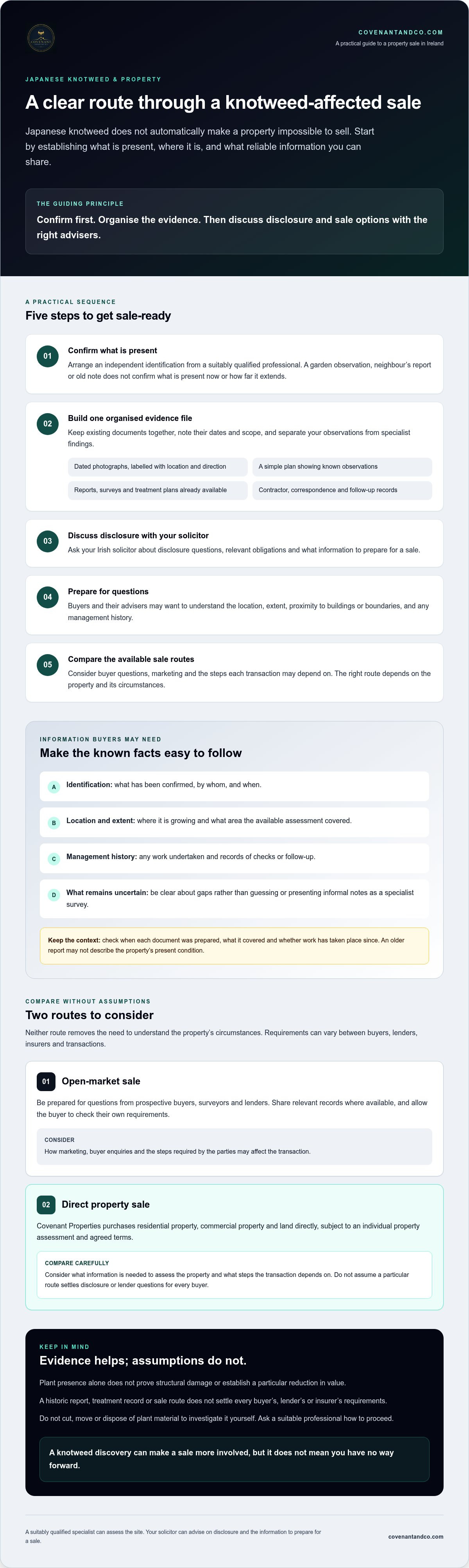
How to prepare for a sale when Japanese knotweed is present
A clear, factual record gives you and your advisers a stronger starting point. If you plan to Sell property with Japanese Knotweed Ireland, work through these steps before approaching buyers. You don’t need to have every answer straight away. Be clear about what’s confirmed and what still needs checking.
- Confirm the identification. If the plant hasn’t been professionally identified, arrange an assessment before presenting it as Japanese knotweed. Keep the written findings and note which areas were inspected.
- Gather the records. Bring together reports, dated photographs, property plans, correspondence and any treatment or management documentation. Record the dates and scope of past inspections or work.
- Seek relevant advice. Speak with your Irish solicitor early about property information and disclosure. Ask other relevant property professionals what they need to assess the sale. If a buyer has mortgage or insurance requirements, they should confirm them with the relevant lender or insurer.
- Compare sale routes. Once you have a useful summary of the property and available evidence, consider whether an open-market listing or a direct property sale better fits your circumstances. Compare written terms, conditions and information requirements before deciding.
A practical checklist before approaching buyers
Prepare a short summary covering what has been identified, what was inspected, when it was inspected and what remains uncertain. Include relevant reports and treatment records, but don’t describe historic work as proof that the plant has been eradicated unless a suitably qualified professional has confirmed that. Ask your solicitor which information to provide to prospective buyers and when.
Keep your wording consistent across conversations and documents. For example, if a report confirms knotweed in one area but hasn’t assessed the full site, state that limit rather than implying the whole property has been surveyed. If something is unknown, say so and ask what assessment may be needed.
How to manage questions and avoid preventable delays
Answer buyer questions using relevant records, not assumptions or unsupported assurances. If a question concerns legal disclosure, check with your solicitor. If it concerns the plant’s condition or management, refer to the appropriate professional. Buyer, lender and insurer requirements can differ, so ask the relevant parties to confirm what applies to the transaction rather than relying on general expectations.
Keep a written note of agreed actions, who is responsible and any dates discussed. This helps everyone track outstanding information and can reduce avoidable confusion. For wider planning, see this Irish guide to planning a property sale.
If you’re also considering a direct property sale, you can discuss your property sale options with Covenant Properties. The company purchases residential property, commercial property and land directly. Any proposal depends on an individual assessment and agreed terms.
Discuss a knotweed-affected property sale with Covenant Properties
A direct property sale may be worth considering if you’d prefer an alternative to marketing on the open market. Covenant Properties purchases residential property, commercial property and land directly across Ireland. A property affected by Japanese knotweed isn’t automatically suitable for purchase. Suitability and any proposal depend on an individual assessment and agreed terms.
An initial discussion can help you decide whether direct acquisition merits consideration. It isn’t a promise of an offer or sale. You can explain what’s known about the property, share the records you have and ask what further information may be needed for an assessment.
What information to share in an initial discussion
A concise, factual overview is a useful starting point. You may wish to include:
- The property type and your ownership position.
- Your preferred timing for a sale, if you have one.
- Any identification reports, dated photographs or management records available.
- Questions that remain unresolved, such as whether the full site has been assessed.
There’s no need to present an uncertain detail as fact. Separate professional findings from your own observations, and explain the scope and date of any report. If you don’t have a document, say so. This gives the buyer a clearer basis for deciding what to check next.
Choose a sale route that fits your circumstances
Before committing to either route, compare the written terms and conditions and discuss them with your solicitor. Consider what matters most to you: exposure to the open market, flexibility around the sale process or having a clear proposal to assess. A direct sale is one option, not a universally better choice. Your decision should reflect the property, your priorities and the evidence available.
If you’re weighing up whether to Sell property with Japanese Knotweed Ireland through a direct buyer, ask how the specific property will be assessed and what information is needed before a proposal can be considered. Check the proposed price, conditions, costs and transaction steps in writing, and seek professional advice on anything unclear.
You can discuss your property with Covenant Properties without assuming an enquiry guarantees a purchase. Share your circumstances and available knotweed information, then take time to consider whether the route and any agreed terms suit you.
Choose your next step with confidence
A Japanese knotweed discovery can add questions to a property sale, but it doesn’t automatically close off your options. Independent identification and organised records can help you explain what’s known, while early advice from your solicitor can clarify sale information and disclosure questions.
If you’re deciding how to Sell property with Japanese Knotweed Ireland, compare the open-market route with a direct sale. Consider buyer interest, the evidence required, written terms and the process that best fits your circumstances. Ask your professional advisers to review any proposal before you commit.
Covenant Properties represents local Irish investors and directly purchases residential property, commercial property and land. It offers an alternative to traditional market listings, with each property’s suitability and any proposal depending on an individual assessment. An initial discussion can help you consider whether this route may be relevant, without assuming a purchase is guaranteed.
To discuss your circumstances and explore a direct sale, contact Covenant Properties. Share the information you have and take time to consider whether the route and any agreed terms suit you.
Frequently Asked Questions
Can I sell a property with Japanese knotweed in Ireland?
Yes. A property with Japanese knotweed can be sold in Ireland; the plant’s presence doesn’t automatically make a sale impossible. The route forward depends on the property, the plant’s confirmed location and extent, available management records and buyer requirements. Arrange a professional identification if needed, then discuss the evidence and sale options with your solicitor. A conventional sale and a direct property sale are both options to consider, depending on the circumstances.
Do I have to disclose Japanese knotweed when selling a property in Ireland?
Ask your Irish solicitor what information you should disclose and when. Sellers may be asked direct questions during conveyancing, so answer accurately. Don’t present an unconfirmed suspicion as fact or conceal known information. Keep reports and management records available. Disclosure obligations can depend on the circumstances and transaction documents, so don’t rely on general guidance alone. Your solicitor can advise on how to respond to enquiries about the plant.
Will a mortgage lender refuse a property with Japanese knotweed?
Not necessarily. Lender requirements can vary, and a knotweed finding may lead to further questions or requests for specialist evidence or management information. The buyer should check directly with their lender what applies to the specific property. Don’t assume approval or refusal based only on the presence of the plant. If the buyer’s lender requests documents, ask your solicitor and the relevant property professional how to provide them.
What should I do first if I find Japanese knotweed before selling?
If you’re unsure what the plant is, arrange an independent professional identification first. Don’t describe it as confirmed Japanese knotweed based only on a photograph or informal report. Gather dated photographs, any existing inspection or treatment records, correspondence and a plan noting where it has been observed. Don’t cut, move or dispose of plant material without suitable professional advice. Contact your solicitor early to discuss sale preparation and property information.
How much does Japanese knotweed treatment cost in Ireland?
There isn’t one fixed treatment cost. The method, site conditions and extent of the infestation all affect the price. Indicative figures in the research available for this guide put excavation and disposal at around €4,000 to €12,000, and on-site burial or containment at around €8,000 to €16,000. These are not quotes for your property. Ask suitably qualified providers for a written assessment and costs for the work proposed.
Can I sell a house with Japanese knotweed without treating it first?
Potentially, yes. A sale doesn’t automatically require treatment to be completed first, but a buyer may want evidence about the identification, location, extent and management options. Their solicitor, surveyor, lender or insurer may also have questions or requirements. Be transparent about what’s known, share available records and get advice before agreeing how the issue will be handled. Whether a buyer proceeds depends on their assessment and the terms agreed.
What happens if Japanese knotweed is discovered after an offer is made?
Tell your solicitor promptly and share any report or new information. The buyer may ask for further assessment, records or clarification, and their lender or other advisers may have separate requirements. The effect on the sale depends on the transaction stage, the contract and the parties’ decisions. Don’t guess about your legal position or make assurances about treatment. Ask your solicitor how to respond and what information to provide.
Can I sell directly to a property buyer if Japanese knotweed is present?
You can explore a direct sale, but a buyer’s interest or purchase isn’t guaranteed. Covenant Properties directly purchases residential property, commercial property and land, with each property subject to individual assessment and any proposal depending on agreed terms. Share available knotweed reports, photographs and management records, and ask what further information is needed. Compare any written proposal and conditions with the open-market option, and consult your solicitor before committing.


