

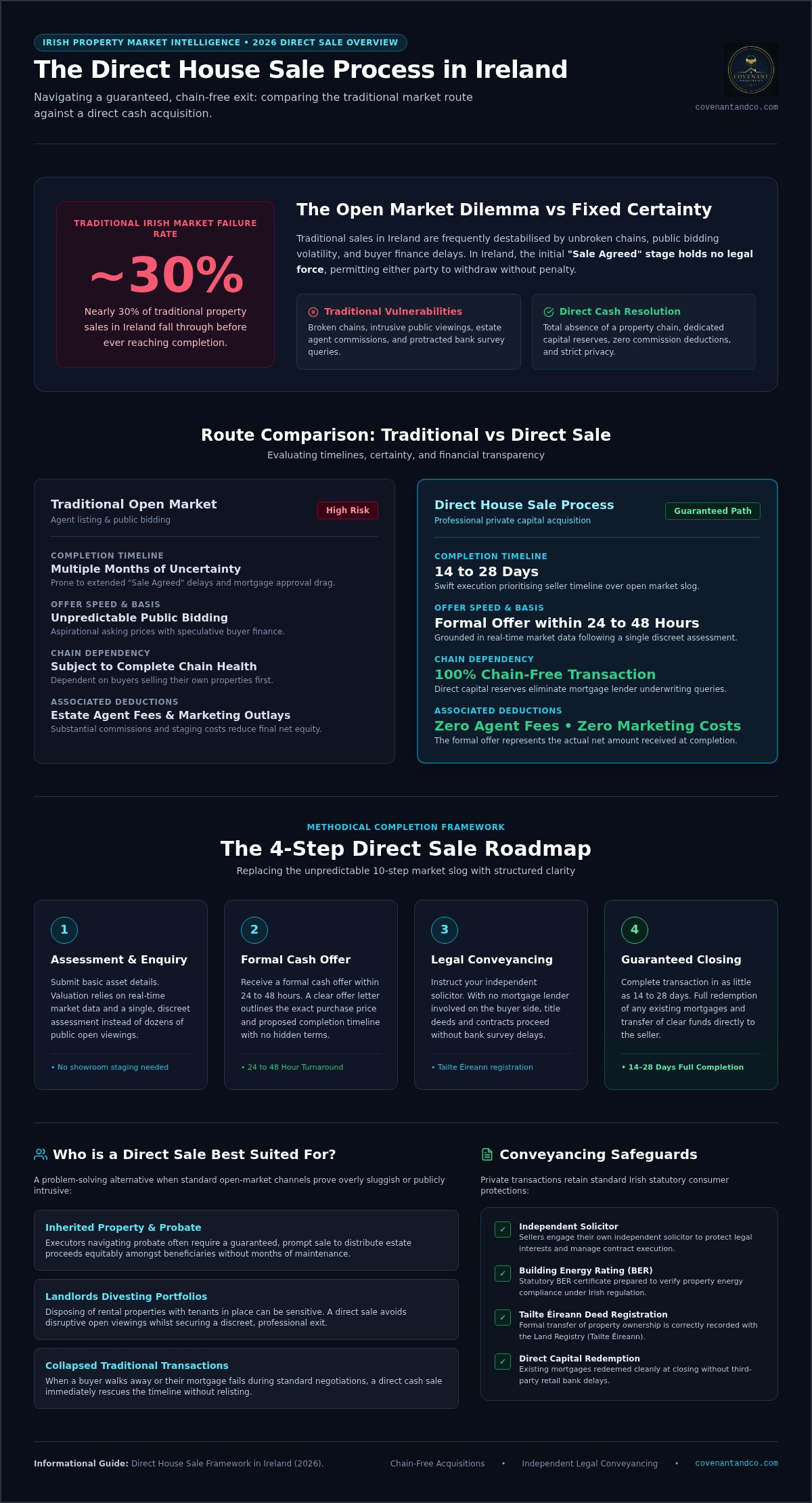
Did you know that nearly 30% of traditional property sales in Ireland fall through before they ever reach completion? It's a sobering statistic for any homeowner who needs a reliable exit. For many, the standard market route has become a source of immense stress. It is often defined by broken chains, intrusive public viewings, and estate agent fees that eat into your hard-earned equity.
We understand that you're looking for a simpler way forward. The direct house sale process Ireland provides in 2026 offers a refreshing alternative to the months of uncertainty found on the open market. This guide is designed to help you navigate that route with confidence. You'll discover how to secure a certain, chain-free transaction that prioritises your timeline over market delays. We will walk you through the streamlined roadmap to a guaranteed closing; showing you how to bypass commissions and marketing costs to achieve a clean, professional sale on your own terms.
Key Takeaways
- Learn how the direct house sale process Ireland offers in 2026 provides a certain exit without the risk of chain collapse.
- Discover how to complete your sale in as little as 14 to 28 days by skipping the traditional open market slog.
- Compare your true net proceeds after removing estate agent fees and marketing expenses to see the real value of a cash offer.
- Understand the streamlined 4-step roadmap that moves you from an initial enquiry to a formal cash offer within 48 hours.
- Identify the legal essentials you need to prepare, such as your Building Energy Rating certificate and independent solicitor.
Understanding the Direct House Sale Process in Ireland
The standard way of selling a home in Ireland is often exhausting. You list with an agent, wait for a buyer, and hope their finance is secure. A direct house sale process Ireland homeowners can access is fundamentally different. It is a private transaction between a property owner and a professional cash buyer. This route removes the need for public listings, estate agent boards, and the stress of bidding wars whilst maintaining total privacy. It's a path built for speed and clarity.
Many sellers find themselves trapped in "sale agreed" limbo for months. In Ireland, this stage has no legal force; either side can walk away without penalty. This volatility causes immense anxiety. A direct purchase replaces this uncertainty with a fixed timeline. Because the buyer uses their own capital, the risk of the deal collapsing due to bank delays or mortgage refusals disappears. It's a grounded alternative for those who value their peace of mind over the theatre of the open market.
The Core Components of a Direct Transaction
A direct sale is a professional acquisition that bypasses public marketing. Instead of setting an aspirational asking price and hoping for the best, the offer is based on current market data and the property's condition. This transparency ensures you aren't chasing a figure that won't materialise. One of the greatest benefits is the total absence of a property chain. You aren't dependent on the buyer selling their own home first, which is the most common reason for transactions to fail in the traditional sector.
While the marketing is private, the legal protections remain robust. You will still engage with the standard legal conveyancing process through your own independent solicitor. This ensures that the transfer of title and the redemption of any existing mortgages are handled with full professional integrity.
Who is a Direct Sale Best Suited For?
The direct house sale process Ireland offers is particularly effective for people in complex or time-sensitive situations. It acts as a problem-solver for scenarios where the traditional market is too slow or too public. Common examples include:
- Inherited Property: Executors dealing with the probate process often prefer a certain sale to distribute assets to beneficiaries without a long wait.
- Landlords Divesting: Selling a rental property can be difficult if tenants are in place. A direct sale allows for a discreet exit without the need for intrusive public viewings.
- Failed Transactions: If a buyer has recently pulled out of a traditional sale, a direct purchase offers an immediate way to get the transaction back on track.
The 4-Step Direct Sale Roadmap: From Offer to Completion
The traditional 10-step market slog is often unpredictable. By contrast, the direct house sale process Ireland offers is built on a simple, 4-step roadmap. It replaces months of "sale agreed" uncertainty with a methodical path to completion. This process is designed to give you back control of your timeline and your peace of mind.
Step 1 & 2: The Assessment and Offer Phase
Step 1 involves a simple enquiry where you provide basic details about the asset. Professional buyers don't need dozens of public viewings to understand a property's value. They evaluate properties using real-time market data and a single, discreet assessment. This removes the stress of hosting strangers and keeping your home in "showroom" condition for months on end.
By Step 2, you receive a formal cash offer. This happens quickly, usually within 24 to 48 hours. A professional offer is transparent. It represents the actual amount you receive at completion, with no deductions for estate agent commissions or marketing fees. Look for a formal offer letter that clearly outlines the price and the proposed timeline without any hidden conditions. You can get a clear offer today to compare it against your open-market expectations.
Step 3 & 4: Navigating the Legal Path to Completion
In Step 3, you instruct your solicitor. Even in a private sale, independent legal representation is essential for your protection. The direct house sale process Ireland follows moves into the legal phase much faster than a standard sale. This is because there is no mortgage lender involved on the buyer's side. This removes the weeks of waiting for bank surveys, underwriting queries, or loan offers to be finalised.
Your solicitor will manage the technicalities of transferring property ownership in Ireland, ensuring the deeds are correctly registered with Tailte Éireann. Because there is no chain, the legal work focuses solely on your property, which significantly reduces the risk of delays.
Step 4 is the completion. Unlike the open market, where closing dates are often dictated by complex chains, you choose the date that suits you. This flexibility is vital for those who need to coordinate a move or settle an estate. Once the contracts are signed and exchanged, the funds are transferred through the solicitors' client accounts. You get a certain exit from the property on the day you choose. There are no last-minute surprises or requests for repairs. It's a straightforward conclusion to a streamlined journey.
Direct Sales vs Traditional Market Listings: A Timeline Comparison
Selling on the open market in Ireland is a long-distance race. In 2026, the average timeline from listing to completion sits between 4 and 7 months. This is a significant commitment of time and emotional energy. The direct house sale process Ireland offers operates on a different scale entirely. It can move from an initial offer to a final closing in as little as 14 to 28 days. This speed is possible because the process removes the layers of bureaucracy that typically slow down a transaction.
Why Traditional Sales Often Stall
The "Sale Agreed" status in Ireland is often misunderstood. It is entirely non-binding. Either party can walk away without penalty until formal contracts are signed and exchanged. Industry benchmarks show that approximately 20% to 30% of sales agreed via traditional private treaty fail to complete. These collapses often happen due to chain issues, mortgage underwriting refusals, or disagreements over structural survey findings. For the seller, this means keeping the house in a perpetual state of "viewing-ready" for months, only to find themselves back at square one if the buyer pulls out.
The Speed Advantage of Cash Acquisitions
Speed in a direct sale is not about cutting corners. It is about removing the hurdles that slow down traditional transactions. When you sell to a cash buyer, you eliminate the need for bank-mandated loan-to-value assessments and mortgage approvals. These two factors alone can save 8 to 12 weeks of conveyancing lag. Simplified structural checks focus on the core asset value rather than the minute details required by retail lenders. Speed does not mean a lack of due diligence, but rather a more efficient execution of the necessary checks.
The legal transfer of property ownership in Ireland remains thorough. However, it is executed with greater efficiency because the buyer's funds are already verified and ready for transfer. This professional approach ensures that all records with Tailte Éireann are updated correctly without the back-and-forth typical of bank-financed deals.
A direct sale is a "chain-free" transaction. You aren't waiting for a buyer to sell their own home, and they aren't waiting on a bank. This prevents the "domino effect" where one person's problem ruins several other sales. For a deeper look at timeline management, our guide on fast property sale Ireland provides additional insights into navigating the 2026 market. This certainty allows you to plan your next move with total confidence.
Navigating the Legal Requirements for a Direct Property Sale
The direct house sale process Ireland follows is efficient, but it is not informal. Every property sale in the country must adhere to strict legal standards to ensure the transfer is valid and binding. While a direct sale removes the marketing noise, it maintains the same legal rigour as any other transaction. One of the first requirements is a valid Building Energy Rating (BER) certificate. This is a legal necessity for any home offered for sale. If your certificate has expired or you have recently modernised the property, you'll need to arrange an assessment to reflect the current energy performance.
Preparing Your Documentation
Documentation is the engine room of a fast transaction. If you have an active mortgage, your bank or lending institution holds your title deeds. Retrieving these deeds on an Accountable Trust Receipt (ATR) can take between 2 and 5 weeks. Requesting them the moment you decide to sell is vital for maintaining momentum. You also need to demonstrate that your Local Property Tax (LPT) is fully paid and compliant. Depending on the sale price and its relation to your declared valuation band, your solicitor may need to obtain specific clearance from the Revenue Commissioners to proceed.
A clear map of the property and proof of planning permission for any alterations or extensions are also essential. Having these papers ready allows your legal team to move straight to drafting the contract for sale. For a clear look at how these technical costs compare to the traditional route, you can read our sell home without estate agent Ireland guide to see a full fee breakdown.
The Role of the Solicitor in a Direct Sale
You are legally required to appoint an independent solicitor to protect your interests. In Ireland, a solicitor is strictly prohibited from acting for both the buyer and the seller in a residential transaction. This ensures you receive impartial advice throughout the journey. Your solicitor’s primary duty is to review the contract for sale and ensure the terms protect your equity whilst reflecting the agreed offer. They will also verify that the buyer has provided sufficient proof of funds to complete the transaction.
They also handle the discharge of any existing mortgages once the purchase funds are received into the solicitor's client account. In the direct house sale process Ireland provides, the "exchange of contracts" happens without the wait for a chain of other transactions to align. This speed allows you to move from an agreed offer to a completed fund transfer with far less friction. If you're ready to see how this professional process applies to your property, you can request a professional assessment to get started today.
Why a Direct Cash Purchase is the Modern Choice for Irish Homeowners
The traditional Irish property market often focuses on the "gross" sale price. This is the headline figure you see on a listing. However, for a homeowner, the only figure that truly matters is the "net" amount that arrives in your bank account. The direct house sale process Ireland offers prioritises this financial clarity from the start. By removing the middlemen, you keep more of your property's value. There are no estate agent commissions, which typically range from 1% to 2.5% plus VAT. You also avoid the upfront marketing costs for photography and portal listings that often exceed €500.
Selling "as-is" is another significant advantage. Preparing a house for the open market in 2026 often requires thousands of Euro in repairs, painting, and professional staging. A direct cash purchase removes this burden. You don't need to fix the roof or modernise the kitchen to secure a sale. This is a practical, stress-relieving solution for those who want a respectful exit without the physical or financial strain of a renovation project.
Financial Clarity and Cost Savings
Calculating the true cost of a traditional sale involves more than just fees. You must also consider the "holding costs" of keeping a property for an extra six months. Mortgage payments, insurance, utilities, and Local Property Tax all add up whilst you wait for a buyer's bank to approve a loan. A sale that completes in weeks rather than months can save you thousands in these hidden expenses. It allows for much sharper financial planning for your next chapter.
Covenant Properties acts as a "straight shooter" in this market. We value your time and your specific circumstances. We understand that life doesn't always wait for the slow gears of the traditional property market to turn. Our approach is built on professional reliability and local commitment. We provide a grounded alternative for those who prefer discretion over public listings. There are no "For Sale" boards and no public viewings. Your business remains your own.
Taking the Next Step
Moving forward is simple. You can request a no-obligation assessment of your residential or commercial property to see how the numbers work for you. This provides immediate clarity without any pressure to proceed. The peace of mind that comes from a guaranteed, chain-free offer is invaluable. It removes the fear of a sale falling through at the last minute and gives you a certain closing date to work towards. If you are ready to explore a certain exit, you can contact Covenant Properties for a direct house sale assessment today. We are here to act as your supportive guide through a smooth, professional transaction.
Secure Your Property Exit with Confidence
Choosing the right path for your property sale depends on your priorities. If you value speed, privacy, and financial transparency, the direct house sale process Ireland offers is a modern solution that fits your needs. You've seen how removing open-market hurdles can cut months off your timeline. By skipping public viewings and avoiding the risk of chain collapse, you gain back control of your future plans. You don't have to settle for the uncertainty of "sale agreed" limbo or the burden of estate agent commissions.
At Covenant Properties, we act as direct Irish investors with deep local expertise. We offer a guaranteed, chain-free transaction that lets you sell your property exactly as it is today. There are no hidden marketing costs and absolutely no estate agent fees to worry about. Our goal is to move you from a state of hesitation to one of total clarity. If you're ready to take the next step, you can get a certain, fee-free cash offer for your property today. We are here to provide the straightforward, professional exit you deserve.
Frequently Asked Questions
How long does the direct house sale process take in Ireland?
A direct sale typically completes within 14 to 28 days. This is significantly faster than the four to seven months often required on the open market. The speed depends largely on how quickly your solicitor can retrieve title deeds from your lender. Once the legal paperwork is ready, the fund transfer happens almost immediately. This efficiency is a core part of the direct house sale process Ireland offers to those needing a certain exit.
Do I still need a solicitor if I sell my house directly for cash?
Yes, you must appoint an independent solicitor to manage your side of the transaction. In Ireland, the law prohibits a single solicitor from representing both the buyer and the seller in a residential sale. Your solicitor ensures the contract is fair, handles the redemption of any existing mortgages, and manages the legal transfer of title. While the buyer is a cash professional, your own legal counsel remains your primary protection throughout the journey.
Will I get a lower price if I sell my property directly?
A direct offer focuses on the net value rather than an aspirational gross asking price. While the headline figure might differ from a high-street listing, you must subtract estate agent commissions, VAT, and marketing costs from the latter. When you also factor in the absence of repair costs and the savings on months of mortgage payments, many homeowners find the certain net proceeds of a direct sale to be financially comparable.
Can I sell a house in probate through a direct sale process?
Yes, selling a property in probate is a very common use case for a direct transaction. Executors often choose this route to provide beneficiaries with a certain and timely distribution of assets. Once the Grant of Probate is issued, the sale can move forward rapidly. It avoids the stress of managing a long-term listing whilst dealing with the complexities of an estate, providing a respectful and efficient solution for all involved.
Are there any hidden fees when selling to a cash buyer?
There are no hidden fees or commissions when selling directly to a professional cash buyer like Covenant Properties. You don't pay for professional photography, floor plans, or listings on property portals. Your only significant out-of-pocket expense will be your own solicitor's professional fee and any necessary outlays. This transparency allows you to know exactly what you will receive at completion, stripping away the financial guesswork associated with traditional estate agency models.
Do I need to make repairs before selling my house to a direct buyer?
No, you don't need to carry out any repairs or decorative work before the sale. Professional cash buyers purchase properties in any condition, including those that require significant modernisation or structural attention. This as-is approach saves you the time and expense of managing contractors or staging the home for public viewings. You can walk away from the property exactly as it stands, which is ideal for inherited homes or older assets.
Is a direct house sale legally binding in Ireland?
A direct sale becomes legally binding at the same point as any other Irish property transaction: the formal exchange of contracts. Before this point, a sale agreed status is non-binding for both parties. However, because a direct purchase doesn't rely on mortgage approvals or property chains, the gap between an offer and a binding contract is much smaller. This reduces the window of uncertainty and provides the seller with a much higher security level.
What happens if I have a sitting tenant in the property I want to sell?
You can certainly sell a property with a sitting tenant through a direct sale. Professional investors are often happy to acquire residential or commercial assets with existing lease agreements in place. This avoids the need to issue notices to quit or wait for a property to become vacant before listing it. It provides a seamless transition that respects the tenant's rights whilst allowing you to divest your asset without disturbing the current rental arrangement.


