

What if the house that feels like a financial burden is actually your fastest ticket to a fresh start? Many homeowners feel trapped when a surveyor's report highlights mica, pyrite, or complex title issues. It's exhausting to watch a sale collapse because a bank refuses to lend. Whilst selling an unmortgageable property Ireland can feel impossible, you've likely spent weeks worrying about specialist repair costs as inheritance taxes or bridging loans continue to loom. You're not alone in feeling that the traditional market has failed you.
This 2026 guide reveals how you can bypass traditional lenders entirely to secure a certain, straightforward exit. We will explore how to turn structural, legal, or environmental deal-breakers into a fast cash completion. You'll discover exactly how to avoid the stress of the open market and gain the clarity you need to move forward. There is a way out of the legal limbo, and it starts with understanding your options beyond the high street banks.
Key Takeaways
- Recognise the structural and legal deal-breakers, such as pyrite or Japanese knotweed, that cause Irish lenders to refuse a mortgage.
- Avoid the "mortgage trap" where traditional sales collapse late in the process, costing you time and unnecessary marketing fees.
- Evaluate the true cost of repairs versus the speed and certainty of selling an unmortgageable property Ireland to a specialist cash buyer.
- Learn how to secure a certain exit from properties in legal "limbo" or those with significant damage without needing to carry out any work yourself.
- Discover the benefits of a direct acquisition model that eliminates estate agent commissions and the stress of repeated public viewings.
What Defines an Unmortgageable Property in Ireland?
An unmortgageable property is simply a building that a commercial lender refuses to accept as security for a loan. You might be living in the house right now. It might have a warm fire and a roof over your head. However, if a bank sees a risk they can't quantify, they'll pull the plug on a buyer's funding. This is the core challenge when selling an unmortgageable property Ireland; the building's habitability doesn't always align with its mortgageability.
The structural survey is the gatekeeper in this process. In the Irish mortgage market, a surveyor acts as the bank's eyes. They aren't looking for cosmetic flaws like peeling wallpaper or dated carpets. They're looking for fundamental threats to the building's longevity. If they find evidence of mica, pyrite, or significant subsidence, the traditional buyer pool vanishes instantly. These "red-flag" issues signal to the bank that the asset could lose its value entirely, making it a bad bet for a thirty-year loan.
The Lender’s Perspective on Risk
Banks aren't just lending against a home; they're investing in an asset. If that asset could crumble or become legally contested, their investment is at risk. Sometimes, a bank might offer a "retention." This means they hold back a portion of the loan until specific repairs are finished. A flat refusal is different. It's a hard "no" that stops a sale in its tracks. In these cases, the only viable market is the all-cash buyer. These are individuals or firms who don't need a bank's permission to move forward. They see the underlying value where a lender only sees a liability.
Common Signs Your Property Might Be Flagged
Physical red flags are often the easiest to spot. Large, diagonal cracks in external masonry or bowing walls suggest subsidence. Internally, a property must have a functional kitchen and a plumbed bathroom to be considered security. Without these basic facilities, lenders won't even consider an application. It's a common hurdle for those trying to sell inherited homes that have fallen into disrepair.
Beyond the physical, there are invisible hurdles. These include the presence of Japanese Knotweed within seven metres of the structure or complex legal title issues that prevent a clean transfer of ownership. If your deeds are in limbo or there are unresolved boundary disputes, most banks will walk away. When selling an unmortgageable property Ireland, recognising these flags early saves you months of wasted time with traditional estate agents who may not understand the lending criteria for non-standard homes.
Common Obstacles: From Structural Defects to Legal Title Issues
Moving through the traditional property market becomes difficult when a surveyor identifies fundamental flaws. These aren't just cosmetic issues like peeling paint; they're systemic problems that threaten the integrity of the building. When selling an unmortgageable property Ireland, you're often fighting against a list of criteria designed to protect the bank's investment rather than your sale.
Structural and Environmental Red Flags
In Ireland, the names Pyrite and Mica carry heavy weight. These minerals cause internal chemical reactions that lead to cracking and crumbling masonry. Because the cost of remediation often exceeds the property's value, banks view these homes as zero-value assets. Most lenders require a professional assessment of Structural Defects before they'll even consider an application. If the test comes back positive for these minerals, the mortgage process stops immediately.
Environmental risks are equally destructive to a sale. Japanese Knotweed is a notorious example. This invasive plant can grow through concrete and damage foundations. If it's found within seven metres of a dwelling, most high-street lenders will reject the property unless a long-term, insurance-backed treatment plan is already in place. Similarly, extensive dry rot or rising damp can be flagged as structural failures. Banks don't want to risk a buyer defaulting because the house became uninhabitable shortly after purchase.
Legal and Administrative Barriers
Physical problems aren't the only hurdles. Legal complications can be just as final when selling an unmortgageable property Ireland. Boundary disputes or mapping errors at the Land Registry often come to light during the conveyancing stage. If the physical boundaries on the ground don't match the official maps, a bank won't release funds. This often happens with older rural properties where fences have moved over decades without formal updates.
Incomplete probate is another common delay. Selling a house whilst the legal title is still being settled can take months, or even years, if the estate is complex. Banks require a clean title to secure their loan. Rarer issues like flying freeholds, where part of one property reaches over or under another, also cause confusion. Most Irish lenders lack the appetite for these non-standard legal arrangements. If you find yourself stuck in one of these scenarios, it might be time to request a direct cash offer to avoid the cycle of failed private sales.
Finally, non-standard construction can be a deal-breaker. Homes built with timber frames without modern certification, pre-cast concrete, or those in a derelict state often fail to meet lending criteria. These properties require a specialist approach that traditional estate agents simply cannot provide.
The Problem with Traditional Sales for Non-Standard Properties
Listing a house on the open market is the standard choice, but for homes with structural or legal flaws, it often leads to a "mortgage trap." You find a buyer, agree on a price, and wait. Three months later, the bank's surveyor visits. The report highlights a defect, the lender refuses the loan, and the sale collapses. This cycle is more than just frustrating. It's expensive. You've likely already paid for professional photography, online portal listings, and perhaps even initial legal fees.
Traditional buyers are naturally cautious. Their solicitors are paid to protect them, often citing the legal principle of Caveat Emptor, or "buyer beware." If a property has a known issue, a solicitor will almost always advise their client to walk away unless the problem is fully resolved. When selling an unmortgageable property Ireland, this means your pool of potential buyers shrinks to almost zero, whilst the emotional toll of repeated public viewings and rejections continues to mount.
Why Estate Agents Often Struggle
Most estate agents are experts at marketing "turnkey" homes. They are incentivised to get listings on their books, but they often lack the specialist knowledge required for selling an unmortgageable property Ireland. They might underestimate the cost of remediating mica or pyrite, leading to unrealistic price expectations. If a property sits on the market for six months and suffers multiple failed sales, it becomes "stale." Other buyers start to wonder what's wrong with it, even if they have the cash to buy it, further damaging your chances of a fair sale.
The Advantage of a Direct Cash Purchase
A direct purchase removes the uncertainty of the high street. Because we use our own funds, there is no mortgage chain to worry about and no bank valuation to wait for. In the traditional Irish market, a sale can take six months or more to reach completion. A direct cash purchase cuts this timeline down significantly, providing a certain exit when you need it most. It's about removing the hurdles that banks put in your way.
Discretion is another major benefit. You don't need a "For Sale" sign on your lawn or public listings that broadcast your property's issues to the entire neighbourhood. It's a private, professional transaction that allows you to move on without the stress of the open market. This approach prioritises your peace of mind over the theatre of public viewings and the anxiety of waiting for a bank's approval that may never come.
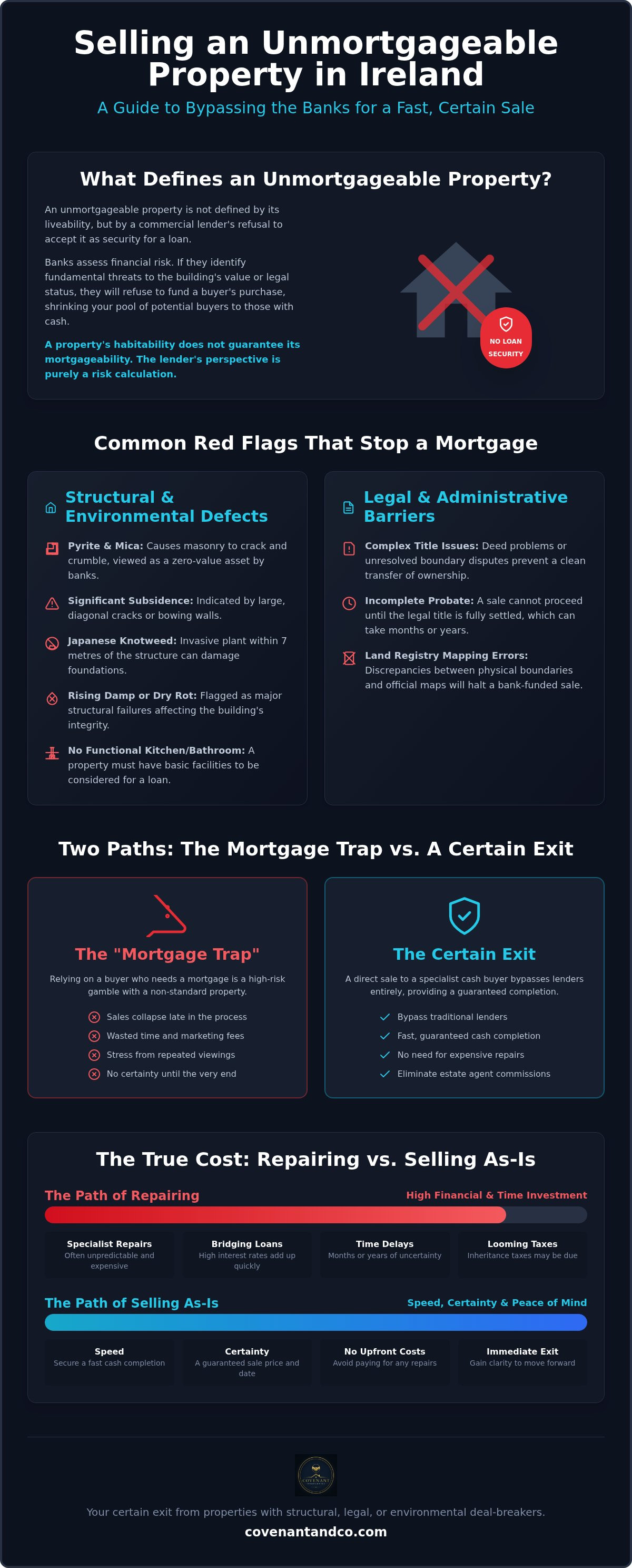
Repairing vs. Selling As-Is: Calculating the Best Path
Deciding whether to fix a house or walk away is a heavy choice. You might think that a bit of work will unlock a higher price. This is the "Remediation Gap." It is the difference between what you spend on repairs and the actual value increase. Often, the math does not add up. When selling an unmortgageable property Ireland, you must account for the time and stress of managing a construction site whilst waiting for a buyer who can actually get a loan. The math is simple; the reality is often hard.
Renovation is rarely just about bricks and mortar. It involves planning permission, structural engineers, and rising material costs. If a project takes 18 months to finish, you are gambling on the market. A higher price in two years might be worth less than cash today once you factor in inflation and holding costs. There is also the risk of over-improving. If the market dips, you might never recover the money you poured into the foundations. Cash in hand provides immediate flexibility. It allows you to invest elsewhere or pay down existing debts right now.
Assessing the Cost of Repairs
Structural remediation quotes are rarely the final bill. Unexpected issues usually appear once walls are opened. Legal title corrections also take time. Current Land Registry turnaround times can stretch for months, keeping you in limbo. When calculating your net gain, don't forget the 33% Capital Gains Tax on any profit above your €1,270 annual exemption. You are also liable for Local Property Tax (LPT) for 2026 if you owned the home on November 1, 2025. Structural repairs in Ireland often require specialist certification for future resale.
The "As-Is" Financial Framework
Selling "as-is" provides a different financial framework. You calculate your net gain by subtracting estate agent fees, solicitor costs, and taxes from the offer. You also avoid holding costs. Insurance, rates, and general maintenance add up quickly. These small expenses drain your bank account every month the property sits empty. selling an unmortgageable property Ireland to a professional firm means you stop paying for a house you no longer want. It is a clean break from liability. You move on with cash in the bank rather than debt in the walls.
If you want to see how the numbers look for your situation, get a direct cash offer today and compare it to the cost of repair.
How Covenant Properties Secures Your Exit
Selling an unmortgageable property Ireland doesn't have to be a battle with bureaucracy. At Covenant Properties, we act as the direct solution for owners who've been rejected by traditional lenders. We don't rely on mortgage approvals or bank valuations. Instead, we use our own funds to acquire residential and commercial assets in any condition. This removes the uncertainty that usually hangs over a property with structural or legal issues. We focus on the asset's potential rather than its current defects.
Our approach is built on the "straight shooter" philosophy. We provide transparent offers without the hidden conditions or last-minute price drops that often plague open-market sales. Whether your property has mica, pyrite, or complex title defects, we look at the underlying asset value. We operate with national reach, providing a certain exit for owners across the entirety of Ireland. Our team understands the local implications of building regulations and land registry delays. This expertise allows us to move from an initial enquiry to a certain closing date with speed.
The Benefits of Partnering with Covenant
Working with us removes the friction of a traditional sale. You won't pay estate agent fees or marketing costs. There's no need to fix structural issues or even clear the site before we visit. We buy properties exactly as they are. This saves you thousands in upfront costs and months of wasted effort. When selling an unmortgageable property Ireland, avoiding these costs is often the difference between a clean exit and a financial loss. We also offer flexible timelines. You choose the closing date that suits your situation; whether you need a fast exit or extra time to organise your move, we work around you. Our goal is to provide a stress-free transition from a problem asset to a cash-ready position.
Getting Started with Your Direct Sale
The process begins with a simple conversation. You provide the property details for a professional assessment, and we move quickly to provide clarity. We value integrity and local expertise in every transaction. We aren't a distant corporation. We're a dedicated firm that understands the unique challenges of the Irish property landscape. We treat every seller with respect and every property with a professional eye. If you're ready to move on from a problem asset, Contact Covenant Properties today for a confidential discussion about your asset.
Take the Next Step Toward Your Fresh Start
The traditional property market isn't designed for homes with structural defects or legal hurdles. If you've been stuck in a cycle of failed sales, it's time to look beyond high-street banks and their rigid lending criteria. We've explored how structural issues like mica and pyrite, or complex title disputes, can halt a sale for months. You've also seen how the hidden costs of repair and 2026 tax liabilities often outweigh the potential profit of a long-term renovation project.
Choosing a different path allows you to bypass the stress of public viewings and the disappointment of surveyor rejections. When it comes to selling an unmortgageable property Ireland, you deserve a partner who values your time and provides a certain outcome. As an Irish-owned investment group, we specialise in direct cash acquisition. This means you can avoid estate agent fees, skip the repairs, and move forward on a timeline that suits your needs. There is no need to wait for a bank's permission to move on with your life.
Don't let a problem property hold you back any longer. Get a direct cash offer for your property today and regain your peace of mind. You have options, and a clean break is well within reach.
Frequently Asked Questions
Can I sell a house with Japanese Knotweed in Ireland?
Yes, you can sell a house with Japanese Knotweed. Whilst traditional banks often refuse mortgages for properties where the plant is within seven metres of the structure, cash buyers don't have these restrictions. A direct sale allows you to bypass the requirement for expensive, years-long treatment plans and insurance-backed guarantees that lenders demand. It provides a reliable way to exit the property without the plant stopping the transaction.
What happens if a survey shows pyrite or mica during a sale?
If a survey identifies pyrite or mica, a traditional sale usually collapses immediately. Lenders view these minerals as high-risk because they cause systemic structural failure. The buyer's mortgage approval will be withdrawn, and you'll be left with a property that's effectively unmortgageable on the open market. In these cases, selling an unmortgageable property Ireland to a cash-funded investment group is often the only way to secure a certain sale.
Is it possible to sell a derelict property for cash?
Yes, derelict properties are ideal candidates for a direct cash purchase. Banks typically won't lend on buildings without a functional kitchen and bathroom, or those with significant decay. A cash buyer assesses the land value and the building's potential rather than its current state of repair. This means you can sell a property in any condition, avoiding the need for planning permission or costly renovations to make it habitable.
How long does a direct cash property purchase take in Ireland?
A direct cash purchase is significantly faster than the traditional market, often completing in a matter of weeks. Whilst the standard Irish property sale can take six months or more due to mortgage chains and bank valuations, a cash transaction removes these hurdles. Once the legal title is verified, the closing date is flexible. You can choose a timeline that suits your personal situation, ensuring a swift and certain transition.
Do I need to pay estate agent fees when selling to a cash buyer?
No, you don't pay estate agent fees when you sell directly to a cash buyer like Covenant Properties. Because the transaction happens privately and without a public listing, there's no need for marketing, professional photography, or portal fees. This allows you to keep more of the sale proceeds. It simplifies the process by removing the middleman, creating a direct line between the property owner and the investment group.
Can I sell a property that has legal title issues or mapping errors?
Yes, properties with title defects or mapping discrepancies can still be sold to professional cash buyers. Traditional lenders require a clean title and perfect Land Registry maps before they release funds. However, a specialist firm has the expertise to evaluate these legal risks. They can purchase the asset as-is, taking on the responsibility of rectifying the errors at a later date, which provides you with an immediate and certain exit.
What is the difference between a cash buyer and a traditional buyer?
The main difference is the source of funds and the lack of conditions. A traditional buyer relies on a bank's approval, which depends on surveys, valuations, and the property's condition. If the bank says no, the sale fails. A cash buyer uses their own capital, meaning they don't need a surveyor's approval to proceed. This makes the process certain, discreet, and much faster than waiting for a mortgage-backed offer to complete.
Will a cash buyer purchase a commercial property that is unmortgageable?
Yes, cash buyers frequently acquire unmortgageable commercial assets, including retail units, offices, and industrial sites. Lending criteria for commercial property are often even stricter than residential rules, especially regarding environmental risks or non-standard construction. A direct purchase provides a professional disposal route for these assets. It allows business owners to release equity quickly without the complexities and public exposure of the open commercial market, ensuring a clean break.


