

How much is that empty property actually costing you whilst you wait for the legal process to catch up? It is a heavy burden to carry. Between Local Property Tax, rising insurance premiums, and constant maintenance, an inherited house can quickly become a financial drain. You likely feel the pressure of beneficiaries wanting a resolution, yet the 2026 probate timelines remain a significant hurdle for many executors. You need to sell house during probate Ireland with certainty, not more stress.
We believe in a straightforward approach that prioritises your peace of mind. This guide simplifies the complex legal steps, from filing the Inland Revenue Affidavit to understanding the latest CAT thresholds. You will learn how to navigate the Courts Service requirements and secure a guaranteed sale without the risk of a chain falling through or the hassle of public viewings. We are here to help you move from a state of uncertainty to total clarity, providing a professional route to a clean and certain exit.
Key Takeaways
- Learn why you can market a property and agree a sale whilst the Grant of Probate is still pending in the Irish Courts.
- Discover how to sell house during probate Ireland using specific "Subject to Probate" clauses to protect the estate and the buyer.
- Identify the hidden financial risks of holding empty properties, including insurance restrictions and the ongoing drain of maintenance costs.
- Understand the benefits of a direct cash purchase to eliminate the uncertainty of broken chains and the stress of public viewings.
- Find out how to dispose of a property "as is" to avoid spending inheritance funds on costly repairs or renovations before a sale.
Understanding Probate and Property Sales in Ireland
Probate is the legal bridge between a person passing away and their assets being distributed to those left behind. It is the formal process where the Irish Courts validate a will and give a specific person the authority to manage the estate. If you intend to sell house during probate Ireland, you will quickly find that the court acts as a gatekeeper. Whilst you might be the person named in a will to inherit a home, you don't technically own the legal title yet. You hold what is called "beneficial interest." This means you have a right to the value of the property, but you cannot sign away the deeds to a new buyer until the Grant of Probate is physically in your hands.
The process differs slightly depending on whether a valid will exists. An Executor is the person named in the will to carry out the deceased's wishes. If there is no will, the person who steps up is called an Administrator. Both roles carry heavy legal weight. A solid foundation starts with Understanding Probate as a concept of legal transition rather than just a bureaucratic hurdle. Until the court issues that final document, the property's legal ownership remains in a state of limbo.
The Role of the Executor in a Property Sale
An executor has a clear legal duty to act in the best interests of the beneficiaries. In most cases, this means securing the best possible price for the property to ensure the estate is distributed fairly. It isn't just about finding a buyer. It involves meticulous paperwork, such as managing the Statement of Affairs (SA2) form for Revenue. This form is a complete snapshot of the deceased person's assets and is vital for calculating any Capital Acquisitions Tax (CAT) that might be due. You should also gather the original title deeds as early as possible. Locating these documents in old files or with solicitors can take weeks. Any delay in finding the deeds will stall your sale later, even if you have a buyer ready to go.
Why Probate Timelines Vary Across Ireland
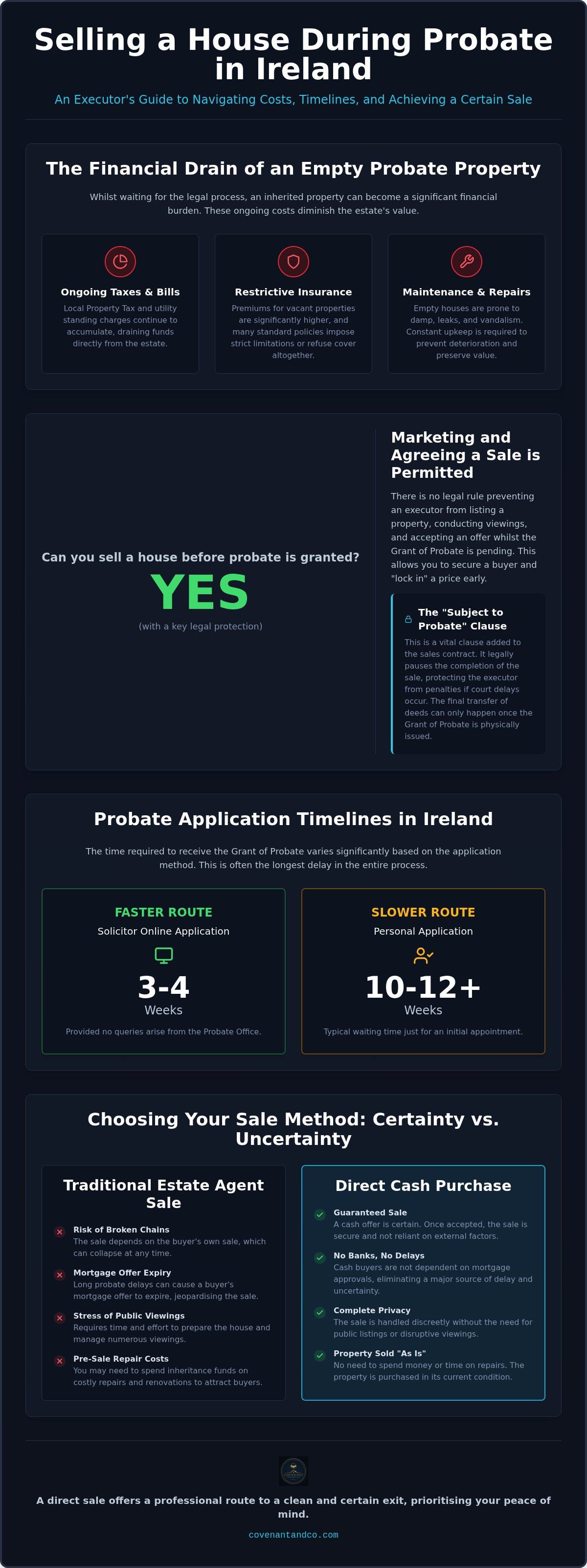
In 2026, timelines are influenced by court backlogs and the complexity of the estate itself. If a will is contested or if beneficiaries are living abroad, expect the process to slow down. There is also a clear divide in speed based on how you apply. Solicitor applications using the online portal are currently processed in about 3 to 4 weeks, provided no queries arise from the Probate Office. Personal applications are a different story. They currently face a 10 to 12 week waiting time just for an initial appointment. If you are asking how long does it take to sell a house in Ireland in 2026?, the answer depends heavily on your application method and the clarity of the estate's records. Being a straight shooter with beneficiaries about these timelines helps manage expectations from the start.
Can You Sell a House Before Probate is Granted?
Yes, you can start the process immediately. There is no legal rule stopping you from listing the property or accepting an offer. In fact, many executors choose to sell house during probate Ireland to get the ball rolling as soon as possible. You can reach "Sale Agreed" status, but the final legal transfer is effectively paused. The deeds cannot be signed over until the Probate Office issues the formal Grant.
This period of waiting is a core part of The Irish Probate Process, ensuring all debts are settled before assets move. Whilst the contract is binding, the completion date is "parked." This means both parties are committed, but the clock only starts ticking once the Grant is in the solicitor's hands. It provides a level of security, but it also requires a buyer with a high degree of patience.
The "Subject to Probate" Contract Mechanism
Solicitors use a specific "Subject to Probate" clause to protect the estate. This ensures the executor isn't penalised for delays beyond their control. However, 2026 interest rates have made traditional buyers more cautious. If a buyer's mortgage offer expires during a long wait, they may be forced to pull out or renegotiate. This is why cash buyers are often preferred. They don't rely on bank approvals that might vanish. If you want to avoid these complications, you might consider a direct property cash purchase to bypass the uncertainty of mortgage-backed chains.
Expected Timelines for Completion
The journey from "Sale Agreed" to "Keys Handed Over" varies. In a standard probate case, you should prepare beneficiaries for a waiting period of several months. Managing their expectations is vital. They need to know that reaching an agreement with a buyer is only the halfway mark. The final sprint only happens once the court acts. In 2026, the average probate delay ranges from 3 to 4 weeks for solicitor portal applications to over 12 weeks for personal appointments.
The Hidden Risks and Costs of Holding Probate Property
The time between a person passing away and the final sale of their home is rarely just a legal pause. It is a period of mounting financial pressure. Whilst you wait for the court to act, the property remains your responsibility. Every month the house sits empty, it costs money. If you decide to sell house during probate Ireland, you must account for these "invisible" expenses that chip away at the final inheritance.
Local Property Tax (LPT) continues to accrue regardless of the circumstances. In 2026, the Vacant Home Tax has become a stricter reality for many estates. If the property remains unoccupied for long periods, you may find yourself facing significant tax bills before a single cent has been distributed to beneficiaries. These costs, combined with utility standing charges and security measures, can quickly reach thousands of Euro. The financial drain is constant, and it starts the moment the house becomes vacant.
Insurance and Security for Empty Homes
Standard home insurance is rarely enough for a probate sale. Most Irish insurers have a strict "30-day rule." Once a house is empty for more than a month, your standard cover may become void. You will likely need specific "Unoccupied Property Insurance." This cover is significantly more expensive and often comes with restrictive conditions. As an executor, you are personally responsible for the asset. If a pipe bursts in mid-winter or vandals target the building, the financial loss could fall on the estate. You could even be held liable for negligence if the property was not properly secured. Keeping the heating on a low setting and visiting the site weekly is essential, but these tasks take time and energy you may not have.
Beneficiary Pressure and Financial Difficulty
Family dynamics add another layer of complexity. Beneficiaries often have their own financial needs. They might be counting on the inheritance to pay off personal debts or fund a mortgage. This creates a high-pressure environment for the executor. When multiple people are involved, disagreements over the sale price or the timing of the sale are common. A house left empty for too long also risks becoming a "problem property." Gardens become overgrown. Damp sets in. These issues lower the market value and make the house harder to sell later. Dealing with these burdens whilst grieving is an immense emotional toll. It is often better to seek a certain exit early rather than letting the property, and the family relationships, deteriorate over a year of waiting.
Direct Cash Buyers vs. Traditional Estate Agents
Choosing how to sell house during probate Ireland is a pivotal decision for any executor. The traditional route focuses on high visibility. You list with an estate agent, host public viewings, and wait for the highest bidder. However, this path comes with significant uncertainty. You will likely face commission fees between 1% and 3%, plus additional marketing costs. More importantly, you are at the mercy of the open market and the buyer's financial situation.
A direct cash purchase offers a different experience. It prioritises speed and certainty over public exposure. There are no estate agent fees. There are no "For Sale" signs. There are no strangers walking through the home of a deceased relative. For many families, this privacy is a relief. It allows you to manage the estate's affairs discreetly without the neighbours' curiosity. Cash buyers are also immune to the mortgage expirations that plague traditional sales in 2026. Whilst a bank-funded buyer might see their loan offer vanish during a three-month probate wait, a cash buyer remains ready to close.
Eliminating the Property Chain
Property chains are the primary reason sales fail in the Irish market. Recent industry data suggests that approximately 1 in 3 property sales fall through before completion. Often, this happens because a buyer further down the line loses their own sale, causing a domino effect that reaches you. Direct buyers act as the end of the chain. They provide total certainty because they don't need to sell another asset to buy yours. If you want to avoid these complications, you can learn how to sell home without estate agent Ireland to keep the process simple and the inheritance intact.
Selling "As Is" Without Repairs
Traditional buyers usually want a home that is ready to move into. Following a survey, they may demand that you fix a leaking roof or update an old heating system. They might even use the survey results to renegotiate the price at the last minute. This puts the executor in a difficult position. Should you spend the estate's limited funds on repairs? Direct buyers like Covenant Properties purchase in any condition. We don't ask you to "freshen up" the paint or clear out decades of belongings. We take the property exactly as it stands today, saving you both time and money.
If you need a certain exit without the stress of an open market listing, you can request a residential property cash purchase offer today.
Navigating Your Probate Sale with Covenant Properties
We understand the weight on your shoulders. Managing a deceased estate is a full-time job you likely didn't ask for. Between legal meetings and family discussions, the last thing you need is a property sale that feels like another battle. We provide a professional, straightforward route to sell house during probate Ireland that removes the guesswork. Our team acts as a straight shooter. We give you a cash offer within 24 hours of our assessment. We don't hide behind jargon or complicated contracts. We tell you what we can do, and then we do it.
Whilst the legal system moves at its own pace, your financial planning shouldn't have to stay in limbo. We work directly with your solicitor to ensure our timelines align perfectly with the Probate Office. We provide the certainty you need to tell beneficiaries exactly when the sale will conclude. This moves you from a state of uncertainty to total clarity, allowing you to focus on your family instead of a building.
Our Direct Acquisition Process
Our process is designed to be as low-pressure as possible. It begins when you contact us for a confidential, no-obligation assessment of the property. We don't need the house to be "staged" or cleared out. Once we've reviewed the asset, we provide a fair cash offer based on current 2026 market values. We don't engage in the "bidding wars" or gazumping that define the open market.
If you accept, we agree on a closing date that suits your specific probate application. We are comfortable waiting for the Grant of Probate to be issued. Because we are cash buyers, there is no risk of us pulling out if the court takes longer than expected. You get a binding agreement now, and we handle the wait. It is a methodical way to secure the estate's assets without the stress of a traditional listing.
Why Irish Executors Choose Covenant Properties
Executors choose us because we offer a professional disposal route without open market complexities. We bring empathy to a sensitive time. We know this isn't just a transaction; it's often a family home filled with memories. Our goal is to make the exit as respectful and efficient as possible. You avoid the "For Sale" sign and the constant stream of strangers through the hall.
By choosing a guaranteed cash house sale Ireland, you eliminate the 1 in 3 chance of a sale falling through. You save the estate the cost of repairs, agent fees, and marketing. Most importantly, you gain peace of mind. You can rest easy knowing the property is sold and the funds are secured, even whilst the final paperwork finishes in the background. It is about taking control of a complex situation and finding a simple, certain solution.
Secure a Certain Exit for Your Estate
Navigating the legal requirements of an inherited property in 2026 doesn't have to be a source of constant anxiety. You now understand how to manage the "Subject to Probate" mechanism and avoid the mounting costs of empty home insurance. By choosing a direct route, you bypass the risks of broken chains and mortgage expirations that often stall traditional market sales. It is entirely possible to sell house during probate Ireland with complete confidence and transparency.
We believe in providing a path that respects your family's circumstances whilst delivering a clear financial result. You can move from the stress of managing a deceased estate to the relief of a guaranteed exit. We offer a professional, chain-free certainty that traditional estate agents simply cannot match. You don't have to wait for the court's final decree to secure your peace of mind and stop the financial drain.
Request a confidential cash offer for your probate property today. We provide an offer within 24 hours and charge no estate agent fees, giving you a straightforward way forward. You've handled the difficult legal steps; let us help you finish the journey with clarity and ease.
Frequently Asked Questions
How long does probate take in Ireland in 2026?
In 2026, the timeline depends on your application method. Solicitor applications via the online portal typically take 3 to 4 weeks, provided no queries arise. Personal applications currently face a 10 to 12 week waiting period just for an initial appointment. These timelines can fluctuate based on the complexity of the will and court resources. It is vital to manage beneficiary expectations early, as the Grant of Probate is the key to finalising any sale.
Can I put a house on the market before probate is granted?
You can absolutely list a property and reach "Sale Agreed" status whilst the legal paperwork is pending. Many executors choose to sell house during probate Ireland to avoid the costs of an empty home. Your solicitor will include a "Subject to Probate" clause in the contract to protect the estate. This ensures the deal is legally bound, but the actual completion and transfer of deeds are paused until the Grant of Probate is issued.
Do I need a solicitor to sell a house during probate?
Whilst you can technically make a personal application for probate, you will need a solicitor to handle the property conveyancing. Selling an inherited home involves complex legal transfers that require professional oversight. A solicitor ensures the Statement of Affairs (SA2) is filed correctly with Revenue and manages the "Subject to Probate" contracts. They act as the essential link between the Courts Service and the buyer's legal team to ensure the title is cleared properly.
What are the main costs of selling an inherited property?
The costs go beyond simple legal fees. You must account for Local Property Tax (LPT), vacant home insurance, and ongoing maintenance to prevent damp or neglect. If you use a traditional estate agent, expect to pay 1% to 3% in commission plus marketing fees. Capital Acquisitions Tax (CAT) may also apply at a rate of 33% on inheritances above your specific group threshold. These expenses can quickly diminish the final inheritance if the sale process drags on.
What happens if a buyer pulls out while waiting for probate?
If a buyer pulls out, the estate must start the marketing process from scratch. This is a common risk with traditional buyers whose mortgage offers may expire during the 2026 probate wait. A broken chain can cause a domino effect, leading to months of further delays and mounting costs for the empty property. This uncertainty is why many executors prefer the certainty of a cash buyer who does not rely on bank financing.
Is Capital Acquisitions Tax (CAT) due when I sell the house?
CAT is due on the inheritance itself, not specifically the sale, though the sale often provides the funds to pay it. In 2026, the CAT rate is 33% for values above your threshold. Group A (children) has a €400,000 limit, whilst Group B is €40,000 and Group C is €20,000. For inheritances valued between January and August, you must pay and file by 31 October of that same year to avoid penalties.
Can I sell an inherited house if there are multiple beneficiaries?
The executor or administrator has the legal authority to sell the property to distribute the estate's value. However, it is highly recommended to obtain the written consent of all beneficiaries before proceeding. Disagreements over the sale price or the method of sale can lead to lengthy legal disputes. Clear communication is the best way to ensure a smooth process and avoid the stress of family conflict whilst managing a deceased relative's assets.
Why is a cash buyer better for a probate sale?
A cash buyer provides certainty in a process that is often defined by delays. Unlike traditional buyers, they don't depend on mortgage approvals that might expire during the 2026 probate timelines. They also eliminate the risk of a broken property chain. Companies like Covenant Properties purchase homes exactly as they stand, meaning you don't have to spend estate funds on repairs or renovations. This allows for a swift, professional exit without the stress of public viewings.


