

Ireland has no specific legislation governing brownfield sites. If you plan to sell a brownfield commercial site in Ireland, its asking price and redevelopment potential depend on the site’s characteristics, location and realistic future use.
It’s natural to look for a clear price guide, but listings show why no single figure suits every site. Size, planning context and the condition of the land or buildings all affect how a property is presented to potential buyers.
This article looks at Irish commercial land listings, from asking prices and site sizes to redevelopment opportunities. It also explains what information can help show a site’s potential and what due diligence to prepare for a sale.
Key Takeaways
- Compare asking prices alongside site size, location and planning context to understand how Irish commercial land is presented for sale.
- Some listings state a price, whilst others use price on application; the way a site is marketed can shape how buyers assess its potential.
- Explore how zoning, existing structures and redevelopment prospects may influence a site’s appeal and possible future use.
- Environmental due diligence, including surveys of soil, groundwater and surface water, can help clarify contamination exposure and remediation considerations.
- Consider whether a direct property or land sale suits your circumstances, especially if a straightforward transaction matters to you.
Asking prices and price on application
Irish development land listings show a wide range of asking prices. These are asking prices, not confirmed sale prices.
Location and intended use make for very different comparisons. These examples show why size alone does not explain an asking price.
Smaller landholdings can also have substantial asking prices. The town setting and potential use matter alongside acreage.
Price on application gives no public figure to compare. An 8.03-acre development site in Ireland is offered on this basis. For an owner preparing a sale, that approach can keep the advertised price open whilst interest is assessed. It also means buyers need enough site information to judge whether the opportunity suits them.
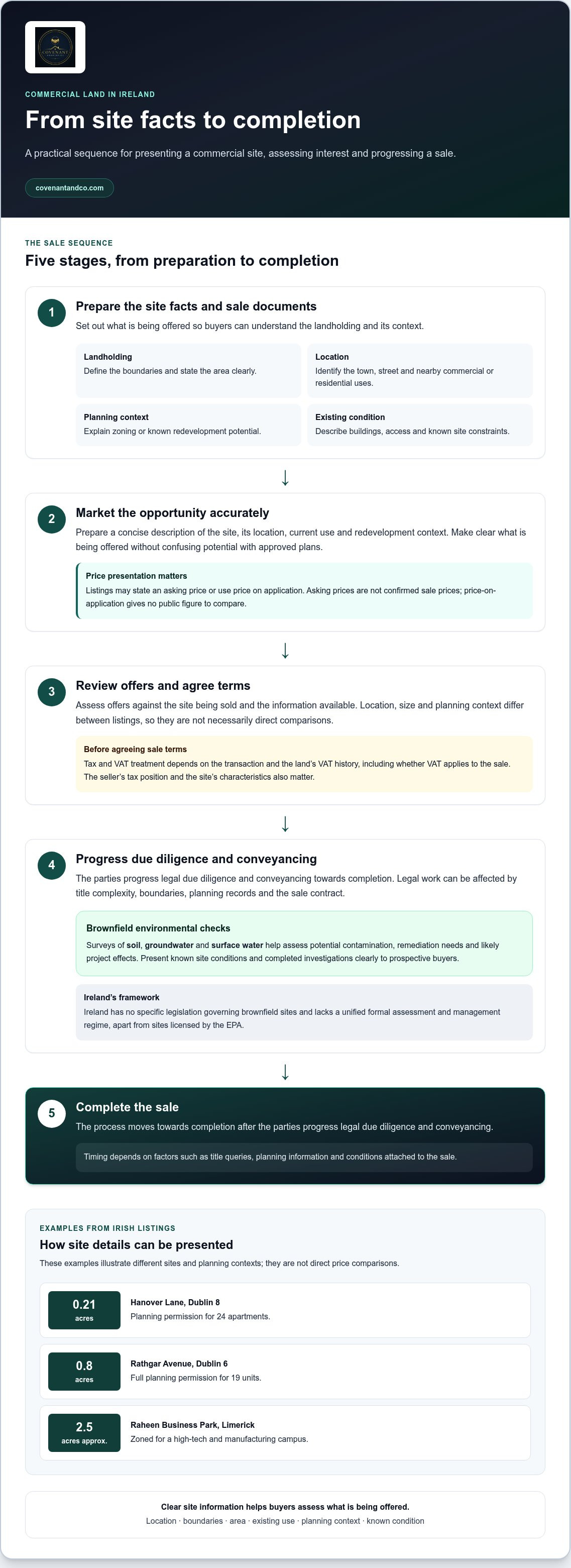
Before setting an asking price, organise the details that shape a buyer’s assessment:
- Landholding: define the site boundaries and state its area clearly.
- Planning context: explain the zoning or known redevelopment potential.
- Existing condition: describe buildings, access and any known site constraints.
- Location: identify the town, street and nearby commercial or residential uses.
These details help distinguish general development land from a site with a more specific opportunity, such as residential development. They also put a listed figure in context. For example, a parcel adjoining a town centre may attract different interest from land outside the settlement. The asking price should reflect the site being offered, not just its acreage.
Compare listings carefully: their locations, sizes and stated development contexts may differ. A price-on-application listing cannot be compared with a published figure without further pricing information. Treat each listing as an example of how sites are presented, not as a guaranteed valuation.
For a brownfield commercial site, present the asking price alongside clear facts about its condition and potential. If you choose price on application, make the landholding’s size and location easy to understand. This gives prospective buyers a practical starting point, whether the site is a town-centre parcel or a larger development opportunity.
Commercial property listings for sale
Commercial land listings show different site types and potential uses. Hanover Lane in Dublin 8 covers 0.21 acres and has planning permission for 24 apartments. Rathgar Avenue in Dublin 6 covers 0.8 acres, with full planning permission for 19 units. These examples show how listings can present planning details alongside the landholding.
What taxes and VAT apply to selling commercial land in Ireland? The treatment depends on the transaction and the land’s VAT history, including whether VAT applies to the sale. The seller’s tax position and the site’s characteristics also matter, so establish these details before agreeing sale terms.
Legal and conveyancing costs depend on the work the transaction requires. Title complexity, boundaries, planning records and the sale contract can all affect the legal work involved. Ask for a clear breakdown of professional fees and additional expenses before proceeding.
To attract a suitable buyer, prepare a concise description of the site, its location and its redevelopment context. Consider who may have a relevant interest, such as developers or businesses seeking commercial land. A well-presented listing helps buyers assess the opportunity without confusing potential with approved plans.
Listings across Ireland illustrate the range of sites offered for sale:
- New Ross, County Wexford: Marshmeadows comprises 12.5 acres.
- Athlone East, County Westmeath: Bower View is a 0.64-acre development site.
- Raheen Business Park, Limerick: the site measures approximately 2.5 acres and is zoned for a high-tech and manufacturing campus.
These are different types of opportunity, not direct price comparisons. A retail or industrial site, for example, may interest a different buyer from land presented for residential development. State the current use, known planning context and relevant site features accurately.
What are the steps and typical timeline for selling commercial land in Ireland? First, prepare the property details and sale documents. Then market the site, review offers and agree terms with a buyer. The parties progress legal due diligence and conveyancing towards completion. Timing depends on factors such as title queries, planning information and conditions attached to the sale.
For a clearer listing, organise the site facts before marketing: location, boundaries, land area, existing use and planning context. Dublin 8’s Hanover Lane listing, for example, pairs a 0.21-acre size with permission for 24 apartments. Clear details help prospective buyers understand what is being offered and what information supports its redevelopment potential.
Listings include 0.75 acres of zoned land on Circular Road, Roscommon Town, County Roscommon; The Old Creamery Site, 3.4 acres, Bosheen, New Ross, County Wexford; and 0.645 acres in Killybegs, County Donegal.
Brownfield and redevelopment opportunities
A brownfield site’s appeal depends on its location, condition and possible future use. Planning context and environmental information help buyers assess the opportunity.
Environmental assessments and disclosures
Environmental due diligence should begin with surveys of soil, groundwater and surface water. These help assess potential contamination, remediation needs and likely project effects. Ireland has no specific legislation governing brownfield sites and lacks a unified formal assessment and management regime, apart from sites licensed by the EPA. Present known site conditions and completed investigations clearly to prospective buyers.
Zoning and planning effects
Zoning indicates the uses a planning authority considers for an area; planning permission relates to a specific proposal. Neither should be presented as interchangeable. Hanover Lane in Dublin 8 has permission for 24 apartments, whilst the Kilmeague site in County Kildare has potential for 110-150 units, subject to planning permission. Clear distinctions help buyers understand what is approved and what remains a possibility.
National planning policy also puts previously developed land in focus. The National Planning Framework Ireland 2040 proposes that 50% of new housing in Irish cities should be on brownfield sites, and 30% outside cities. These targets provide useful context for residential redevelopment. They don’t grant permission for a particular site, so describe them as policy direction, not as an approval or guaranteed outcome.
Local planning context can shape how a redevelopment proposal is received. Cork County Council pre-planning discussions indicate that a suitably balanced mixed-use scheme is likely to receive support for brownfield redevelopment. For a seller, this makes the site’s location and potential mix of uses important details. Distinguish clearly between a discussion, a planning application and permission granted.
Contamination affects the work and timing a buyer needs to consider. The EPA licensing process for remediation and recovery of contaminated soils can take more than two years before a final decision is issued. Developers in Ireland typically use “dig and dump” disposal when treatment and reuse options are unavailable and project timelines need to remain manageable. Disclose relevant reports and remediation records so buyers can assess what is known.
A seller’s exposure after completion is shaped by the sale contract, disclosures and any continuing remediation obligations. Record known contamination, investigations, agreed works and responsibility for outstanding actions in the transaction documents. Don’t describe a site as clean or remediated unless the available reports support that description. Clear records help both parties understand what was represented and what responsibilities remain.
Present the opportunity with a short, evidence-based summary:
- Planning: identify zoning, permissions and application status separately.
- Environment: summarise relevant surveys and remediation records.
- Potential: explain possible residential or mixed-use development without implying approval.
- Constraints: flag known site conditions that could affect redevelopment.
For example, Raheen Business Park in Limerick has permission for a warehouse measuring approximately 5,200 square metres. That specific permission gives buyers a clearer reference point than general redevelopment potential. By contrast, the 11-acre Cork Road site in Skibbereen is presented as a mixed-use development opportunity. Accurate wording helps each site find buyers whose plans fit its actual planning position.
What documents and due diligence are needed to sell commercial land in Ireland?
Prepare a clear information pack before marketing the site. Start with the title documents, a map showing the boundaries and a description of the land’s current use. Add planning records and environmental reports where available. Together, these help prospective buyers understand what is being sold and identify questions early.
Organise records by subject. A buyer examining a former industrial property, for example, may need different environmental information from one assessing an unused commercial plot. Label reports by date and site area, and distinguish completed investigations from proposed work. This makes the information easier to follow and reduces the risk of presenting an assumption as a finding.
- Ownership and boundaries: assemble title records, site maps and any relevant access information.
- Planning: group zoning details, planning applications, decisions and permission documents.
- Environmental: collect surveys, site investigations and remediation records.
- Property condition: describe existing buildings, structures and known site constraints.
Environmental due diligence should cover soil, groundwater and surface water. These surveys help assess contamination exposure, remediation costs and project timelines. If earlier reports identify an issue, include the findings and records of any work completed. For example, provide a soil report with its location and scope so buyers can understand which part of the site it covers.
EPA licensing can affect remediation planning. In Ireland, the licensing process for remediation and recovery of contaminated soils can take more than two years before a final decision is issued. That period may matter to a buyer’s programme. Share relevant licensing records and correspondence as part of the site information, rather than relying on a broad description of the land.
Planning documents need similar care. Separate an adopted planning permission from a pre-planning discussion or an unapproved concept. Hanover Lane in Dublin 8, for instance, has planning permission for 24 apartments. That is different from presenting a site as having only redevelopment potential. Clear wording helps buyers assess the actual planning position.
Before agreeing sale terms, list known site matters and the supporting documents. Include environmental reports, planning decisions, boundary information and records of remediation. A solicitor can use these materials during conveyancing and help record disclosures and any outstanding responsibilities in the contract.
For a brownfield site, complete these practical steps:
- Organise ownership, boundary and access records.
- Gather planning and environmental documents in separate files.
- Summarise known conditions, linking each point to its supporting record.
- Keep the information pack consistent with the sale particulars and contract.
This preparation gives buyers a clearer basis for due diligence. It also helps sellers explain the difference between documented facts, proposed remediation and future development ideas. For example, a site with a soil survey and planning permission can be presented more precisely than one described only as a redevelopment opportunity.
What are recent sale prices for brownfield commercial sites in Ireland?
Public listings provide useful price examples, but show asking prices, not confirmed sale prices. The distinction matters: a guide price or advertised figure is the seller’s stated starting point, not proof of the amount eventually paid. Compare listings as market indicators, not records of completed transactions.
The land extends to about 0.16 hectares and has approximately 15 metres of road frontage. Its setting and frontage give context to the asking figure. They also show why the headline price alone cannot describe a site’s appeal.
Other Irish listings span different landholding sizes and locations. These figures aren’t directly comparable: one is a smaller holding, while the other is a much larger development land site.
Price on application makes comparison harder. The 8.03-acre development site on Dan Spring Road in Tralee, County Kerry, is offered without a public asking figure. Buyers can’t use it for a simple price comparison with published listings. Instead, focus on the stated site area, location, planning context and any information describing redevelopment potential.
Use a consistent comparison process when reviewing listings:
- Identify the figure: record whether it is an asking price, guide price or price on application.
- Note the landholding: capture the stated acreage or area.
- Compare context: record the location and described development potential.
- Separate evidence: don’t describe an advertised price as a completed sale.
The large difference reflects distinct sites and circumstances. It doesn’t establish a general rate for Irish brownfield property.
To assess your own site, bring together its area, location, planning position and known condition. Then compare it with listings that share those features, rather than relying on a broad national price range. A residential or mixed-use opportunity, for example, may attract different interest from land without the same stated potential.
If you’re considering a direct sale of commercial property, discuss selling your commercial site as a next step.
Dan Spring Road is offered at a price on application, with no public asking figure.
Covenant Properties: Residential Property Cash Purchase
Covenant Properties buys commercial property and land and development sites directly for cash. If you own a brownfield commercial site, a direct sale may suit you better than a conventional marketing process. The site’s location, condition, planning context and available environmental information can help frame the opportunity and inform the transaction discussion.
Residential Property Cash Purchase is also available for owners selling residential property. Each route addresses a different property situation, so focus on whether you’re selling a commercial site, development land or a home. For a straightforward next step, contact Covenant Properties or visit covenantandco.com.
Choose the next step that suits your site
Deciding how to sell a brownfield commercial site in Ireland means considering more than the asking price. Think about the outcome you want, the information you can share with buyers and the level of certainty you need. Set out your priorities before choosing a route. A direct cash sale through Covenant Properties is an alternative to marketing the site on the open market.
If you’re considering a direct route, contact Covenant Properties to discuss your site. Share the location, current use and any relevant planning or environmental details. These give the conversation a practical starting point, without needing to resolve every question in advance.
Your site has its own history and potential. Start with the information you have, then choose a next step that suits your circumstances. If a direct cash sale is right for you, contact Covenant Properties to discuss your brownfield commercial site.
Frequently Asked Questions
How do I sell a brownfield commercial site in Ireland?
Start by deciding whether an open-market sale or a direct sale better suits your priorities. Prepare a site brief covering ownership, boundaries, current use, access, planning context and known environmental issues. If the land is occupied or has existing agreements, include clear details so buyers can understand the arrangement. Review offers against your preferred terms, not just the headline figure, then progress the chosen sale through conveyancing.
How is a brownfield commercial site valued in Ireland?
A site’s value reflects its location, size, access, condition and realistic development potential. Planning status matters: land with permission for a defined project differs from land with only a possible future use. Known contamination or remediation needs can also affect a buyer’s assessment. Compare relevant listings carefully, remembering that asking prices are not completed sale prices. A useful valuation considers the site as it stands and the evidence supporting its potential.


