

Planning status can shape a land sale, but it doesn’t remove the tax question. If you want to sell agricultural land for commercial development in Ireland, Capital Gains Tax of 33% is chargeable on land sales, including farmland. The site’s planning position and suitability for commercial use also affect how a buyer may assess it.
It’s understandable to want a clear picture before deciding whether to sell agricultural land for commercial development in Ireland. The figures and rules can feel complicated, especially when the land is still in agricultural use or has no planning permission. This guide explains how planning status, Capital Gains Tax, transaction costs and site suitability can affect a sale, so you can identify the details that matter and decide what to consider next.
You’ll also find a practical overview of development land for sale across Ireland, including how location, access and a site’s potential use can affect buyer interest. Every holding is different, but understanding these considerations can help you approach a sale with greater clarity.
Key Takeaways
- Planning permission and zoning are separate considerations. Understand both, alongside access and site constraints, to present the land clearly to potential commercial buyers.
- Capital Gains Tax of 33% applies to land sales, including farmland. Check whether a relevant relief may affect your position before making decisions about the sale.
- Transaction costs depend on the nature of the transfer and whether reliefs apply. Knowing which costs relate to the buyer and which may affect you helps avoid confusion.
- Commercial site suitability depends on more than acreage. Location, access, permitted use and development potential all shape how a site may appeal to buyers.
- Compare development land opportunities across Ireland by looking beyond asking prices: planning status, intended use and site characteristics help put each holding in context.
Land with or without planning permission
Planning permission can strengthen a commercial land sale, but agricultural land may also attract interest without it. The key is to distinguish an approved proposal from zoning, then explain what the site could realistically accommodate.
Selling agricultural land subject to planning permission in Ireland can involve delays, conditions that affect a proposal’s viability, and a sale dependent on permission taking effect. If a contract makes completion conditional on planning, uncertainty about the decision can affect whether and when the sale proceeds.
Permission for commercial uses
Planning permission applies to a defined development, not every possible commercial use of a field. Review the decision, approved drawings and conditions together, then compare them with the buyer’s intended use. For example, a business park site might have permission in place for a warehouse of approximately 5,200 square metres, also stated as 55,972 square feet. That specific approval is more informative than describing the land simply as suitable for business.
Without permission, a buyer may need to apply for approval for the proposed use. For example, if agricultural land is being considered for a warehouse, present it as land with development potential, not as an already approved commercial site.
Zoning and planning permission
Zoning sets out the development uses envisaged for an area in a local development plan. It does not grant permission for a particular building or guarantee approval for a proposal. A buyer still needs to consider the specific project, its design and the site’s practical constraints.
A typical commercial holding often falls under a local area plan and features a mix of zonings, while business parks are often zoned for high-tech or manufacturing campus use under a county development plan. These examples show why sellers should identify the zoning for each part of a holding rather than describe a large site as having one uniform use.
For a sale, match the zoning map and plan wording to the site boundary. If plots have different designations, show where each applies. This gives buyers a clearer starting point for considering commercial, industrial or residential proposals.
Risks of selling land with permission
Permission can add value to a proposal, but it limits what a seller can accurately claim: the approval applies to the stated development and its conditions. A buyer considering a different commercial use may need a new application or changes to the approved plans. That can affect costs, design and the time needed to proceed.
Before marketing, assemble the planning decision, approved plans, conditions and any related correspondence. Make clear whether permission covers the whole holding or only part. For instance, where a holding comprises multiple plots, identifying which plots relate to a particular designation or approval would help buyers assess the land accurately.
For land without permission, don’t present zoning as approval. Set out the current agricultural use, relevant zoning and proposed development idea as separate facts. This helps potential buyers assess the steps ahead without confusing planning potential with an authorised commercial development.
Capital Gains Tax on land sales
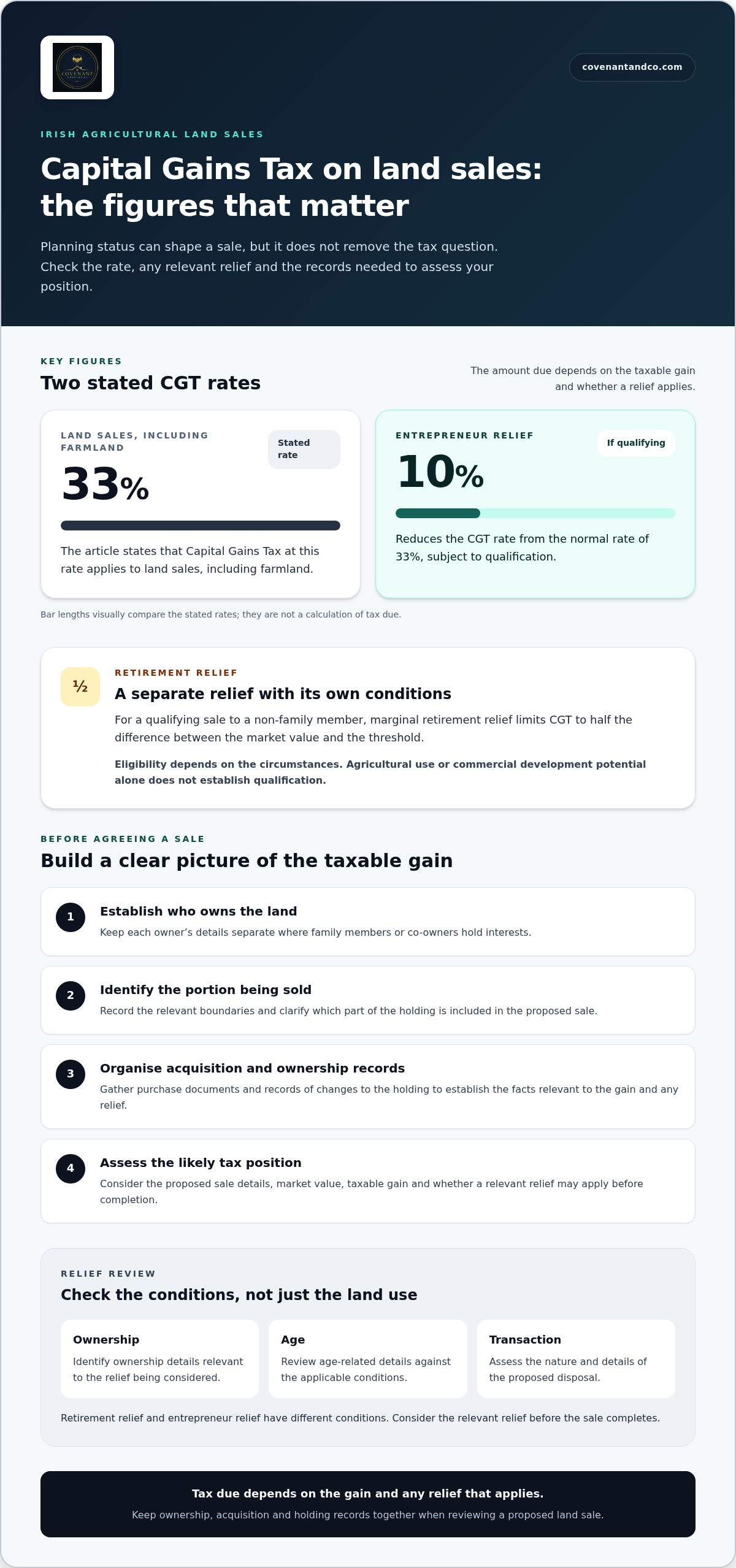
Capital Gains Tax can materially affect the proceeds from selling farmland for commercial development. In Ireland, the stated CGT rate on land sales, including farmland, is 33%. The amount due depends on the taxable gain and any relief that applies, so consider tax alongside the sale price rather than treating it as an afterthought.
Start with the taxable gain
Before agreeing a sale, gather the records that explain how you acquired and held the land. Keep purchase and ownership documents, boundary details and records of changes to the holding. These help establish the facts needed to calculate the gain and consider whether relief applies. A commercial development sale can involve a substantial difference between the land’s original value and its sale value, so accurate records matter.
Use a clear sequence: establish who owns the land, identify the portion being sold, organise the relevant acquisition records, then assess the likely tax position. If several family members or co-owners hold interests, keep each person’s ownership details separate. This provides a clearer basis for considering the transaction before signing sale documents.
Retirement relief and entrepreneur relief
Retirement relief can reduce or remove CGT for qualifying disposals. Retirement relief may be available for qualifying disposals to non-family members, depending on the circumstances. For a qualifying sale to a non-family member, marginal retirement relief limits CGT to half the difference between the market value and the threshold.
Entrepreneur relief reduces the CGT rate to 10% instead of the normal rate of 33%, subject to qualification. These reliefs have different conditions, so don’t assume that agricultural use or commercial development potential alone establishes eligibility. Identify the relief being considered and assess the relevant ownership, age and transaction details against its conditions.
Plan the tax review before completion
Relief can make a substantial difference to the tax due, but it should be considered before the sale completes. A practical review brings together the proposed sale details, ownership records, market value and any relevant relief. For retirement relief, compare the sale circumstances with the stated age and market-value conditions. For entrepreneur relief, establish whether the disposal meets its qualifying requirements.
Keep the tax review separate from the buyer’s development plans. Planning permission, zoning and a commercial proposal describe the land; they don’t by themselves establish eligibility for CGT relief. If you’re preparing to sell agricultural land for commercial development in Ireland, organise ownership and transaction information early, then use those records to assess the tax position before completion.
Commercial and industrial development sites
Commercial buyers assess more than acreage. They consider the site’s location, intended use, access and development potential together. For agricultural land, presenting these details clearly helps buyers understand what the holding could offer and what further work may be needed.
Should you sell outright, use an option agreement, or enter a joint venture with a developer? An outright sale transfers the land directly, while an option gives a developer time to assess a purchase under agreed terms. A joint venture shares the development opportunity and its associated risks, so the right structure depends on your priorities and appetite for involvement.
Assess the site as a commercial proposition
Begin with a clear description of the land and its boundaries. Record its area, location, current use and access points. Then set out the commercial or industrial use being considered, distinguishing existing facts from future possibilities. This gives a buyer a practical starting point without presenting a development idea as an approved project.
Location can help explain a site’s role. The Raheen Business Park site in Limerick is approximately 2.5 acres, or 1.01 hectares, and sits approximately 7 km south of Limerick City Centre. Those details place its size and position in context. They don’t, by themselves, establish that another agricultural site has the same commercial suitability.
Consider access and infrastructure
Check how vehicles reach the land and whether its boundary connects conveniently with existing roads. Note nearby commercial areas, settlements and services that help describe the location. For a larger holding, explain whether it is one continuous parcel or separate sections. Buyers need to understand how the shape and layout may affect their intended use.
Compare the site’s scale with its proposed purpose. Development land at Clarina Road, Patrickswell, County Limerick, measures 1.85 hectares. The site at Dublin Road, Castletroy, Limerick, comprises approximately 0.41 hectares. These examples show the range of site sizes available; the area alone doesn’t establish suitability for a particular project.
Choose a sale structure that fits your plans
An outright sale is the clearest route if your priority is transferring the land rather than participating in future development. An option agreement may suit a seller willing to give a developer time to investigate the site before deciding whether to buy. Its terms should clearly address the option period, price mechanism and what happens if the developer doesn’t proceed.
A joint venture may appeal if you want to remain involved in the project. It can also mean sharing decisions, costs and uncertainty with the developer. Compare that commitment with a direct commercial property sale, especially if you prefer a defined transaction over an ongoing role. For each structure, understand the obligations, timing and payment terms before committing.
For any option or joint venture, write down how each party’s responsibilities and returns are calculated. A landowner considering the 10.8-acre Kilmeague site in Co. Kildare, for example, would need to assess the proposed structure against that site’s circumstances, not acreage alone. A solicitor can review the agreement’s terms and explain their effect before you sign.
Land purchase transaction fees
Transaction costs affect the proceeds a seller keeps and the purchaser’s total budget. Separate seller-side legal and preparation costs from purchase taxes, then identify which costs the sale agreement assigns to each party. Stamp duty rates and reliefs can change the purchaser’s calculation, so the transaction type matters.
Understand stamp duty and reliefs
For qualifying farm consolidation transactions, stamp duty is charged at 1%. This is a specific relief, not a general rate for every agricultural land purchase. Farm consolidation relief applies to qualifying transfers of agricultural land executed from 1 January 2018 through 31 December 2020. The execution date and eligibility therefore matter when assessing whether this historic window applies.
Consanguinity relief reduces stamp duty to 1% for qualifying transfers of land between related persons, compared with the general rate of 6%. The relationship between the parties and the transfer’s eligibility are central. Don’t assume a family connection alone makes a transaction qualify; the relevant conditions must fit the transfer.
Stamp duty is only one part of the cost of a transaction. A purchaser’s budget may also include legal work and site investigations, while a seller may face conveyancing, mapping or document-preparation costs. The work involved depends on the title, boundaries, access arrangements and complexity of the holding.
Identify the costs attached to your holding
Start with a written list of the work required to transfer the land. A single parcel with clear boundaries may need different preparation from a holding divided into plots or shared between owners. Ownership records, rights of way and boundary details can all affect the documents needed to describe the property accurately.
For example, a sale involving several plots needs clear mapping that links each parcel to its title information. If access crosses another person’s land, the relevant rights should be understood and recorded. These details can affect the legal work and enquiries needed, but don’t by themselves change the stated stamp duty rate.
Keep professional fees distinct from taxes. Legal fees cover work involved in the transaction, while survey or mapping costs relate to the land’s physical description. The amount depends on the work required and the property’s circumstances, so an itemised estimate is more useful than combining everything under a broad “sale cost”.
Prepare a clear cost checklist
Before agreeing terms, list the likely costs and establish who is responsible for each. Include legal work, mapping or survey requirements, and any purchase-side stamp duty consideration. Record whether the sale covers the whole holding or selected plots, as this affects the information and documents needed.
Finally, separate relief eligibility from the commercial terms. A 1% rate under a named relief applies only where its qualifying conditions are met; the general rate stated for comparison is 6%. A clear cost breakdown helps both parties understand the transaction without treating a relief as automatic.
Development land for sale across Ireland
Irish development land ranges from small parcels on the edge of towns to larger holdings. Compare location, planning position and site constraints, not acreage alone.
For a sale, organise title documents, boundary maps, planning records and details of access and services. A boundary or topographical survey can clarify the site’s shape and levels; environmental or flood assessments can identify constraints relevant to a proposed use.
There is no single commercial-development value for agricultural land. Price depends on location, permitted or potential use, site condition, access and buyer demand.
To find Irish price context, distinguish advertised asking prices from completed transactions. In 2025, Irish development land deals totalled €589 million across 83 deals, with an average deal size of €7 million. Those figures describe development land deals, not the value of every agricultural holding.
Access, utilities, environmental designations and flooding can each affect development feasibility. Restricted road access may complicate a proposal; distance from available services can mean additional infrastructure is needed. Environmental constraints or flood exposure may limit usable areas or influence a project’s design and cost.
Assessing agricultural land value
Compare land with similar locations, sizes and development characteristics, and distinguish asking prices from completed sales. A comparable sale is a market example, not a direct valuation of a different parcel.
Consider the proposed use alongside planning status, site access and constraints. Irish development land transactions fell by 1% in number in 2025 compared with 2024, whilst their total value fell by 21%. These market figures provide context, but an individual holding’s characteristics still shape its appeal.
Site factors affecting land value
Map the entrances, boundaries and routes connecting the land to public roads. Record available information on water, electricity and drainage, then note any gaps that could affect development. For example, a site with access along only one boundary may offer fewer layout options than a parcel with more direct connections.
Environmental designations and flood exposure also matter. Identify affected areas on the site plan and consider how they relate to the proposed commercial use. A constrained section may reduce developable space or require layout changes, while services and good access can support practical use. Assess these factors together, not in isolation.
Prepare a clear sale file with title and ownership records, maps, planning material, survey information and available site reports. For example, a holding divided into several plots needs maps that distinguish each parcel and its access. This helps buyers compare the land’s stated characteristics with their intended project.
Covenant Properties: Residential Property Cash Purchase
Covenant Properties acquires land and development sites directly, including agricultural land. If you’re considering a direct sale rather than continuing to manage the property, its cash-purchase service may also suit commercial property owners.
The right next step depends on your holding and plans. You may be weighing an outright sale against a longer development arrangement, or want to understand whether a direct sale suits your circumstances. The considerations above cover planning status and site suitability, as well as tax and transaction costs. Use them to prepare a clear outline of the land and the decision you’re facing.
If you’re considering a direct sale, contact Covenant Properties to discuss your property.
Take the next step with a clear plan
If you’re considering selling agricultural land for commercial development in Ireland, turn your findings into a practical decision plan. Set out what you want from the sale, which parts of the holding are included and how involved you want to be after agreeing terms. This gives you a useful framework for discussing the land and choosing the route that best suits your circumstances.
Covenant Properties buys Irish land and sites, commercial properties, and residential properties directly for cash. These services may suit owners considering a direct property transaction, depending on the asset they want to sell. A clear conversation about your land can help establish whether a direct sale fits your plans.
When you’re ready to discuss your property, contact Covenant Properties. Take the decision at your own pace, with your priorities clearly in view.
Frequently Asked Questions
Buying and selling land: what are the tax considerations?
For a land sale in Ireland, consider Capital Gains Tax and the transaction’s tax treatment before agreeing terms. The stated CGT rate on land sales, including farmland, is 33%, with qualifying reliefs potentially changing the outcome. Organise ownership and acquisition records, identify the portion being transferred, and distinguish the seller’s tax position from purchase-related stamp duty. VAT also requires consideration where the nature of the land or transaction makes it relevant.
What factors affect the value of farmland with commercial zoning or development potential in Ireland?
Value reflects the site’s location, size, access, services and realistic development use. Zoning can influence buyer interest, but it isn’t the same as permission for a specific project. For example, a parcel near an established commercial area may attract different interest from an isolated holding, even with similar acreage. Layout, environmental constraints and the work needed to prepare the site also shape how buyers assess its potential.
How can I check whether Irish agricultural land is zoned for commercial development?
Start with the local authority’s development plan and zoning maps, then match the land’s boundaries to the map. Check the written plan for the zoning label and its stated objectives, especially if the holding spans separate designations. A parcel can cross more than one zoning area, so inspect each section rather than relying on a nearby site’s designation. Keep a map extract and plan reference with your sale records.
What planning permission is required to develop agricultural land commercially in Ireland?
Planning permission relates to the specific development proposed, such as an industrial building, warehouse or commercial premises. An application should clearly describe the intended use, scale, access, layout and relevant site details. Permission for one project doesn’t automatically cover a different use or redesigned proposal. Before presenting land as ready for a particular development, distinguish an approved proposal from a concept that still requires planning consideration.
How do County Development Plans and Local Area Plans affect commercial development potential?
A County Development Plan sets out land-use policy across a county, while a Local Area Plan provides a more focused framework for a defined area. Their zoning maps and written objectives help indicate which uses are envisaged. Read the documents together and locate the exact parcel on their maps. A commercial designation can inform a proposal, but it doesn’t approve a particular building or guarantee permission.
How do I sell agricultural land to a commercial developer in Ireland?
Prepare a clear sale file before approaching potential buyers. Include ownership and boundary information, access details, current land use, planning records and available site reports. Decide whether you prefer a direct sale or a conditional arrangement, then make sure the proposed terms explain timing, conditions and what happens if the transaction doesn’t proceed. Clear documentation helps a developer assess the holding and makes discussions more focused.
What taxes apply when selling agricultural land for commercial development in Ireland, including CGT and VAT?
Capital Gains Tax is chargeable at 33% on land sales, including farmland, although qualifying reliefs can alter the tax position. VAT treatment is a separate consideration and depends on the property and transaction circumstances. Stamp duty is also relevant to land purchases, with specific reliefs applying only to qualifying transfers. Keep these taxes distinct, and organise the transaction details so each can be assessed on its own facts.


