

Commercial development sites in Ireland range from 0.21 acres in Dublin 8 to 30 acres in Straffan, County Kildare. If you plan to sell a development site for commercial use in Ireland, its acreage is an important starting point, but size alone doesn’t explain its potential or appeal.
It’s understandable to focus on how much land you have. Next, consider how the site’s area relates to its location, planning context and potential commercial use.
This guide explains how to describe a site’s area, what buyers may assess alongside it, and how zoning and planning can shape development potential. It also covers the information that can help present the land clearly for sale.
Key Takeaways
- Compare your site’s acreage with its usable area and layout, not just the total landholding.
- Understand how zoning and planning permission relate to the commercial use a buyer may consider.
- Use comparable sites carefully: location, planning position and site characteristics affect how asking prices per acre compare.
- Present the features that shape a site’s development potential clearly, including access, services and constraints.
- Consider tax implications alongside the sale proceeds, as the land’s history and your circumstances can affect the calculation.
Development site area
Site area sets the scale of a development opportunity, but acreage alone doesn’t establish what can be built. Irish listings show a wide range. A development land listing in Dublin 8 covers 0.21 acres; Rathgar Avenue in Dublin 6 covers 0.8 acres. Greystones, County Wicklow, has a 2.14-acre listing, whilst a site in Straffan, County Kildare, covers 30 acres.
If you plan to sell a development site for commercial use in Ireland, state its measured area clearly. Give the total acreage and identify any parts that may not be usable. Boundaries, access routes, slopes, existing buildings and service corridors can affect the developable area. A site plan helps buyers understand the site’s shape, street frontage and relationship to neighbouring land.
Location changes how buyers interpret the same area. A compact site on a well-connected Dublin street may suit a different proposal from a larger parcel outside a town. The Maynooth development site covers 5.5 acres, while the Blessington site covers 1 acre. These figures describe scale, not planning approval or a guaranteed use. Residential development examples also show why area and permitted use must be considered separately.
Should I sell a commercial development site by private treaty or auction in Ireland? Private treaty allows discussions with interested buyers and scope to negotiate. An auction sets a defined bidding process and may suit sellers prioritising clear terms and competitive interest. The site’s planning position, level of market interest and your preferred timetable can help guide the choice.
What legal documents and surveys are needed? Gather title documents, a folio or boundary map, planning records and available site plans. A measured survey can clarify the boundaries and area; relevant reports may cover ground conditions, drainage and access. Which records matter most depends on the property and transaction.
How do I market the site and find buyers? Bring together the location, measured area, access, planning context and supporting plans in a clear information pack. Focus the marketing on buyers whose commercial plans may suit the site, and organise key documents for discussions.
What risks and due diligence checks should sellers consider? Compare the title and mapped boundaries with the land being sold. Identify access rights, services, existing uses and known constraints. Clarify the planning history and disclose material information consistently, so buyers can assess the site using accurate details.
For owners seeking to sell a development site for commercial use in Ireland, area records are a practical starting point. Compare measured acreage with the usable layout and documented development context. Accurate details help buyers understand what the site represents, whether it covers 0.21 acres in Dublin 8 or 30 acres in Straffan.
What planning permission and zoning rules apply to commercial development land in Ireland
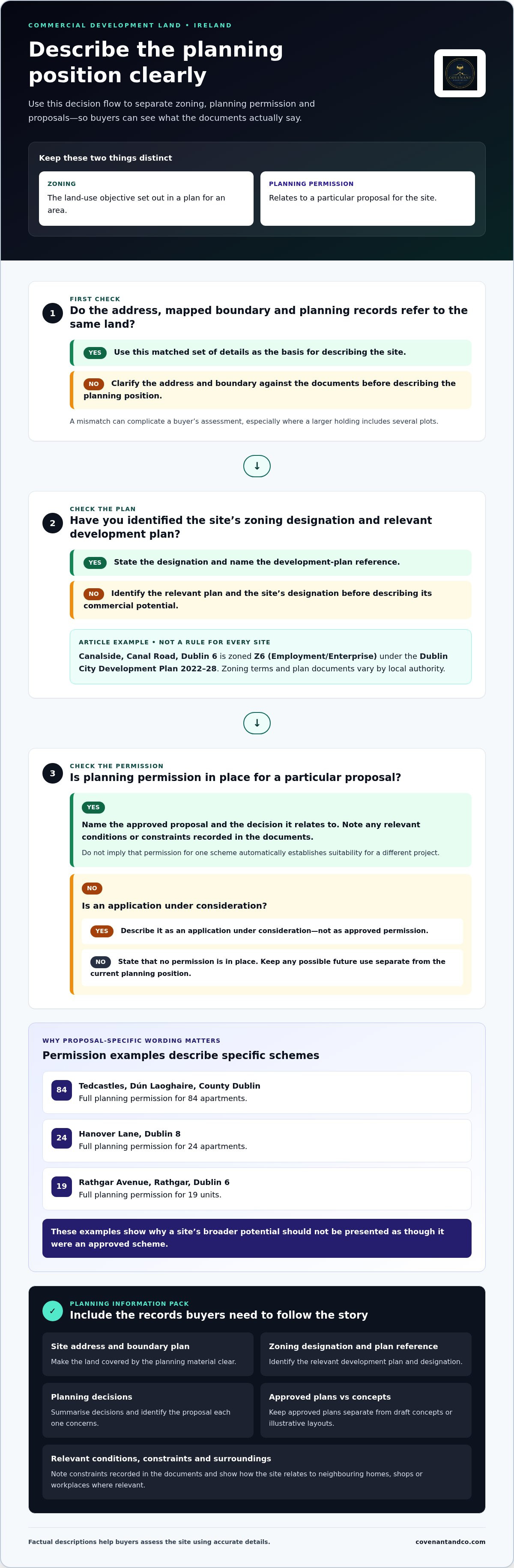
Zoning and planning permission describe different aspects of a site’s development context. A zoning designation indicates the land-use objective set out in a plan for an area. Planning permission relates to a particular proposal. Buyers need to understand both when assessing whether a commercial scheme may suit the land.
Canalside on Canal Road in Dublin 6 is zoned Z6 (Employment/Enterprise) under the Dublin City Development Plan 2022-28. This is a specific example, not a rule for every Dublin site. Zoning terms and plan documents vary by local authority. Identify the relevant development plan and the site’s designation before describing its commercial potential.
Describe the planning position precisely. State whether the site has permission for a particular scheme, whether an application is under consideration, or whether no permission is in place. Don’t present a possible future use as approved. This helps buyers distinguish the current planning position from a proposal that requires its own assessment.
For a sale pack, organise the planning material so buyers can follow it:
- Give the site address and a plan showing its boundaries.
- Include the relevant zoning designation and development-plan reference.
- Summarise planning decisions and identify the proposal each decision concerns.
- Separate approved plans from draft concepts or illustrative layouts.
- Note relevant conditions or constraints recorded in the documents.
These details help distinguish zoning from planning permission. A site’s zoning may support a stated employment or enterprise use, but it does not set out every design detail or determine the status of a specific scheme. Similarly, existing permission relates to the approved proposal and does not automatically establish suitability for a different commercial project.
Check that the address, site boundary and planning documents all refer to the same land. A mismatch can complicate a buyer’s assessment, particularly where a larger holding includes several plots. If the site is beside homes, shops or workplaces, show its surroundings clearly. This context helps explain how a proposed use relates to the neighbouring area.
Keep the wording factual. Say what the plan designates, what permission covers and which documents support each statement. Buyers can then assess the proposal without relying on broad claims such as “commercial potential”. For owners considering a direct route, a direct commercial property sale can bring the site and its planning information into the same discussion.
Other site examples show why the approved use and broader potential should be kept distinct. The Tedcastles site in Dún Laoghaire, County Dublin, has full planning permission for 84 apartments, while the Hanover Lane site in Dublin 8 has full planning permission for 24 apartments. The Rathgar Avenue site in Rathgar, Dublin 6, has full planning permission for 19 units.
By contrast, the Kilmeague site in County Kildare has potential for 110-150 residential units, subject to planning permission. Canalside in Dublin 6 has full planning permission for a substantial Grade A office development. These examples underline the value of describing planning status precisely: potential remains subject to planning permission, while full permission applies to the proposal described. Buyers can use that distinction to understand what is authorised and what would still require assessment.
How much are commercial development sites worth per acre in Ireland
There’s no single per-acre figure for every Irish development site. Asking prices vary widely, even among sites with development potential.
Asking prices can help with comparisons, but they aren’t a standard rate. Dividing a listing price by its acreage gives a rough asking price per acre, not proof that another site will sell at the same rate. The figure reflects the listing’s specific location, land characteristics and development context.
Consider two further examples from County Galway. Their differences show why acreage alone cannot determine a site’s value. The sites are in different locations, and their descriptions don’t establish that they have the same uses or planning positions.
Other listings highlight the variation. The smaller Roscommon site has a different location and zoning description. Comparing the sites by area alone would overlook those distinctions.
For a practical comparison, record the same details for each listing:
- Asking price and stated acreage.
- Town, county and position relative to the centre.
- Zoning description and planning status.
- Access, site shape and any stated constraints.
- The proposed or described development use.
Then compare like with like. A listing described as zoned land should not be treated as equivalent to a parcel merely described as having development potential. The 1.30-acre site near Ballinamuck, County Longford, is listed as having development potential, whilst the Roscommon Town Centre listing is described as zoned. Those descriptions provide different information for a buyer’s assessment.
Use per-acre calculations as an initial screening tool, not as a valuation. Ask whether each comparison reflects a similar planning position, location and set of land characteristics. The asking figures show a broad spread, not a dependable rate for every Irish site.
Record its asking price and acreage alongside the other examples, but treat the calculation as a comparison of asking prices, not evidence of a completed sale or independently assessed value. The description mentions development potential, but does not establish that the site’s planning position or intended use matches another parcel.
Keep each listing description alongside its figures. A lower per-acre asking price may look attractive, but it doesn’t show whether the site suits a particular proposal. Use the comparison to prompt further checks on the land and its stated context, not as a shortcut to a reliable valuation.
What factors affect the value of a commercial development site in Ireland
A site’s value reflects more than its acreage. Location, access, planning context and physical condition all shape buyer interest. Raheen Business Park in Limerick illustrates how these details work together. Its site is approximately 7 km south of Limerick City Centre. It also has planning permission for a warehouse of approximately 5,200 sq m. That context gives buyers more to assess than land area alone.
Planning status can influence how clearly a buyer understands potential use. Broomhill Road in Tallaght has full planning permission for 609 square metres of retail space and 75 residential units. That approved scheme gives buyers specific information about the permitted development. A different site without permission requires buyers to assess a proposal separately. The distinction can affect their view of risk, timing and potential.
Location matters because it affects how a site connects with surrounding activity. Access from a public road, nearby services and neighbouring uses can influence a commercial proposal. Raheen Business Park’s position relative to Limerick City Centre is one example of useful location context. A site plan and clear access details help buyers understand these connections rather than relying on a map pin alone.
Physical characteristics matter too. Ground conditions, drainage, levels, boundaries and existing structures can affect the layout or preparation needed for development. A site with a clear shape may offer different design opportunities from land divided by access routes or other constraints. Provide available surveys and plans, and describe known features accurately, so buyers can relate them to the proposed use.
Use a consistent checklist to review the factors that may shape buyer interest:
- Planning: identify the permission and its approved proposal, as at Broomhill Road.
- Location: explain access and nearby centres, as with Raheen Business Park.
- Services: describe available connections and supporting documentation.
- Site condition: share relevant surveys, boundaries and ground information.
- Use potential: distinguish an approved scheme from a possible future proposal.
Demand depends on whether a site’s characteristics suit a buyer’s intended project. Cherrywood Town Centre in Dublin 18 has potential for approximately 30,000 square metres of retail and leisure space. That stated potential describes a particular location and opportunity. It is not a template for sites elsewhere. A local buyer’s assessment will weigh the proposed use against the site’s own context.
Support each value factor with evidence. For example, pair a planning reference with the relevant decision, and access details with a boundary plan. Clear, consistent information helps buyers compare the site with their intended commercial use. It also distinguishes documented features from assumptions about future development.
What taxes apply when selling development land in Ireland
Selling development land can raise different tax questions, including Capital Gains Tax (CGT), Value Added Tax (VAT) and income tax. The correct treatment depends on the seller’s circumstances, the land’s history and the nature of the transaction. No single calculation applies to every Irish land sale.
For CGT, the calculation focuses on the gain, not simply the sale proceeds. The original acquisition cost, ownership history and eligible costs may affect the result. Keep purchase records, invoices for relevant work and sale documents together. For inherited or gifted land, retain records showing how ownership transferred.
VAT requires separate consideration. The land’s physical characteristics, past use and transaction details can affect the analysis. A site with buildings or a history of commercial activity may raise different questions from undeveloped land. Gather records of its use and previous transactions, and don’t assume that every development site receives the same VAT treatment.
Income tax may also need consideration where the sale relates to trading or a pattern of property activity. The distinction between disposing of an investment asset and selling land as part of a trade can matter. Ownership records, the seller’s activities and the reason for acquiring the land help explain the circumstances.
Organise the tax information before agreeing sale terms:
- Record the acquisition date, purchase documents and ownership changes.
- Collect invoices for relevant land or property expenditure.
- Describe the site’s previous uses and current condition.
- Keep planning records and sale documents with the property file.
- Separate the proposed land transaction from any buildings or other assets.
For example, a vacant site and a site containing commercial premises present different information for review. The land at Raheen Business Park in Limerick has planning permission for a warehouse of approximately 5,200 sq m. That planning detail describes the site; it does not, by itself, settle the seller’s tax treatment. Keep planning evidence distinct from acquisition and expenditure records.
Before signing, connect each relevant document with the tax question it may help answer. Purchase records support the ownership history, invoices explain recorded expenditure, and planning files describe the site. A solicitor or tax adviser can assess the legal and tax position using these details. This preparation can help identify questions early, rather than relying on an asking price to indicate tax liability.
For a direct sale discussion, share your development land details alongside the property records. A clear account of the site and its history makes the proposed transaction easier to understand.
Covenant Properties: Residential Property Cash Purchase
Covenant Properties offers Land and Site Acquisition and Commercial Property Cash Purchase for owners considering a direct sale of development land. These options may suit you if you’re weighing a direct purchase against a conventional marketing process. The company acquires land and development sites across Ireland, with a focus on efficient transactions and clarity throughout the sale. The site’s area, planning position and supporting documents can help frame an initial discussion about the property. If you’re considering a sale, you can visit Covenant Properties to discuss your commercial development site.
Take the next step with a clear sale plan
If you’re preparing to sell a development site for commercial use in Ireland, decide what matters most before choosing how to sell. You may prioritise a direct transaction, clear terms or time to consider buyer interest. Being clear about your priorities helps shape a practical conversation about the site.
Covenant Properties acquires land and development sites, including sites with or without planning permission, and purchases commercial properties directly for cash. The service offers a direct sale, with no public listing or agent commissions. Request a free cash quote to discuss selling your site. The offer is obligation-free, and completion can be in days or months, at a pace that suits your needs.
Gather the site’s key details and consider what you need from a sale. A straightforward discussion can help you understand the next steps without pressure or assumptions. Contact Covenant Properties to discuss your property and possible sale route. A considered first step can make the decision ahead feel clearer.
Frequently Asked Questions
How to sell a development site for commercial use in Ireland?
To sell a development site for commercial use in Ireland, organise the title documents, planning information, site maps and details of access, services and any known restrictions. A solicitor can help prepare the sale and check the paperwork. For a direct sale, Covenant Properties’ Land and Site Acquisition service considers Irish sites with or without planning permission. It provides a cash offer within 24-48 hours; contracts can be signed in as little as 7 days, with completion as soon as possible, no pressure.


