

Planning permission is not a blank cheque for future construction or a change of use. For commercial property with planning challenges in Ireland, the key is to understand what the permission allows, which conditions apply and whether the intended use fits. For instance, historic regional transport facilities often operate under specific historical permissions that were granted subject to numerous strict conditions.
It’s understandable to focus on whether a site has planning permission. But conditions, later applications and expiry terms can all affect what happens next. A proposed use may also need separate planning consideration, even if the property has operated commercially before.
This article explains how permissions and conditions can shape construction, what to consider when assessing commercial uses, and why decision timelines and expiry clauses matter. Use this framework to assess a site before committing to a purchase, sale or development plan.
Key Takeaways
- Read the conditions attached to a planning permission, not just the decision notice, to understand what construction it allows.
- Allow for the steps that can shape a planning decision timeline, and consider how delays may affect project and property decisions.
- Compare the intended commercial use with the site’s planning history and applicable exemptions before making plans for a change of use.
- Review permission dates and any use-it-or-lose-it terms so you can judge whether a development can still proceed under the existing consent.
- Build a clear picture of a site by tracing its planning applications, decisions, conditions and zoning context.
Planning permission and construction activity
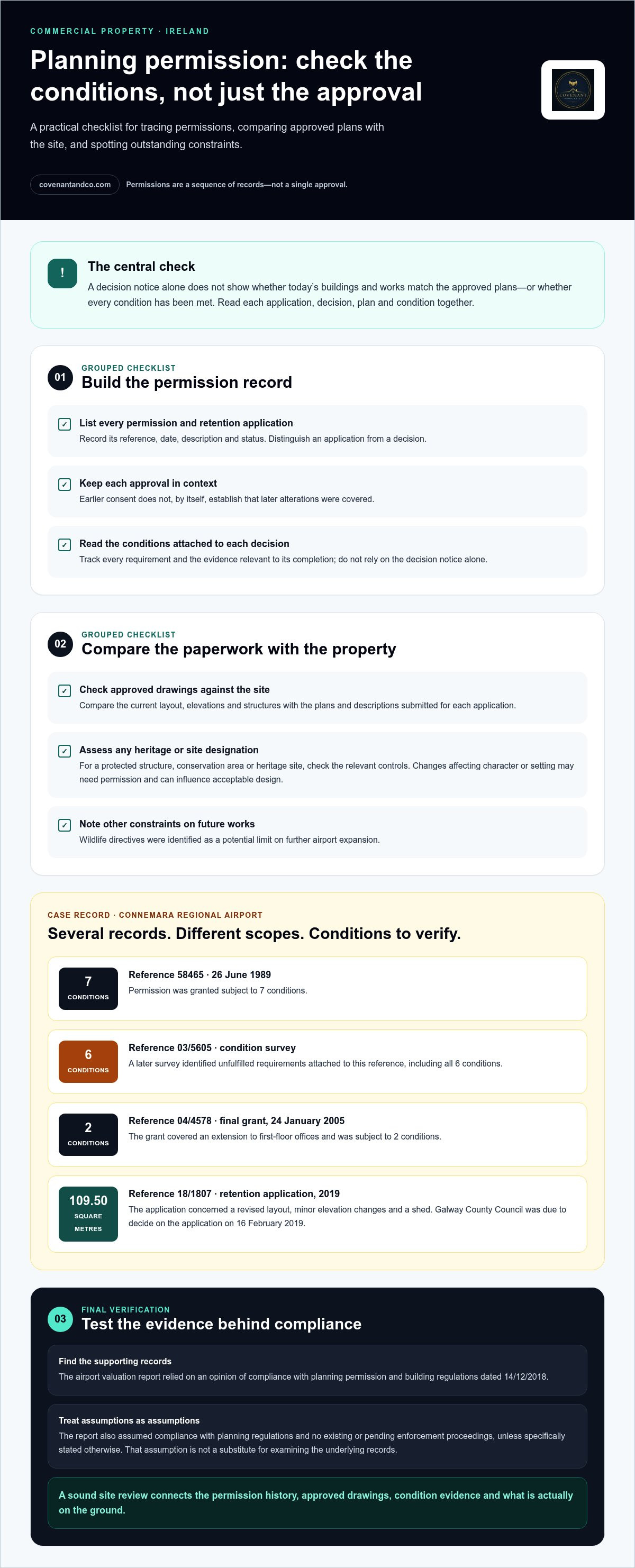
Planning permission defines the approved development, while its conditions can shape work on site. The decision notice is only part of the picture. At Connemara Regional Airport, planning reference 58465 was granted on 26 June 1989 subject to 7 conditions. A later condition survey identified unfulfilled requirements attached to reference 03/5605, including all 6 conditions. This illustrates why a property’s planning history must be read as a sequence, not as a single approval.
For a protected structure, conservation area or heritage site, assess proposed work against its designation and relevant planning controls. Alterations that could affect a building’s character or setting may need planning permission, and heritage considerations can influence which design changes are acceptable.
Older permissions can leave practical questions for a buyer or developer. Check each decision notice and approved drawing, then compare them with the buildings and uses on site. Permission reference 04/4578 received a final grant on 24 th January 2005 for an extension to first-floor offices, subject to 2 conditions. That record differs from a later retention application under reference 18/1807 in 2019. An earlier approval does not, by itself, show that later alterations were covered.
The 2019 application concerned retention for a revised layout, minor elevation changes and a shed. Galway County Council was due to decide on a retention application covering 109.50 square metres of work on 16 th February 2019. Compare the application description with the physical works. A revised layout, a shed or an altered elevation may have a different planning status from an earlier office extension. Record what each application sought, and distinguish an application from a decision.
Next, match the condition wording with evidence of compliance. The airport valuation report relied on an opinion of compliance with planning permission and building regulations dated 14/12/2018. It also assumed compliance with planning regulations and no existing or pending enforcement proceedings, unless specifically stated otherwise. That assumption is not a substitute for examining the underlying records. The condition survey had identified unfulfilled earlier requirements, showing how assumptions and site history can differ.
- List every permission and retention application by reference and date.
- Compare approved plans with the current layout, elevations and structures.
- Track each condition and the evidence relevant to its completion.
- Consider site constraints: wildlife directives were identified as a potential limit on further airport expansion.
These steps help establish whether existing permissions support the intended construction or whether a further planning decision may be needed.
Planning clarity and timeliness
Clear planning information helps owners assess whether a commercial site can support a proposed development. A site may fall within a broad policy area without having a dedicated zoning designation or its own local area plan. The distinction matters: development plan policy provides context, but it does not automatically make every proposed use acceptable.
For a buyer or owner, identify the policies that apply to the specific property and intended use. Read the relevant county development plan and any local area plan covering the site. Compare the proposed activity, access and services with the plans’ objectives. A general policy reference alone cannot resolve every question about a specific commercial proposal.
The Irish Government says housing land should be zoned and serviced, with clear, timely planning. For the property sector, clarity helps inform early decisions about whether to pursue a use, prepare a development proposal or account for unresolved planning questions. Servicing also matters: a site’s policy designation and its practical readiness for development are related, but not interchangeable.
What are the appeal deadlines and costs for Irish planning decisions to An Coimisiún Pleanála? Deadlines and fees depend on the type of appeal and the relevant decision. Include the applicable appeal period and fee in the project timetable rather than treating an appeal as an open-ended extra step.
A useful review can follow a short sequence:
- Identify the local authority and development plan covering the property.
- Check whether a local area plan also applies to the site.
- Note the site’s zoning status and the plan policies relevant to the intended activity.
- Separate policy support from practical matters, including servicing and additional planning steps.
This sequence distinguishes a policy question from a timing issue. If a proposal conflicts with plan objectives, that may affect its prospects before detailed design begins. Even where the policy context is favourable, unresolved servicing or other planning steps can affect when construction is realistic. Record each point separately so a clear policy reference does not obscure an outstanding site constraint.
For property owners weighing a sale while planning questions remain, understanding commercial property sale options can help frame the next decision.
The Connemara Regional Airport property is included in the Gaeltacht plan in the Galway County Development Plan 2015 -2021, but it is outside any specific local area plan and is not specifically zoned. This example shows why a plan reference should be read alongside the site’s exact planning status. Inclusion in a plan does not, by itself, establish a specific zoning designation or confirm that a particular use is acceptable. For an owner assessing a proposal, keep these points distinct: the plan context, the absence of a specific local area plan, and the absence of specific zoning. Recording each separately can help ensure that a broad policy reference is not mistaken for a site-specific planning conclusion.
Planning permission for commercial uses
Irish local development plans and zoning guide which uses are supported on a site, but a designation alone does not establish that every proposal is acceptable. Compare the intended activity with the relevant county development plan, any local area plan and the site’s planning record.
A commercial property may operate under an existing permission or an applicable exempted development right. Certain changes of use within the definition of a shop are presumptively exempt, and the Irish Government has introduced exemptions for converting commercial space into homes. The scope and conditions of each exemption matter: calling a property a “shop” does not establish that a particular use qualifies.
Environmental impact assessment, Appropriate Assessment and flood-risk considerations can affect what information is needed to assess a commercial proposal. Check whether the site’s location, proposed works or likely effects raise these issues. They can influence the evidence required and the development’s prospects.
Buying a property with unresolved planning issues can leave uncertainty about whether its existing permissions match its current layout and use. That uncertainty may affect a buyer’s plans, construction programme and assessment of the site. For commercial property with planning challenges in Ireland, compare the buildings and current activity with the permission record before assuming there is a right to continue or change use.
You can trace planning applications and decisions through the relevant local authority’s planning records. Planning consultants and solicitors have distinct roles: planning advice focuses on proposals and planning records, while legal advice covers the property transaction and related documents.
Use this practical sequence to assess a proposed commercial use:
- Write down the current activity and the intended use, including any planned building work.
- Find the site’s planning applications and decisions in the local authority record.
- Compare approved plans and conditions with the property’s current layout and use.
- Read the applicable development plan and zoning context alongside any claimed exemption.
- Identify environmental or flood-risk questions that could affect the proposal’s assessment.
Small details can alter the planning picture. The described Irish exemption allows no more than one satellite dish antenna within a business premises’ curtilage. A separate exemption for changing premises to refugee or asylum-seeker accommodation applies for 3 years from the commencement of that change of use. These examples show why the precise activity, premises and exemption wording belong in the record review.
Keep a written record of the relevant application references, approved drawings, conditions and intended use. This makes it easier to spot gaps between the property as it stands and the planning basis for its next commercial purpose.
Use-it-or-lose-it planning clauses
The Irish Planning and Development (No.1) Bill 2014 included a vacant site levy and a “use it or lose it” clause for planning permission. This connects two policy concerns: land left vacant and permissions that do not lead to development. For a commercial property owner, the practical lesson is to separate that legislative proposal from the actual terms and status of a site’s planning permission.
A clause tied to a permission can make progress on the approved development important. Start by reading the grant and its conditions to understand what action is required. Consider the full decision, approved plans and any later amendments together. Permission for one layout or use is not blanket approval for a different project, even at the same property.
For a site under consideration, create a dated record of its planning position. Note the decision date, the development described, the conditions and any later applications or decisions. Compare these records with what has been built and the work still proposed. This helps establish whether the intended project matches the approved scheme or needs a separate planning step.
Timing affects commercial decisions, even where a particular “use it or lose it” clause may not apply. Design changes, funding arrangements, access works and site constraints can all affect whether a permitted scheme proceeds. If the project changes while these matters are being resolved, compare the revised proposal with the permission before treating it as the same development. Keep relevant correspondence and decision documents together.
- Read the operative planning decision, not a summary or marketing description.
- List each condition and identify the evidence that addresses it.
- Compare the approved drawings with the current site and intended works.
- Record subsequent applications, decisions and changes to the proposal.
The 2014 Bill is a useful reminder that planning policy can address both unused land and delivery. It does not, by itself, establish that a particular commercial property currently has a use-it-or-lose-it condition. For that, assess the permission documents and relevant planning history for the specific site. Keep the distinction clear when valuing land, setting a development timetable or negotiating a purchase.
Where a permission’s wording or history affects a transaction, organise the documents around the specific site and proposed works. A clear record distinguishes an approved scheme from an assumption, and a policy proposal from a condition attached to an individual grant. That helps you decide whether to proceed, revise the project or account for unresolved planning issues.
How can I check planning history and zoning for a commercial property in Ireland?
Start with the property’s address, map location and site boundary. Use these details to search the relevant local authority’s planning records and identify applications affecting the correct land. A large holding may include separate buildings or parcels, so match each record to the area under consideration.
Search for the address and any planning reference linked to the site. Read each application description, decision and available plan. An application is not the same as a grant, and a grant does not automatically cover later changes. Record each decision’s status and note conditions relevant to the proposed commercial use or construction.
Next, open the county development plan and check its maps and written policies. Look for the site’s zoning, any applicable local area plan and objectives relevant to the intended activity. If the property includes several buildings or land parcels, compare the map with the precise area under consideration. A single address may not show whether every part has the same planning context.
- Pinpoint the land on a map and note its address and boundaries.
- Search the relevant local authority’s planning records using the address and known references.
- Compare application descriptions, decisions and drawings with the property as it stands.
- Read the development plan maps and policies for the specific site.
- Keep a dated record of permissions, conditions, refusals and later applications.
Use a simple comparison table to identify gaps. Put the planning reference, application purpose, decision and relevant condition in separate columns. Then note whether the existing building, layout and use match the documents. For example, do not assume permission for offices covers a different activity simply because it takes place in the same building.
Check the full sequence, not just the newest entry. A later application may concern retention or a limited alteration rather than replace every earlier permission. Compare its drawings with earlier approved plans. If the documents show different layouts, list the differences and identify which decision applies to each part of the site.
For a purchase or sale involving uncertain records, organise the property documents around the relevant land and intended transaction. Explore a commercial property sale as a direct option for a property decision shaped by planning history.
Covenant Properties: Residential Property Cash Purchase
Covenant Properties directly purchases residential and commercial properties, as well as land and development sites. If planning conditions, historic permissions or zoning questions are shaping your next move, a direct sale may be worth considering alongside further development. It does not replace planning review, but offers property owners a way to discuss selling rather than progressing a project themselves.
For a commercial building or development site, Covenant Properties offers a Commercial Property Cash Purchase or Land and Site Acquisition. For a home, it also offers a Residential Property Cash Purchase. Consider which option best matches the property you’re looking to sell.
To discuss a property sale, contact Covenant Properties or visit covenantandco.com.
Choose your next step with clarity
A planning issue does not have to determine the whole property decision. It may be one factor in deciding whether to continue with a development, adjust your plans or consider a sale. For commercial property with planning challenges in Ireland, clarify what matters most: the site’s current position, your intended outcome and the uncertainty you’re prepared to carry.
Before acting, organise the key property and planning documents and identify the decision you need to make. A focused discussion with Covenant Properties about selling can help you consider a direct sale alongside your other plans. You do not need to have every detail resolved before starting the conversation.
Contact Covenant Properties about your property to discuss your situation. A clear next step can make a complicated property decision feel more manageable.
Frequently Asked Questions
What commercial property uses require planning permission in Ireland?
Planning permission may be needed when a proposal changes a property’s use or involves development beyond an applicable exemption. The specific activity and premises matter. Certain changes of use within the definition of a shop are presumptively exempt, and the Irish Government has introduced exemptions for converting commercial space into homes. Do not assume, for example, that a shop’s exemption covers every new activity. Compare the intended use with the permission and any relevant exemption conditions.
What are common planning challenges for commercial property developments in Ireland?
Common challenges include a proposed use that conflicts with development plan objectives, outstanding conditions and site constraints affecting further development. Environmental assessment questions or flood risk can also complicate a proposal. For example, a commercial site may have permission for its current activity, while a new layout or expansion raises separate planning questions. Identify each issue separately: a zoning concern and an outstanding condition can affect a project in different ways.
How do I apply for planning permission for commercial property in Ireland, and what are the steps and fees?
Start by defining the proposed use and works, then assemble the site details, plans and supporting information needed to describe the proposal clearly. Submit the application to the relevant local authority with the applicable fee. The fee depends on the application category and proposal details, so use the authority’s current fee schedule when preparing your budget. Keep the submitted material and decision documents together so you can compare later project changes with the application.
How long do commercial planning applications and appeals typically take in Ireland?
There is no single timeline for every commercial application or appeal. Duration can depend on the proposal’s complexity, the completeness of its supporting material, environmental questions and submissions received during assessment. An appeal adds another stage, with its own submission deadline and fee based on the appeal category. Build these steps into the project schedule, and treat the applicable deadline as firm rather than assuming the process will finish by your preferred construction start.


