

What if you could bypass the traditional six-month wait and sell commercial unit Ireland assets without a single public viewing? Most property owners expect the disposal process to be a marathon of high estate agent fees, failed finance applications, and constant tenant disruption. It's an exhausting cycle that often leaves you stuck in limbo whilst the market shifts. You've worked hard to build your portfolio; you shouldn't have to struggle just to exit it.
This 2026 guide reveals the exact steps to navigate the Irish commercial market and shows you how to bypass the open market for a certain, stress-free sale. We'll examine the current tax landscape, including the 7.5% stamp duty rate and CGT obligations. You'll also learn how a direct cash purchase eliminates the risk of buyers pulling out or failing to secure finance. It's time to move from uncertainty to a clean, professional break from your property.
Key Takeaways
- Understand why traditional sales cycles often exceed twelve months and how to avoid these common liquidity traps in the current sector.
- Discover how to sell commercial unit Ireland assets directly to bypass expensive estate agent fees and intrusive public viewings.
- Compare the total costs of an open market listing against a direct cash sale to identify which route offers the best net return for your business.
- Identify the essential documentation, such as clear title deeds and up-to-date lease agreements, required for a seamless and professional disposal.
- Learn how a direct cash offer provides total certainty by removing the risk of a buyer's finance falling through at the final stage.
Understanding the Irish Commercial Property Market in 2026
The Irish commercial sector in 2026 presents a complex picture. Whilst investment volumes reached over €1 billion in the second quarter, liquidity remains a significant hurdle for individual owners. If you want to sell commercial unit Ireland assets, you'll likely face a market where bank lending criteria are stricter than ever. High interest rates have changed buyer behaviour; investors now demand higher yields and undergo much deeper due diligence. This caution often pushes traditional sales cycles beyond the twelve-month mark.
Understanding the history of the Irish property market helps explain this modern hesitation. Banks haven't forgotten previous volatility, leading to a "flight to quality" amongst lenders. Prime industrial units are currently the market leaders, with rents projected to rise by 4%. Prime offices follow closely, whilst secondary retail assets continue to struggle. This uneven recovery means that unless your unit is a high-spec, sustainable building, finding a buyer on the open market is rarely a swift process.
The Challenges of the Open Market
Listing a property publicly carries a hidden risk: the "stale" factor. If a unit remains on the market for several months without moving, potential buyers often assume there's a structural or legal issue. This perception can lead to low-ball offers or, worse, no interest at all. Meanwhile, the costs of maintaining a vacant unit continue to mount. You're still responsible for security, insurance, and rates, even if the building is empty. Current market sentiment is divided; whilst 57% of chartered surveyors view prices as fair, 38% still consider the market expensive. This gap in expectations often causes negotiations to stall indefinitely.
Identifying Your Reason for Selling
Most owners aren't selling just for the sake of it. Common triggers in 2026 include retirement, portfolio consolidation, or the need to liquidate funds for more profitable ventures. In this environment, speed of execution is often more valuable than chasing the absolute highest paper valuation. A protracted sale doesn't just cost money in fees; it costs time and mental energy. Before you engage an agent, it's vital to have a clear exit strategy. Are you prepared for a 12-month wait, or do you need a certain exit to move on to your next chapter?
How to Sell a Commercial Unit: The Traditional Step-by-Step Process
Choosing to sell commercial unit Ireland properties via the traditional route involves a specific sequence of administrative and legal hurdles. It begins with a professional valuation to set a realistic asking price. Unlike residential sales, commercial buyers are focused on the "maths" of the deal. They look at your tenant's covenant strength, the remaining lease term, and the net initial yield. According to the 2026 Commercial Property Market Monitor, market sentiment remains cautious, making an accurate initial price point vital to avoid your listing becoming stagnant on public portals.
The Role of Professional Valuations
Don't confuse an estate agent's verbal appraisal with a formal RICS Red Book valuation. Lenders almost always require the latter to approve a buyer's finance. The value of your unit is heavily dictated by its income-producing potential. In 2026, yield compression has stabilised as investors prioritise cash-flow security over speculative capital gains. If your unit is vacant, the valuation will likely be lower to account for the risk and cost of finding a new tenant in a competitive market.
Legal Requirements and the BER Certificate
Before you even list the property, you must obtain a Building Energy Rating (BER) certificate. It's a legal requirement in Ireland to display the BER grade on all marketing materials, from online portals to physical signage. Your solicitor should also begin work immediately. They need to verify title deeds and ensure all planning permissions are in order for any previous modifications. Organising your "Replies to Requisitions" early is a smart move. These are standard questions about the property's history that, if left until the last minute, can delay a closing by weeks or even months.
Once the marketing goes live, your agent will manage viewings and negotiate offers. Reaching the "Sale Agreed" stage is a milestone, but it's not the finish line. This triggers a due diligence period where the buyer's team scrutinises your accounts, structural reports, and environmental compliance. This phase is where many traditional sales collapse, often due to the buyer failing to secure their expected level of funding or discovering "red flags" in the legal pack. If this administrative weight feels overwhelming, you might consider a more direct route and sell your commercial unit directly for cash to avoid the open-market stress.
Comparing Direct Cash Sales vs. The Open Market
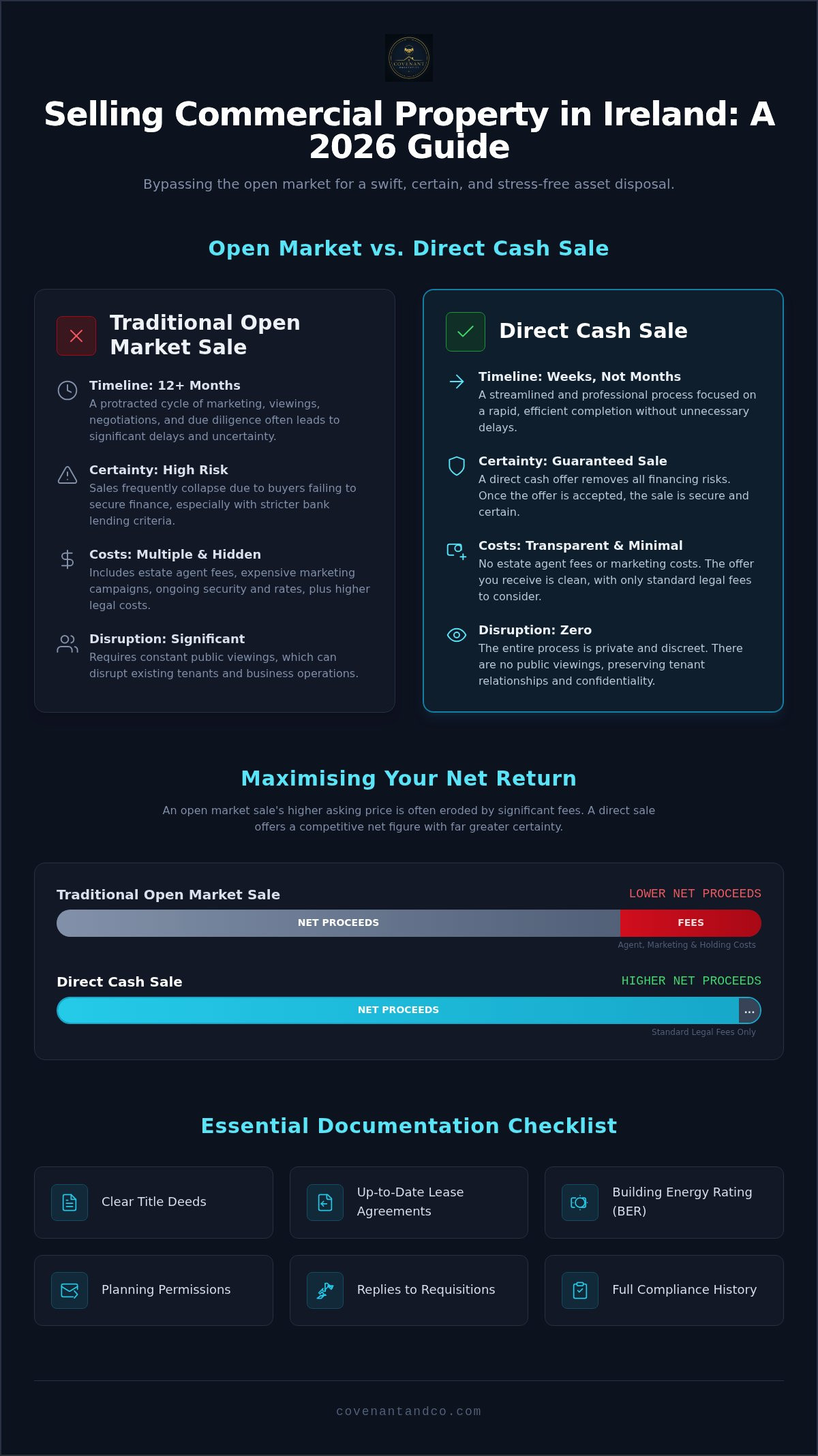
Choosing how to sell commercial unit Ireland assets depends on your priority: maximum exposure or absolute certainty. The open market offers the widest reach, but it comes with significant friction. Traditional sales cycles frequently stretch between 6 and 12 months. During this time, you're at the mercy of market shifts and bank lending appetites. In contrast, a direct cash sale provides a streamlined exit. By removing the need for bank valuations and credit committee approvals, a direct completion can often happen within 2 to 4 weeks.
The "Certainty Factor" is the biggest differentiator. In a traditional sale, a buyer might agree to a price but fail to secure their expected funding. This finance contingency is a common cause of deals collapsing at the final hour. A direct cash purchase eliminates this risk entirely. You gain a guaranteed exit date, allowing you to plan your next investment or retirement with total confidence.
The True Cost of Selling via an Agent
Many owners focus only on the headline sale price. However, the "net" figure is what actually lands in your bank account. Traditional estate agent commissions generally range from 1% to 2.5%. You must also add VAT at 23% to these professional fees. Marketing costs for brochures, signage, and online portal listings are often charged upfront. If your unit sits vacant whilst waiting for a buyer, you're still liable for rates, insurance, and security. These "holding costs" can quickly erode your profit. A direct sale removes these expenses, often resulting in a higher net return despite the lack of public bidding.
Discretion and Public Perception
Public listings aren't always ideal for a functioning business. Placing a "For Sale" board outside a retail or office unit can signal instability to staff, customers, and competitors. It can also cause unnecessary anxiety for existing tenants. A private transaction allows you to maintain business continuity. There are no public viewings and no online footprints. You can organise the sale of the premises quietly and professionally. This level of discretion is particularly valuable for owners with sensitive tenant relationships or those who simply value their privacy whilst consolidating a portfolio.
Essential Documentation for a Seamless Sale
Preparation is the difference between a sale that closes and one that collapses during due diligence. If you intend to sell commercial unit Ireland assets in 2026, you need a "deal-ready" legal pack. This isn't just about proving you own the building. It's about showing a buyer that the asset is compliant, transparent, and ready for transfer. Buyers and their solicitors will scrutinise everything from title deeds to the smallest alteration made to the premises five years ago.
Your documentation checklist should include:
- Proof of Ownership: Clear title deeds and Land Registry documents.
- Planning Compliance: Certificates of Compliance for any alterations or extensions.
- Financial Evidence: Up-to-date records of commercial rates payments and service charges.
- Environmental Data: Asbestos surveys or environmental reports if applicable to the building's age.
Organising Your Lease Information
The "Unexpired Lease Term" is the most critical document for any commercial investor. It dictates the building's value more than the bricks and mortar themselves. You must prepare a clear schedule of rent reviews and identify any upcoming break clauses. If the tenant has a right to exit in eighteen months, a buyer needs to know. You should also ensure all tenant deposits are accounted for and held in a way that allows for a clean transfer upon completion. A messy lease history is a primary reason for price renegotiations late in the process.
Rates, Taxes, and Compliance
Financial transparency builds trust. You'll need to confirm the "Rateable Valuation" of the unit with the Valuation Office to ensure the buyer understands their future overheads. It's also vital to discuss the Capital Gains Tax (CGT) implications with your accountant early. In Ireland, the standard CGT rate on property is 33%, and knowing your net liability helps you make better decisions during negotiations. For modern industrial or office units, the "Safety File" is a mandatory requirement. This file contains all the technical data, drawings, and maintenance manuals for the building's systems.
Gathering these documents can take weeks, especially if you need to track down old planning files or tax receipts. If you'd prefer to avoid the administrative burden of preparing a property for the open market, you can sell your commercial unit to Covenant Properties for a direct cash offer that bypasses the need for extensive public marketing packs.
Sell Your Commercial Unit to Covenant Properties
If the complexities of the open market feel like an unnecessary gamble, we provide a professional alternative. When you choose to sell commercial unit Ireland assets to Covenant Properties, you're opting for a process designed around your schedule. We operate as a direct cash buyer, meaning we don't rely on bank approvals or external funding committees. This independence allows us to move from an initial enquiry to a formal offer with a speed that traditional estate agents simply cannot match. We evaluate units nationally, from retail spaces to industrial warehouses, all whilst maintaining the highest levels of discretion.
Our interaction follows a clear, three-step sequence:
- Enquiry: You provide the basic details of your unit and its current occupancy status.
- Assessment: Our acquisitions team conducts a discreet evaluation without requiring public viewings or intrusive signage.
- Cash Offer: We present a firm, transparent offer with no hidden fees or marketing costs.
A Straightforward Path to Liquidity
We believe in a "straight shooter" approach. Our team conducts due diligence efficiently and respectfully, ensuring we understand the unique legal and structural aspects of your property without causing delays. Because we are direct buyers, there are no "chains" to manage and no third-party finance requirements that might fall through at the final stage. This certainty allows you to plan your next move with absolute confidence. For more insights on how we handle these transactions, you can read our Selling Business Premises in Ireland: 2026 Guide for further context.
Taking the Next Step
Requesting an assessment is entirely no-obligation. We understand that selling a commercial asset is a significant decision, and we're here to provide a clear, stress-free option. To help us move quickly, it's useful to have your basic lease information and rateable valuation ready when you reach out. We move quickly. We can work with you to choose a closing date that suits your specific business needs, whether that's a rapid exit or a longer transition to accommodate a relocation. Ready to move forward? Contact Covenant Properties for a direct cash offer today.
Secure Your Commercial Property Exit
The Irish commercial market in 2026 requires a strategic approach. You've seen that traditional listings often lead to lengthy timelines and high marketing costs. By organising your lease schedules and planning compliance early, you're already ahead of most sellers. However, the true value for many owners lies in reclaiming their time and removing the anxiety of a deal falling through at the eleventh hour.
When you decide to sell commercial unit Ireland assets, you don't have to follow the standard, public path. A direct purchase provides a clean break without the disruption of viewings or finance contingencies. It's about moving from a state of uncertainty to one of total clarity. Covenant Properties offers national expertise across all asset classes, providing discreet, off-market transactions as standard. As direct cash buyers, we eliminate the need for third-party lenders, ensuring your exit is both swift and certain.
Ready to simplify your disposal process? Request a Discreet Cash Offer for Your Commercial Unit and move forward with confidence.
Frequently Asked Questions
How long does it typically take to sell a commercial unit in Ireland?
Traditional sales cycles often exceed twelve months due to complex finance chains and intensive due diligence. In contrast, a direct cash purchase can conclude in as little as two to four weeks. This speed is possible because there are no bank committees or external funding requirements to wait for. Owners who need a swift exit find this route significantly more predictable than the open market where buyer withdrawal is a common risk.
Do I need to pay an estate agent if I sell my unit directly for cash?
You do not need to pay an estate agent when you sell your unit directly to a cash buyer. Traditional commissions usually range from 1% to 2.5% plus VAT. By bypassing the open market, you eliminate these fees along with marketing costs and portal listing charges. This direct approach ensures that the figure agreed is much closer to the net amount that actually arrives in your bank account.
Can I sell a commercial unit that still has sitting tenants?
You can certainly sell a commercial unit that is currently occupied by tenants. In many cases, a sitting tenant makes the property more attractive to an investor because the asset is already producing income. When you sell commercial unit Ireland assets with tenants in place, the existing lease simply transfers to the new owner. This ensures continuity for the tenant whilst providing you with a clean exit from the investment.
What is the difference between a residential and a commercial property sale in Ireland?
Commercial sales are primarily driven by rental yield and tenant strength rather than emotional appeal. The legal process is more intensive, involving detailed scrutiny of lease terms and planning compliance. Additionally, stamp duty for commercial property in Ireland is a flat 7.5%, which is significantly higher than residential rates. Commercial buyers also face stricter lending criteria, which is why cash offers are often preferred for their increased certainty.
Is a BER certificate strictly necessary for a private commercial sale?
A Building Energy Rating (BER) certificate is strictly mandatory for almost all commercial property sales in Ireland. This applies to both public listings and private, off-market transactions. You must provide this certificate to the buyer as part of the legal pack. It's a key part of the transparency required for a professional disposal. If your unit doesn't have a current certificate, you should organise an assessment before the legal work begins.
What happens to the existing lease when I sell my commercial premises?
The existing lease remains legally binding when the premises are sold. The buyer effectively steps into your shoes as the new landlord, inheriting the rights and obligations of the current agreement. All terms, including rent review dates and break clauses, stay exactly as they were written. This protection for the tenant is a standard feature of Irish commercial law, allowing for a seamless transition of ownership without disrupting the business operation.
How is a commercial unit valued in a direct cash acquisition?
Valuation in a cash acquisition focuses on the income-producing potential of the asset. Our team looks at the current rent, the length of the unexpired lease term, and the financial strength of the sitting tenant. We also consider the building’s condition and its suitability for future use. This data-driven approach allows us to provide a fair offer based on current market yields without the speculation often found in open-market appraisals.
Can I choose my own closing date when selling to a cash buyer?
Choosing a flexible closing date is one of the primary benefits of a direct cash sale. Unlike traditional buyers who may be waiting for their own property to sell or for bank funds to clear, a cash buyer has the liquidity ready. You can align the completion with your specific business needs, such as a tax year-end or a planned retirement date. This control helps you sell commercial unit Ireland properties with minimal stress.


