

For a certain land transaction in Ireland, buyers normally pay a 10% deposit when contracts are exchanged. Title must be investigated before the purchaser and vendor sign, and withdrawing after exchange can mean forfeiting the deposit. The important checks happen before you commit.
It’s understandable to focus on the agreed price and completion date, but the paperwork behind a sale matters too. Missing title documents, incomplete vendor records or uncertainty about utility connections can leave important questions unanswered when you need clarity.
This guide explains how contracts and deposits work, what title deeds reveal about ownership, which documents a vendor may need to prepare, and when utility connections should be checked. Use it as a practical reference to identify what needs attention before a transaction moves forward.
Key Takeaways
- Know what exchanging contracts means for your deposit and why title checks need to happen before signing.
- Understand how title deeds and land registration records help establish ownership, and where gaps may need attention.
- Prepare vendor paperwork early, including property, tax and service records that can affect progress towards closing.
- Check utility connections both when viewing a property and before signing, so you understand what is connected.
Exchange of contracts and deposits
Contract exchange is the point when the buyer and vendor sign sale contracts and commit to the transaction. In Ireland, buyers normally pay a deposit of 10% of the purchase price at exchange; withdrawing afterwards can mean forfeiting it.
Pre-contract title investigation is the review of ownership records and property rights before contracts are signed. Under Ireland’s revised sale process, title must be investigated before the purchaser and vendor sign. This gives the purchaser’s solicitor time to examine ownership, boundaries and relevant title documents, then raise queries before either party commits.
Conveyancing is the legal process of transferring property from vendor to buyer. The Republic of Ireland and Northern Ireland have separate legal systems and property procedures, so rules in one jurisdiction should not be assumed to apply in the other.
Stamp duty is a government tax paid by the buyer at completion, calculated as a percentage of property value. For residential property costing up to €1 million, the rate is typically 1%. VAT treatment depends on the transaction and property, so it needs to be addressed during conveyancing before contracts are signed.
Common land transactions include the sale or purchase of residential property, commercial property, and land or development sites. The contract records the property, agreed price and terms.
Land value is the amount agreed by buyer and vendor, informed by the property’s features and circumstances. Location, access, planning status, services and development potential can all shape negotiations. For example, a site’s planning position can affect its appeal.
Completion follows a sequence: agree terms, investigate title, resolve contract queries, sign and exchange contracts, then complete the transfer. The timeline depends on document readiness, title queries and the agreed closing date. Start by gathering title information and responding promptly to conveyancing queries.
Property title deeds and ownership
Title deeds are documents recording the ownership history and terms affecting land. The Land Registry records ownership for almost 90% of legal property titles in Ireland. A solicitor examines the registered title to identify the owner and relevant rights or restrictions. The deed documents and map should be read together, since the description of a boundary matters as well as the owner’s name.
The Registry of Deeds records the existence of deeds for unregistered land. It gives priority to earlier documents over later ones, but does not guarantee ownership. Recording a deed is not the same as having the Registry confirm title. A solicitor traces the relevant documents to understand the property’s ownership history and whether the vendor can transfer it.
Planning status describes the planning history and permissions relevant to a property. A vendor selling a residential dwelling house may need to provide full details, which can include a planning search with the relevant local authority before contracts are issued. For example, planning records can clarify which permissions relate to a house extension. Planning information and ownership records answer different questions, so both may matter to a purchaser.
Long possession is a claim to register land based on sustained possession rather than a straightforward deed transfer. In Ireland, an application based on long possession requires at least 12 years of possession. A Section 49 application needs an affidavit setting out the applicant’s and predecessor’s full possession history. The Land Registry notifies the neighbour, who may object in writing, and the process can take a number of years. In one described case, the occupier had possessed a strip registered to a neighbour for 20 years. If a mortgage lender holds title deeds in Dublin, obtaining them can take one to two months, so locating them early helps avoid a document delay.
Documents vendors need to prepare
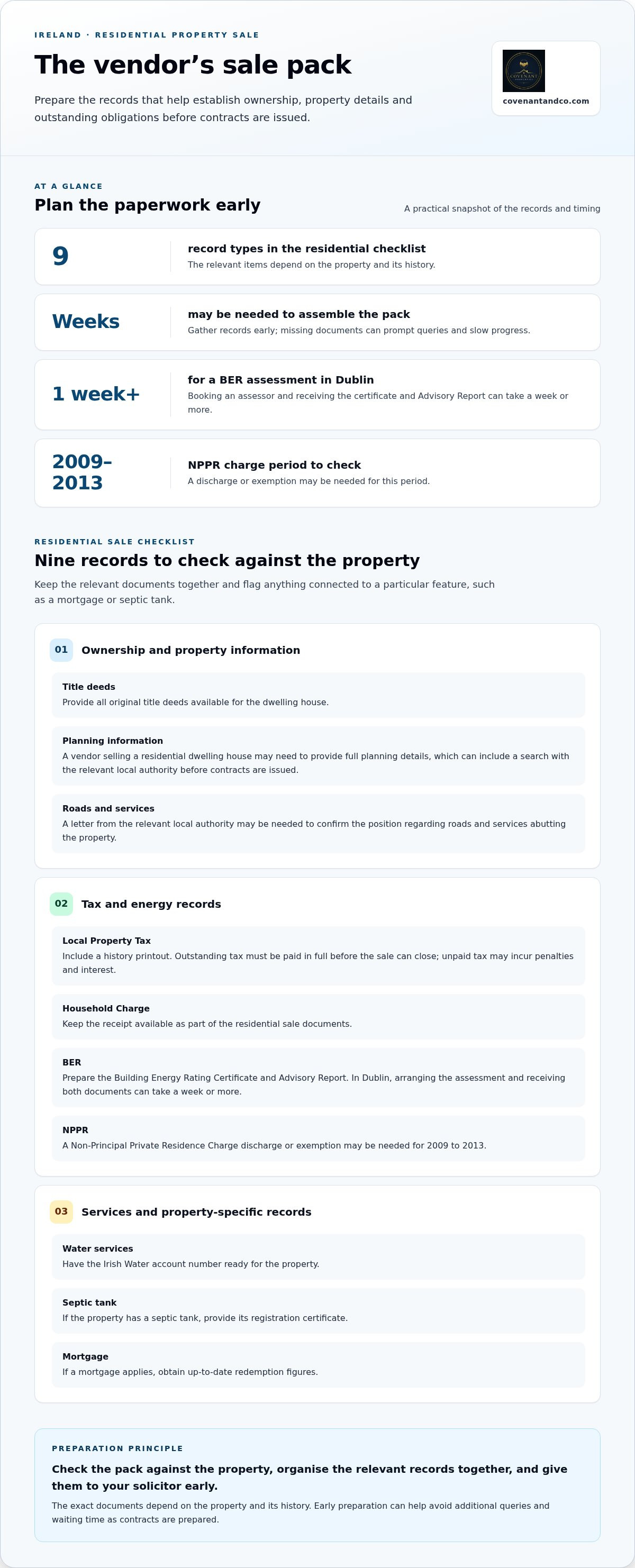
A vendor document pack is the set of records used to prepare a property sale. Organise it early, as vendors may need weeks to assemble everything before contracts are issued. The exact documents depend on the property and its history. Missing records can prompt further queries and slow progress, so gather the relevant items and give them to your solicitor in one organised set.
For a residential dwelling house, the pack may include ownership, tax, energy and service records. Keep them together and flag anything relating to a particular feature, such as a septic tank or mortgage.
- Title deeds: Provide all original title deeds available for the dwelling house.
- Local Property Tax: Include a history printout. Outstanding Local Property Tax must be paid in full before the sale can close; unpaid tax may incur penalties and interest.
- Household Charge: Keep the receipt available as part of the residential sale documents.
- BER: Prepare the Building Energy Rating Certificate and Advisory Report. In Dublin, booking an assessor and receiving both documents can take a week or more.
- Water services: Have the Irish Water account number ready for the property.
- Roads and services: A letter from the relevant local authority may be needed to confirm the position regarding roads and services abutting the property.
- Septic tank: Provide the registration certificate if the property has a septic tank.
- Mortgage: If a mortgage applies, obtain up-to-date redemption figures.
- NPPR: A Non-Principal Private Residence Charge discharge or exemption may be needed for the period from 2009 to 2013.
A BER certificate records the dwelling’s energy rating, while the Advisory Report accompanies it. Allow for the Dublin assessment delay when planning the paperwork; leaving this until contracts are being prepared can add avoidable waiting time.
Check the pack against the property, rather than relying on a generic list. A house with a mortgage needs redemption figures; one with a septic tank needs its registration certificate. If a possession-based application is involved, the described application also requires a Land Registry map marked by an engineer.
Purchaser checks on utility connections
A utility connection links a property to a service such as electricity, water or gas. In Ireland, the purchaser is responsible for checking connections both when viewing the property and when signing contracts. It can be helpful to revisit what you observed at a viewing before committing.
Connection status indicates whether a service appears to be connected to the property. At a viewing, note each service individually rather than assuming every connection is active because the property is occupied. For example, record whether electricity, water and gas connections are visible, and raise any uncertainty as a specific query about that service.
Make a simple record during the viewing. List the relevant services, what you observed and any questions to resolve. If a water connection is unclear, note it separately rather than treating other visible connections as proof. This gives you a clear reference when reviewing the sale documents and discussing the property’s services.
Before signing, revisit utility connections as part of your contract checks. Compare your viewing notes with the information available for the property, then identify any differences or unanswered questions. A vacant property, for instance, may not show the same day-to-day signs of use as an occupied one. Focus on connection status, not assumptions about how well a service performs.
- At the viewing: Record the services present and any uncertainty about their connections.
- Before signing: Review each service again and resolve discrepancies in your understanding of the property.
Keep this record with your other purchase notes so utility queries are not lost among title or contract questions. For example, separate a question about a water connection from one about electricity. This makes your review more precise and shows which points still need an answer before signing.
If you own a property and are considering a sale instead, explore direct residential property sale options.
Covenant Properties: Residential Property Cash Purchase
Covenant Properties offers a Residential Property Cash Purchase for owners considering a direct sale. It may suit you if you’re weighing the paperwork and preparation involved in a conventional transaction against selling directly.
Covenant Properties also directly purchases commercial property, land and development sites across Ireland. Whether you own a home, commercial property or land, the direct cash purchase offers a route to discuss a sale on terms that suit your circumstances. The company handles the paperwork and scheduling, and you choose a completion date that works for you.
Before deciding, consider your property, title documents and preferred sale route. A direct purchase is not the right fit for every seller, but it can be worth exploring if you want to discuss selling your residential property, commercial property or land. There are zero fees, and the cash offer is the amount you receive.
Visit covenantandco.com to discuss your property with Covenant Properties.
Choose your next step with clarity
A property decision is easier to manage when you know what matters most to you. Consider your preferred sale route, the outcome you need and any practical constraints affecting your plans. These priorities can help you decide whether a conventional sale or a direct sale better suits your circumstances.
For a certain land transaction in Ireland, the next step is to turn your priorities into a clear decision. Think about what you need from the sale and any questions you still have. Contact Covenant Properties to discuss a direct cash purchase of your land or site, with a flexible completion date that suits your needs.
If a direct sale is an option you’d like to explore, contact Covenant Properties to discuss your property. Take the next step at a pace that feels right for you, with your priorities clear from the outset.
Frequently Asked Questions
What does a certain land transaction mean in Ireland?
In a certain land transaction in Ireland, the contracts, ownership records and transfer all need to be understood together. Focusing on the agreed price alone is not enough. For example, a purchaser considering a development site may need to understand the title and planning position alongside the sale terms before deciding whether the property suits their plans.
What are the legal requirements for buying or selling land in Ireland?
Buying or selling land involves written sale contracts, conveyancing and checks on the parties and property. Solicitors carry out anti-money-laundering checks, and the purchaser’s solicitor reviews the title and contract information. The buyer also needs to account for stamp duty, a government tax payable at completion. For residential property costing up to €1 million, stamp duty is typically 1% of the property price.
What searches and due diligence should buyers carry out before purchasing land in Ireland?
Buyers should examine title records, planning information and practical details affecting the site’s intended use. A relevant local authority planning search can help establish the property’s planning history. Compare the title description with the land being sold, and record questions about boundaries, access or services. For unregistered land, remember that the Registry of Deeds records the existence of deeds but does not guarantee ownership.
What planning permission and zoning rules affect land transactions in Ireland?
Planning permission and zoning information help buyers assess whether a property’s planning position aligns with its intended use. A vendor selling a residential dwelling house may need to provide full planning-status details, potentially including a search with the relevant local authority. For a site, consider planning records alongside the proposed use and the land described in the title. These records inform due diligence but do not replace a careful review of the specific site.
What risks can arise in an Irish land transaction, such as title defects or access rights?
Risks include unclear ownership records, differences between title documents and the land, and questions about access or boundaries. For unregistered land, the Registry of Deeds records the existence and priority of deeds but does not guarantee ownership. A mismatch in planning history can also raise questions about a property’s status. Keep unresolved points separate, such as a boundary concern and an access query, so each can be addressed during conveyancing.


