

What if the true worth of your Irish acreage has nothing to do with the grass currently growing on it? Many landowners feel a deep sense of frustration when trying to figure out how to value land for sale Ireland, often finding themselves lost in a maze of zoning categories and local area plans. It's perfectly natural to worry about underselling a high-potential site or getting caught out by the 3% Residential Zoned Land Tax. You want a fair price, but you don't want to wait a year for a solicitor to finish the paperwork.
We understand that you need clarity, not more jargon. This professional guide reveals the precise factors that determine Irish land value in 2026, from the impact of the latest planning regulations to the difference between agricultural and development potential. You'll discover how to secure a realistic valuation for your specific plot and explore a faster, fee-free path to a sale. Let's strip away the complexity and get you the answers you need to move forward with confidence.
Key Takeaways
- Understand why "highest and best use" is the core principle of land valuation and how it differs from traditional residential pricing.
- Learn how local zoning and the National Planning Framework set the baseline price for agricultural, residential, and strategic reserve land.
- Master the two most reliable methods for how to value land for sale Ireland, whether you are using local sales data or calculating development potential.
- Identify the essential paperwork and physical checks, such as folio numbers and invasive species assessments, needed to prevent valuation delays.
- Discover how a direct cash acquisition can provide a realistic market value whilst bypassing estate agent fees and the typical 12-month sale cycle.
Understanding the Fundamentals of Land Valuation in Ireland
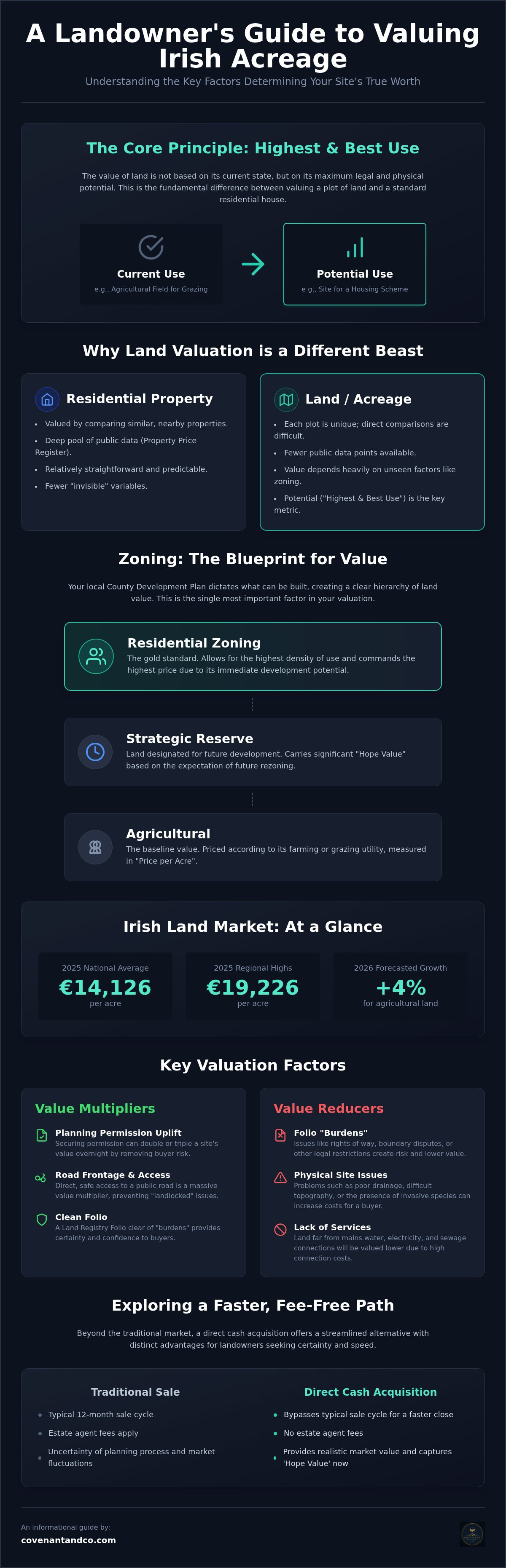
Determining how to value land for sale Ireland isn't as simple as checking a house price on your local street. While residential houses are often valued by comparing identical neighbours, land is a different beast altogether. Every plot is unique. Professionals look for the "highest and best use" of the site. This means the value isn't just based on what the land is today, but what it could legally and physically become. A field currently used for grazing might have one price, but if that same field can support a small housing scheme, its value shifts dramatically.
Residential valuation relies on a deep pool of public data, but land valuation has fewer data points and more "invisible" variables. You can't simply rely on the Property Price Register. While that tool is excellent for seeing what a three-bed semi-detached house sold for in a popular residential area, it lacks the context needed for land. It won't explain the zoning, the access issues, or the complex planning history that dictated a specific sale price. You are often looking at a unique puzzle rather than a standard commodity.
You'll frequently hear the term "Price per Acre", which is the standard metric for agricultural land. However, if your land has potential for building, you must think in terms of "Development Value". This is a calculation of what the finished project is worth minus the costs to build it. To understand the logic behind these different calculations, it helps to review The Three Primary Methods for Valuing Your Site which professionals use to establish a baseline price.
The Importance of the Folio and Land Registry
Your starting point is always the Folio. This document is the "identity card" for your land, held by the Land Registry to confirm ownership and boundaries. A clean Folio is vital for a strong valuation. If there are "burdens" listed, such as an old right of way for a neighbour or a complex boundary dispute, the value will naturally drop. Buyers want certainty. They need to know that the boundaries on the map match the fences on the ground. Any ambiguity here creates risk, and in land sales, risk always costs money.
Current Market Trends in the Irish Land Sector
Ireland's housing shortage continues to drive demand for well-located sites. For 2026, the outlook remains positive, with agricultural land prices forecasted to increase by an average of 4%. This follows a strong 2025 where good quality land reached a national average of €14,126 per acre, though prices in certain regions climbed as high as €19,226 per acre. Under Irish law, "Market Value" is the estimated amount for which an asset should exchange on the date of valuation between a willing buyer and a willing seller in an arm's-length transaction.
Key Factors that Influence Irish Land Prices: Zoning and Planning
The National Planning Framework acts as the master blueprint for Ireland's growth, but your local County Development Plan is where the real detail lies. These documents are updated every six years. They decide exactly what can be built and where. When you ask how to value land for sale Ireland, the answer starts with a colour-coded map. Zoning dictates the baseline price. Agricultural land is priced for farming. Strategic Reserve land is "on deck" for the future. Residential zoning is the gold standard because it allows for the highest density of use.
A common misconception is that land near existing houses is automatically worth a fortune. This isn't always the case. If the council has designated a "green belt" or a "buffer zone" between your plot and the town, that land might remain agricultural indefinitely. However, if you secure planning permission, you experience a "Planning Uplift". This can double or even triple the site's value overnight because you've removed the buyer's biggest risk. You've turned a possibility into a certainty.
The Concept of Hope Value
Hope Value is the premium a buyer pays based on the expectation of future development. It's a calculated gamble on what the next County Development Plan might hold. If your land is on the edge of a growing village, it may carry this extra weight. Calculating it involves looking at local council trends and population growth targets. For many, selling "as-is" to a direct land acquisition specialist is a way to capture some of this value now without waiting years for a zoning change that might never happen. It provides a clean break from the uncertainty of local planning cycles.
Site Access and Services
Road frontage is a massive multiplier for Irish land prices. A site with direct, safe access to a public road is far more valuable than a "landlocked" plot that requires a right of way over a neighbour's field. Beyond access, you must consider services. The cost of bringing mains water, electricity, and sewage to a remote site can be staggering. In 2026, buyers are particularly wary of the 3% Residential Zoned Land Tax (RZLT) on serviced sites, making "ready-to-go" land with existing connections highly sought after. If your site lacks these, the how to value land for sale Ireland calculation must reflect the heavy capital expenditure a buyer will face to make the land functional.
The Three Primary Methods for Valuing Your Site
Once you understand the zoning, you need a mathematical way to arrive at a price. Professional valuers don't guess; they use established formulas to determine how to value land for sale Ireland. The most common approach for agricultural land is the Comparative Method. This involves looking at what similar plots in your immediate area have sold for recently. If good quality land in Wexford is currently averaging €19,226 per acre, a valuer will use that as a benchmark, adjusting for your specific drainage or road access. It's the most transparent method for farmers and neighbours.
For land with building potential, the Residual Method is the industry standard. This calculation works backwards. A developer estimates the "Gross Development Value"-the total sale price of the houses they could build-and then subtracts the build costs, professional fees, and a profit margin. What remains is the "residual" value of the land. This method is highly sensitive. Even a small increase in the cost of materials can significantly lower the amount a developer can afford to pay for the site. Finally, the Investment Method is used for land that generates an income, such as forestry land, which currently ranges from €6,000 to €6,500 per acre for suitable afforestation sites.
If your goal is a quick cash sale, direct buyers often use a streamlined version of the Residual Method. They look for a price that reflects the land's current state whilst accounting for the speed and certainty of a fee-free transaction. This avoids the long-term risks associated with the traditional market.
Self-Assessment vs. Professional Appraisal
Online calculators are a tempting starting point. They offer a quick glimpse into local trends, but they can't see physical obstacles like Japanese Knotweed or poor soil percolation. For informal planning, a self-assessment is fine. However, if you're dealing with probate, bank loans, or a complex family transfer, you'll need a formal "Blue Book" valuation from a Chartered Surveyor (SCSI). These professional reports typically cost between €500 and €1,500, but they provide the legal protection and accuracy that a digital estimate simply cannot match.
The Impact of Local Property Tax (LPT) Valuations
Don't fall into the trap of using your Revenue LPT band as a sale price. These bands are designed for taxation, not for reflecting the true market potential of a development site. The current LPT valuation cycle, which runs through 2025 and 2026, is based on property values from November 2021. Because these figures are several years behind, they often fail to capture the recent 7% rise in agricultural land values or the impact of new zoning. Relying on an outdated LPT band could lead you to significantly undersell a high-value plot.
Preparing Your Land for a Successful Valuation
Preparation is half the battle. If you want to know how to value land for sale Ireland accurately, you need to present your plot as a low-risk asset. Start with the paperwork. You'll need your Folio numbers and up-to-date site maps from the Land Registry. If there's a history of planning applications, gather those documents. Even a previous refusal provides valuable data on what the council might allow in the future. Don't wait for a buyer to ask; have these ready to show you're a serious seller who values transparency.
Walk the ground yourself before any valuer arrives. Is the drainage functioning, or is there standing water in the corners? Are the boundaries clearly marked by established fences or hedges? You must also check for invasive species like Japanese Knotweed. Finding this early is much better than having a sale fall through during a survey later. It's also wise to speak with your solicitor now. They can spot legal hurdles, such as an old mortgage still registered against the land or a missing right of way, before you even set a price. Finally, determine your "Walk-away Price". This is the minimum figure you need to feel the sale is fair and worthwhile.
Identifying Development Constraints
Not all land is buildable. You must check if your plot falls within a Special Area of Conservation (SAC) or contains heritage sites. These designations can halt development entirely. Similarly, flood risk assessments are now a standard part of the valuation process. If the site is in a high-risk zone, the value will drop significantly. Clear, undisputed boundaries are also vital. If a neighbour is contesting a fence line, a professional valuer will likely lower their figure until the dispute is legally resolved.
Maximising Value Without Planning Permission
You don't need full planning to make your land attractive to the right buyer. Small physical improvements matter. Clearing heavy overgrowth allows a valuer to see the topography and potential access points. It makes the site look managed rather than abandoned. Having a pre-planning consultation report from a private consultant can also provide a roadmap for a buyer, showing what is likely to be approved. If you want to skip these hurdles and get a fast, "as-is" assessment, you can request a direct cash offer for your land. This bypasses the need for expensive reports or site staging, giving you a clear price within 48 hours.
Skipping the Market: Securing a Direct Cash Valuation
Traditional methods of how to value land for sale Ireland often focus on what a plot *should* be worth in a perfect market. However, a direct cash valuation provides something far more practical: a real-world price that is ready to close. While the open market can take anywhere from 6 to 12 months to find a buyer and finalise contracts, a direct acquisition bypasses the wait entirely. It transforms a theoretical figure on a page into a concrete offer. This approach is particularly effective for those who value certainty over the unpredictable nature of public auctions or estate agency listings.
Choosing a direct path also strips away the hidden costs that quietly eat into your final profit. You won't face estate agent commissions, which typically range from 1% to 2% plus VAT. There are no marketing fees for signage or online listings, and you don't have to manage public viewings or "tyre-kickers" who lack the funds to close. Covenant Properties assesses land value using private capital and deep local expertise. We look at the site's current state and its future potential, providing a straightforward figure that reflects the true how to value land for sale Ireland without the traditional bureaucratic friction.
The Covenant Properties Process
We believe the journey from valuation to sale should be transparent and rhythmic. Our process is designed to move at your pace, removing the anxiety of the unknown. It follows three simple steps:
- Step 1: You provide your site details, such as the Folio number and location, for a free, no-obligation assessment.
- Step 2: Our team reviews the data and provides a fair cash offer within 24 to 48 hours.
- Step 3: If you accept, you choose a closing date that suits your specific timeline.
Why a Cash Offer is Often the Best Valuation
The open market is volatile. A price agreed in January may not hold by August if interest rates shift or local planning policies change. A cash offer provides a "guaranteed" valuation. It eliminates the risk of a sale falling through at the last minute because a buyer's finance was rejected. By closing quickly, you also save significant money on ongoing legal fees, insurance, and the holding costs of maintaining the land. It is a clean break that allows you to move on with clarity and peace of mind.
Get your free, no-obligation cash quote for your land today and see how a direct valuation can simplify your plans.
Moving from Valuation to Action
Understanding how to value land for sale Ireland is the first step toward a successful and stress-free transaction. You now have the tools to navigate zoning maps, assess development potential, and prepare your Folio for scrutiny. Whether your plot is prime agricultural acreage or a site with significant "hope value", having a realistic price in mind protects you from underselling your asset. Clarity is the ultimate antidote to the frustration and uncertainty of a stalled sale.
If you prefer to skip the traditional 12-month wait and the volatility of the open market, a direct acquisition offers a faster path. You can secure a fair price based on current Irish market data without the burden of estate agent fees or commissions. We value transparency and your peace of mind, allowing you to choose your own closing date to suit your unique circumstances. Get a fair cash offer for your land in 48 hours and take the next step with confidence. Your land represents a significant opportunity, and we are here to help you unlock it simply and respectfully.
Frequently Asked Questions
Is a professional valuation legally required to sell land in Ireland?
No, you don't legally need a professional valuation to sell your land privately. You're free to agree on any price with a buyer. However, if you're settling an estate through probate or dealing with a bank, a formal SCSI report is usually mandatory. For a standard market sale, many sellers find that a direct cash offer provides a clear, practical benchmark without the need for a paid appraisal.
How much does zoning actually affect the price of land per acre?
Zoning is the most significant factor in determining how to value land for sale Ireland. It sets the "ceiling" for the price. While good quality agricultural land averaged €14,126 per acre in 2025, land zoned for residential use can be worth ten times that amount or more. The designation dictates what a buyer can legally do with the site, which directly translates into the financial return they expect.
Can I sell land that does not currently have planning permission?
You absolutely can sell land without existing planning permission. Many developers and cash buyers look for un-zoned or strategic reserve land with the intention of securing permission themselves later. Selling "as-is" means you don't have to spend thousands on architects or engineers. It's a straightforward way to exit a property quickly, especially if you want to avoid the risk of a planning refusal.
What is the difference between agricultural and residential land prices in 2026?
In 2026, the gap remains wide. Agricultural land prices are forecasted to rise by 4%, building on the 2025 average of €14,126 for good quality soil. Residential land is priced using the residual method, meaning its value depends on the number of houses it can support. A single residential acre in a prime commuter town can easily exceed €150,000, depending on the density allowed by the local council.
How long does it take to get a valuation for a development site?
A traditional valuation from a Chartered Surveyor typically takes between seven and ten working days. This includes a site visit and a detailed report. If you need a faster answer, direct land acquisition specialists can often provide a realistic assessment within 24 to 48 hours. This speed is helpful if you're trying to make a quick decision or need to settle a financial obligation without delay.
Who pays for the valuation when selling to a cash buyer?
When selling to a direct cash buyer, they typically cover the cost of their own internal valuation and due diligence. You don't have to pay for their assessment. If you choose to hire an independent SCSI surveyor for your own peace of mind or legal requirements, you'll usually pay a fee between €500 and €1,500. Selling directly is often the most cost-effective way to establish a site's real-world worth.
What documents do I need to provide for a land valuation?
To get an accurate figure on how to value land for sale Ireland, you should provide your Land Registry Folio number and a clear site map. These confirm your ownership and the exact boundaries. It's also helpful to include any details about existing services, such as water or electricity connections, and the history of any previous planning applications. Having these documents ready ensures the process moves forward without technical hitches.
What happens if my land is zoned as a "Strategic Reserve"?
Strategic Reserve zoning means your land is identified for future development but isn't currently prioritised for immediate building. It's a "wait and see" category. This zoning typically increases the land's value above standard agricultural rates because it carries hope value. However, it won't reach full residential prices until the council officially moves it into an active development phase in a future County Development Plan.


